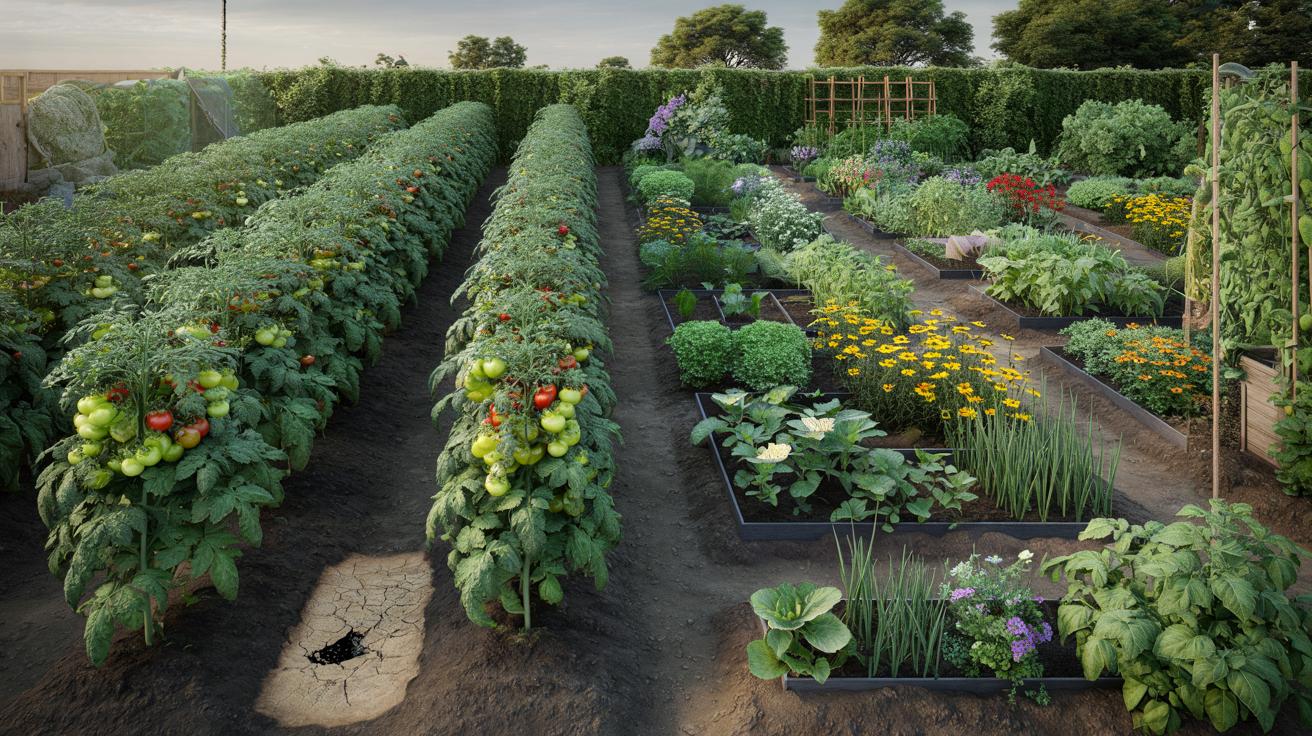
You stand at the edge of your vegetable patch on a soft evening, hose in hand, and you can’t help feeling a pinch of pride. The tomatoes are loaded, the courgettes are ridiculous, the salad bed looks like a lush green carpet. From a distance, your garden says one thing: productivity. Up close though, something feels off. One fungal spot on the tomatoes suddenly worries you. A week of no rain feels like a threat, not just a blip. You’re harvesting baskets of food, yet the whole system seems one hot spell or one pest away from falling apart. You feel like you’ve built a castle out of cards, not roots.
And that sensation is often the first real sign that diversity is too low.
When a “successful” garden is secretly on the edge
Walk through a highly productive but low-diversity garden and you notice a pattern. Long, clean rows of the same plant. Big blocks of tomatoes. A neat bed of lettuce. Another bed, all beans. It looks disciplined, even professional. Your eye glides over the repeating shapes and colors, and your brain reads that repetition as control. The thing is, nature doesn’t work in straight lines and monocultures for long. She usually punishes them.
That quiet anxiety you feel when a single disease appears on one plant? Your garden feels it too.
Picture this: Anna, a new gardener, posts a proud photo in a Facebook group. Twenty tomato plants, all the same variety, packed into one bed. Two weeks later, she’s back posting heartbroken photos. Blight. Every plant hit at once, fruit sagging into brown mush. She did everything “right” with feeding and watering, but one pathogen found a free motorway through that neat monoculture. Someone else shares a story in the comments: a heatwave wiped out all their spinach because that’s 80% of what they grew in spring. The pattern repeats across climates and countries. High yield, low resilience.
One challenge, and the whole thing tips.
This fragility has a simple logic. When one species dominates, anything that dislikes that species struggles. Anything that loves it explodes. Pests and diseases specialise; they feed, reproduce, and spread faster in uniform landscapes. So one aphid, one fungus, one weather extreme doesn’t just nibble around the edges, it hits everything at once. A diverse garden works differently. Some plants lure pests away, others repel them, others fill in when one crop fails. Microclimates overlap, roots explore different depths, flowering times stagger. Diversity is not decor, it’s insurance. *Without enough of it, your garden behaves more like a factory line than a living ecosystem.*
And factory lines are famously fragile.
How to gently thicken the web of life in your garden
Start small: think “layers” instead of “lines”. Instead of a bed that’s just tomatoes, tuck in basil, marigolds, maybe a low row of spring onions. You’re not aiming for chaos, just more company. Add flowers to your vegetable patch, not only to the ornamental border. Grow at least three families of crops in any given space through the year, rotating them. That might look like peas in early spring, followed by tomatoes and basil in summer, then leafy greens in autumn. Just that shift multiplies the kinds of life your garden can host.
Every extra species is another stitch holding the whole fabric together.
A lot of gardeners secretly fear that diversity equals mess. They imagine weeds everywhere, slugs having a party under an overgrown jungle. So they stick to big blocks of one thing, tightly controlled. The joke is, that “control” often creates the perfect buffet for pests. A subtle way to loosen that fear is to give diversity a frame. Raised beds with paths in between. Small mixed patches with clear edges. You can keep structure and order, while filling each bed with a richer mix. Let’s be honest: nobody really does this every single day, but walking the garden with a cup of tea once or twice a week, noting gaps you can fill with something different, changes everything.
You’re editing the garden, not fighting it.
Sometimes the difference between a fragile garden and a resilient one is just a handful of extra species quietly doing work you’ll never fully see.
- Mix plant familiesDon’t rely on just nightshades or brassicas. Add legumes, herbs, flowers, roots. Each family brings different nutrients, scents, and insect allies.
- Layer height and timingCombine tall and low plants, early and late crops. This spreads risk across space and seasons instead of putting it all in one moment.
- Invite beneficial “mess”A small wild corner, a pile of sticks, a shallow water dish. These tiny habitats bring predators, pollinators, and soil life that quietly stabilise the whole system.
Living with a garden that can bend without breaking
There’s a quiet confidence that settles in once diversity starts to rise. You still lose things. A cabbage bed might get munched, a row of carrots might sulk. Yet the story of the season no longer swings on one crop. You notice small birds working the bean trellis, ladybirds camping out on the fennel, a web of spiders between the tomatoes and cosmos. Loss becomes an episode, not a collapse. You walk out after a storm or a heatwave knowing some things will have struggled, some will have thrived, and many will simply have carried on.
A diverse garden doesn’t promise perfection, it offers grace.
| Key point | Detail | Value for the reader |
|---|---|---|
| Plant diversity builds resilience | Mixing species, families, heights, and timings spreads risk across pests and weather | Fewer total failures, more stable harvests season after season |
| Structure + variety beats strict uniformity | Clear bed edges with mixed planting inside keep a tidy look while boosting ecosystem health | Garden feels manageable and beautiful, not chaotic, while still being robust |
| Small habitat tweaks have big effects | Wild corners, flowers, and simple shelters invite pollinators and predators | Natural allies reduce pest pressure and lower the need for constant interventions |
FAQ:
- Question 1How many different plants do I need for “enough” diversity in a small garden?
- Question 2Can I still grow big blocks of my favourite crop, like tomatoes, without risking everything?
- Question 3Does adding flowers really help vegetables, or is that just for looks?
- Question 4What if my soil is poor and only a few things seem to grow well?
- Question 5Is diversity still useful in containers or on a balcony?







