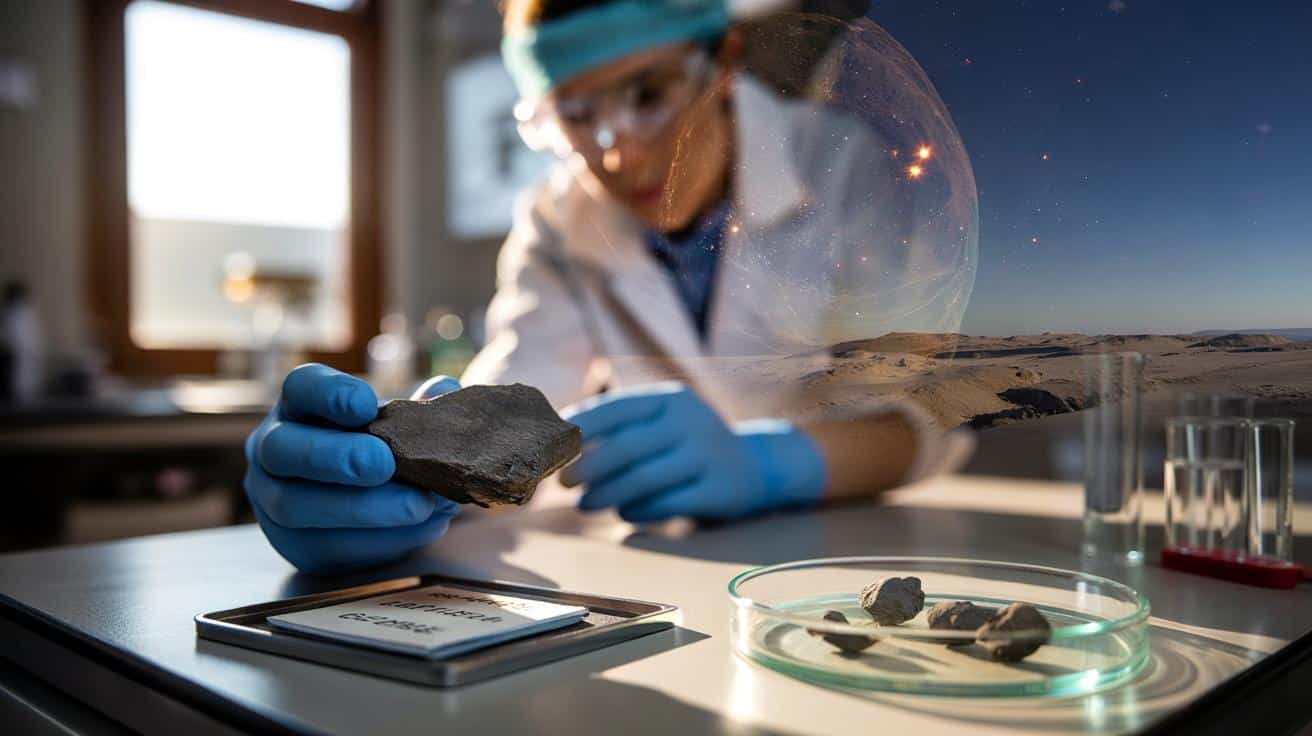
What looked like a handful of dark, nondescript pebbles has turned out to be one of the most primitive meteorites ever studied, packed with microscopic grains that were already ancient long before the Sun flared into life.
A stone that predates the Sun
The meteorite at the heart of this story is known as Chwichiya 002, named after the area of the Western Sahara where it was found in 2018. It is now partly held and studied in France, and scientists consider it a genuine cosmic time capsule.
Fragments of the rock were recovered near the village of Haouza, in a zone of concentration called Chwichiya. Some pieces still carried a thin black fusion crust, the glassy skin formed when a meteorite blazes through Earth’s atmosphere at extreme speed.
Chwichiya 002 contains “pre-solar grains” – tiny bits of dust that formed around ancient stars before our Solar System even existed.
These pre-solar grains are a dream sample for cosmochemists. They record conditions in older stellar systems and interstellar clouds, locked away inside a meteorite that has barely changed for more than 4.5 billion years.
A new and rare class of chondritic meteorites
Meteorites are usually grouped according to their chemistry, texture, and how much they have been heated or altered. Chwichiya 002 belongs to the broad family of chondrites – primitive, unmelted rocks that still preserve tiny spherical grains known as chondrules.
Within that family, it falls into an extremely rare subgroup: a carbonaceous chondrite of type C3.00, “ungrouped”. In plain language, that means two things:
- it is among the least altered carbon-rich meteorites ever found;
- it does not neatly fit into any of the usual sub-families, suggesting a new branch in meteorite classification.
The “3.00” label is crucial. Meteorites in class 3 are considered primitive, but 3.00 is the absolute lower boundary of thermal and chemical alteration that scientists can assign. This rock has barely been heated on its parent body, and it shows almost no evidence of water-driven alteration.
Chwichiya 002 sits at the primitive end of the scale: very little heating, very little interaction with liquid water, and a structure close to the original building blocks of the Solar System.
➡️ Over 65 and feeling mentally full? Your processing speed may be different
➡️ I tried this sticky BBQ chicken recipe and now it’s my most requested summer dinner
➡️ What’s really the most efficient and energy‑saving space heater? Here’s the verdict
➡️ How financial stress slowly affects daily decisions without being noticed
➡️ My cat is gone”: the urgent steps that boost your chances of finding them
Analyses so far also reveal something slightly surprising: while the meteorite is rich in pre-solar grains, it contains very little organic matter. For researchers, that combination is a sign that this material is close to the original dust that formed the early Solar System but has not undergone the chemical processing that often creates more complex organics.
From desert hunt to research laboratories
Chwichiya 002 was first found by meteorite hunters operating in the Western Sahara, a region that has become one of the key hunting grounds for cosmic rocks. The dry climate preserves meteorites, and dark stones stand out against pale sand and rock.
French collector Jean Redelsperger, who works with local Moroccan partners, was involved in documenting the meteorite and recording its precise GPS location. That field data matters: knowing where the fragments lay and how they were scattered helps researchers reconstruct the fall and exclude terrestrial contamination.
Early scientific work was carried out by French geophysicist and cosmochemist Jérôme Gattacceca at CEREGE (Centre de recherche et d’enseignement multidisciplinaire de Provence). His initial measurements pointed to a carbonaceous chondrite of type C3.00, ungrouped, triggering interest from laboratories across the globe.
| Property | What Chwichiya 002 shows |
|---|---|
| Type | Carbonaceous chondrite C3.00, ungrouped |
| Heating on parent body | Very low, almost no metamorphism |
| Water alteration | Minimal evidence of interaction with liquid water |
| Pre-solar grains | High concentration |
| Organic matter | Very low abundance |
A possible cousin of Ryugu and Bennu
As measurements accumulated, something intriguing emerged. Several independent labs reported that Chwichiya 002 shares characteristics with samples brought back from two near-Earth asteroids: Ryugu and Bennu.
The Japanese Hayabusa2 mission returned dust from Ryugu in 2020. NASA’s OSIRIS-REx mission delivered material from Bennu to Earth in 2023. Early results show that both asteroids are rich in primitive, carbon-bearing minerals and hydrated phases.
Comparisons suggest Chwichiya 002 may come from a parent body similar to Ryugu or Bennu, or at least from the same broad population of early Solar System objects.
If that link holds, scientists suddenly gain two complementary viewpoints on the same kind of material. Space missions give pristine samples from a clearly identified asteroid; meteorites like Chwichiya 002 bring larger chunks and a wider range of textures, even if their exact source in space is harder to nail down.
Why pre-solar grains matter
Pre-solar grains are microscopic, but they carry signatures from ancient stars. Many formed in the outflows of red giant stars or in the shock waves of supernovae, before drifting through interstellar space and ending up in the cloud that eventually collapsed to form the Sun and planets.
These grains are typically made of minerals such as silicon carbide, graphite, or tiny silicates. Their isotopic ratios are wildly different from Solar System averages, which is how researchers identify them.
In most meteorites, those fragile grains are partially destroyed by heating or chemical alteration on the parent body. The unusually high number preserved in Chwichiya 002 hints that its parent asteroid remained cold and relatively inactive since its birth.
What this means for the story of the Solar System
Every primitive meteorite adds detail to the early history of the Solar System, but Chwichiya 002 offers several specific clues.
- Timing of dust mixing: The diversity of pre-solar grains can reveal how quickly material from across the galaxy mixed into the nascent Solar nebula.
- Heating and water history: The near absence of aqueous alteration suggests that some early asteroids stayed dry and cold, away from internal heat or ice melting.
- Organic chemistry: The low organic content shows that not all primitive bodies were rich in complex carbon compounds, adding nuance to theories about the delivery of organics to early Earth.
When combined with Ryugu and Bennu samples, Chwichiya 002 could help separate what happened in space from what happened inside individual asteroids. That, in turn, sharpens models of how planets accumulated material and how water and organics arrived at the young Earth.
Key terms that help make sense of this meteorite
Several technical words keep appearing in discussions of Chwichiya 002. A few are worth unpacking:
Chondrite: A stony meteorite containing chondrules, which are millimetre-sized, once-molten droplets that cooled quickly in the early Solar nebula. Chondrites are considered the most primitive class of meteorites.
Carbonaceous chondrite: A subtype rich in carbon and often water-bearing minerals. They are good candidates for having delivered part of Earth’s water and some of its organic molecules.
Parent body: The asteroid (or sometimes a fragment of a dwarf planet) from which a meteorite originated. Understanding a meteorite’s parent body helps reconstruct its thermal and chemical history.
Ungrouped: A label for meteorites that do not fit into existing well-defined chemical groups. These oddballs are precious because they hint at missing or rare building blocks in the early Solar System.
What future research could look like
Looking ahead, scientists are likely to subject Chwichiya 002 to even finer analyses. Nano-scale imaging, noble gas measurements, and high-resolution isotopic studies could map the distribution of pre-solar grains across the rock and trace different generations of dust.
One possible line of work involves simulating how such a parent body formed. Researchers can use computer models of the early Solar nebula, then adjust parameters such as temperature, distance from the Sun, and the timing of radioactive heating. The goal is to reproduce a body that remains cold, dry, and chemically primitive enough to match what is seen in this meteorite.
There is also a more practical angle: meteorite hunters and observatories may pay closer attention to any new falls that resemble Chwichiya 002 in texture and density. If several related meteorites are found, they could outline a broader family of CT3-type objects and strengthen any link with Ryugu- or Bennu-like asteroids.
For the wider public, Chwichiya 002 is a reminder that some of the most revealing cosmic relics look unremarkable at first glance. A palm-sized stone in a French laboratory, collected from a windswept patch of Sahara, now carries one of the clearest records of dust older than the Sun itself.