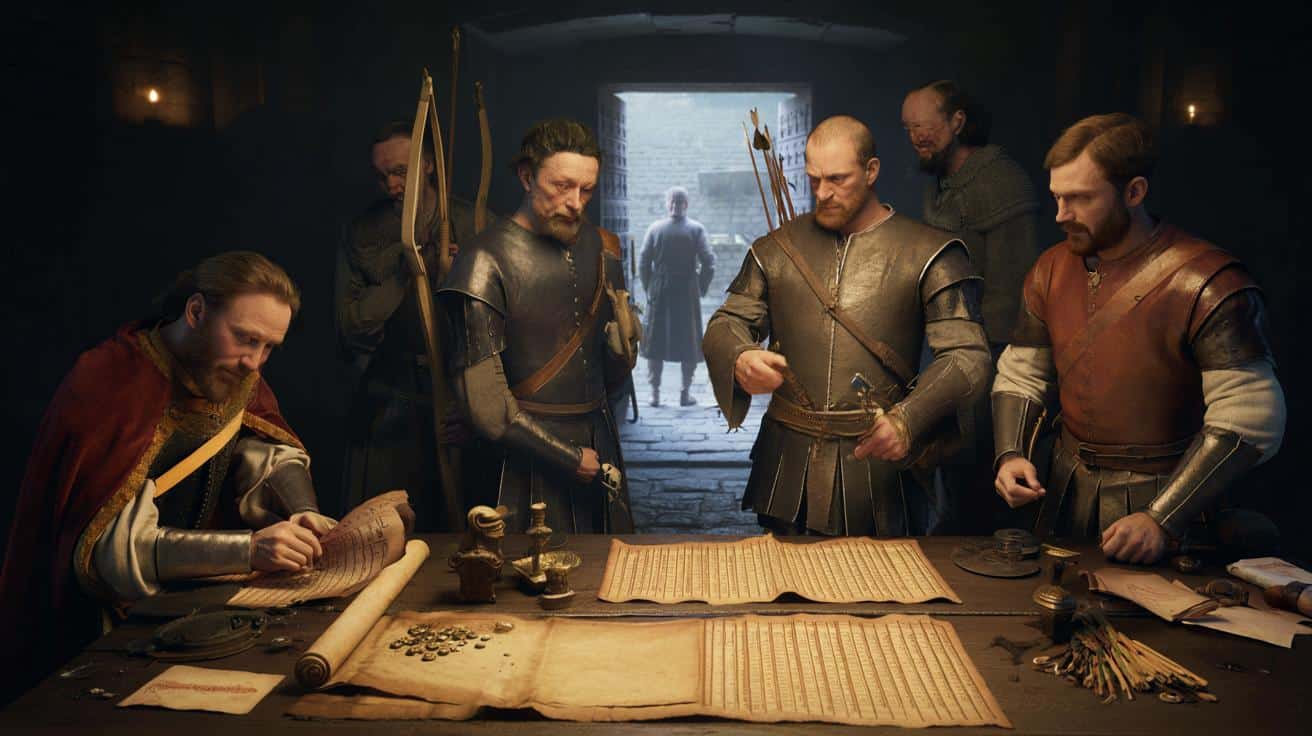
Now, thousands of medieval English soldiers suddenly have names, careers and surprisingly modern problems.
Forget only kings on horseback and heroic charge scenes. Freshly reconstituted records from the Hundred Years’ War show pay disputes, long careers, promotions and even side-switching among English troops posted in France. A huge digital database is quietly rewriting what we think we know about medieval war – and about the men who actually fought it.
From faded parchments to a searchable army
In 2009, a group of historians in England began turning dusty Exchequer rolls and Latin muster lists into something anyone can search online. The result is the Medieval Soldier Database, now the largest open resource on named medieval soldiers in the world.
It covers English troops paid by the Crown between the late 1350s and 1453, the final phase of the Hundred Years’ War. That includes campaigns in France, garrison duty in occupied towns, and the soldiers who later crop up in rebellions back home.
The database holds around 290,000 service records and identifies close to 30,000 individual medieval soldiers by name.
Those entries come mainly from “musters” – formal inspections where officers checked men, armour and weapons. On some surviving lists, tiny ink dots still mark each man who was physically present with the correct kit. These were not loose bands of random fighters. They were audited, paid professionals who needed to justify every penny to the English Exchequer.
Careers that lasted decades, not days
Schoolbook images often show medieval fighters as short‑lived levies: dragged from their fields, handed a spear, then forgotten. The database tells a different story. Many men appear across rolls spanning 15 or even 20 years.
Behind the big set-piece battles sit long working lives: routine garrison shifts, winter campaigns, and slow promotions earned one campaign at a time.
The records show:
- Soldiers repeatedly serving under the same captain across several campaigns
- Archers promoted to men‑at‑arms, with better pay and status
- Individuals shifting between regions, from northern England to Aquitaine or Normandy
- Names first recorded as rank‑and‑file later turning up as local office‑holders
This pattern undercuts the old idea that English armies in the Hundred Years’ War were mostly amateur. A substantial core were seasoned professionals who treated war as a trade and, in some cases, a route upwards.
➡️ A shock is coming: farmland values are set to fall by 60% in these regions over the next few decades
➡️ This simple shift helps the brain transition more smoothly
➡️ Morning birds love certain gardens – here’s why yours keeps pulling them in
➡️ If your garden feels productive but fragile, diversity may be too low
➡️ He decides when we get up”: can a cat really “rule” a household?
➡️ Heating: the 19 °C rule is over, here’s the temperature experts now recommend
War as a ladder: social mobility in armour
The medieval social order looks rigid from a distance. At ground level, things were looser. The database reveals men who start as modest archers but end up respectable gentlemen, landowners or royal servants.
Consistent military service could turn a younger son with no inheritance into someone with land, ransoms and royal connections.
In England’s hierarchical society, this mattered. Land and office were supposed to stay with established gentry. Yet in the fourteenth and fifteenth centuries, the Crown needed capable officers in France and reliable enforcers at home. Good service in the field translated into trust, and trust could mean:
- a minor manor granted as a reward
- a position as sheriff, bailiff or castle constable
- permission to keep captured horses, armour or prisoners
Some of these men later appear in documents unrelated to war: local court records, tax lists, or royal commissions. Their military careers became the foundation for local power.
Who were these soldiers?
The database highlights two main types of fighter: men‑at‑arms and archers.
| Type of soldier | Typical role | Equipment | Social status |
|---|---|---|---|
| Man‑at‑arms | Heavy combat, close fighting, often mounted | Full armour, sword, lance or mace | Knights, esquires, well‑off commoners |
| Archer | Missile support, skirmishing, sometimes melee | Longbow, arrows, lighter armour | Broadly from the middling and lower ranks |
Archers in particular stand out. England’s longbowmen were already legendary for victories like Crécy and Agincourt. The database shows them not only as battlefield assets but as individuals with traceable careers, returning repeatedly to serve in France or along the Scottish border.
A goldmine for family history
While historians use the database to rethink English military structure, amateur genealogists are using it very differently: to trace forgotten relatives.
For many British and North American families, this is the first time a named ancestor from the 1300s or 1400s appears in an easily searchable record.
The site links names to specific campaigns, captains and places. Someone researching a family from, say, Yorkshire might suddenly find a namesake defending a town in Normandy in the 1420s, or joining a royal expedition decades earlier.
Because the records focus on paid service, they skew towards men who were at least moderately equipped and organised. That still covers a surprisingly wide slice of late medieval society. It also helps explain why some families, apparently minor in one generation, appear far richer and more prominent in the next.
War, law and local lives
The database is not limited to muster lists. It also pulls in legal protections and appointments connected with soldiers on campaign. Englishmen serving abroad often needed safeguards at home: someone to manage estates, collect rents or defend a lawsuit while they were in France.
Those legal records show how war threaded through everyday life. A small landholder in Kent might appoint a neighbour as guardian of his property while he rode with the king. A town might lobby to keep a popular captain in place as garrison commander. Soldiers are not just names in battle lists; they appear as husbands, landlords, litigants and sometimes troublemakers.
Some men later surface in records of uprisings and rebellions. Experience in arms did not always stay aligned with royal goals. Veterans of France turn up on both sides of internal English conflicts in the later fifteenth century, carrying their battlefield skills into civil wars.
Challenging myths about medieval war
The project was launched partly to test a long‑standing idea: that late medieval English armies were poorly organised and only loosely professional. By following individual soldiers through time, researchers can check that claim against hard evidence.
Patterns of repeated service, careful equipment checks and detailed pay records point to a system that was structured and, by medieval standards, quite controlled.
The picture that emerges is not one of chaos. Instead, it shows contracted forces, captains with responsibility for named men, and a Treasury that insisted on accountability. Poor performance could mean lost pay or contracts. Good performance might bring promotion or royal favour.
Key terms that shape the records
Several technical words appear in discussions of the database, and they frame how we understand the material:
- Muster: an official inspection where soldiers, weapons and horses were checked and recorded before or during a campaign.
- Exchequer: the Crown’s financial administration, which tracked payments to troops and demanded proof of service.
- Garrison: the permanent or semi‑permanent force stationed in a castle or town, often for months or years.
- Man‑at‑arms: a fully armed heavy fighter, not always a knight, but socially above the basic foot soldier.
Understanding these terms helps modern readers see why the records exist at all. They were created for money and control, not for future historians, yet they now serve as a kind of accidental census of fighting men.
Imagining a soldier’s path through the data
Take a hypothetical archer named John of Lincoln. He appears first on a muster roll in 1371, serving in a small retinue sent to Brittany. A few years later, his name shows up again, this time in the garrison of a French town, drawing regular pay from the Crown.
Two decades down the line, a “John Lincoln, man‑at‑arms” is listed under the same captain’s son in another French campaign. If ages and locations line up, historians might reasonably argue this is the same man, now promoted, still fighting, perhaps with a family depending on his wages and any loot he can bring home.
Back in England, a local court record lists “John Lincoln, gentleman” in a property dispute. It is not certain, but the chain looks plausible: a rural archer turns long‑service veteran, then minor local notable. The database gives researchers the stepping stones needed to build that story.
Risks, rewards and the human reality of service
For the men in these records, war carried clear risks and equally clear attractions. Death, disease and maiming were constant threats. Many never came home. Yet pay, ransoms and the chance of favour from powerful patrons were tempting, especially for those with little to lose at home.
Seen through the database, medieval warfare looks less like a series of disconnected heroic clashes and more like a long, grinding profession. Men signed up, re‑signed, moved units, argued over pay, and slowly built lives shaped by campaigns that stretched far beyond any single famous battle.
For modern readers, that shift in focus – from kings and banners to careers and pay lists – brings the Middle Ages closer. These soldiers traveled, worried about money, relied on paperwork, and tried to turn dangerous work into a better future. The database does not romanticise them. It simply lets them step, by name, out of the crowd.







