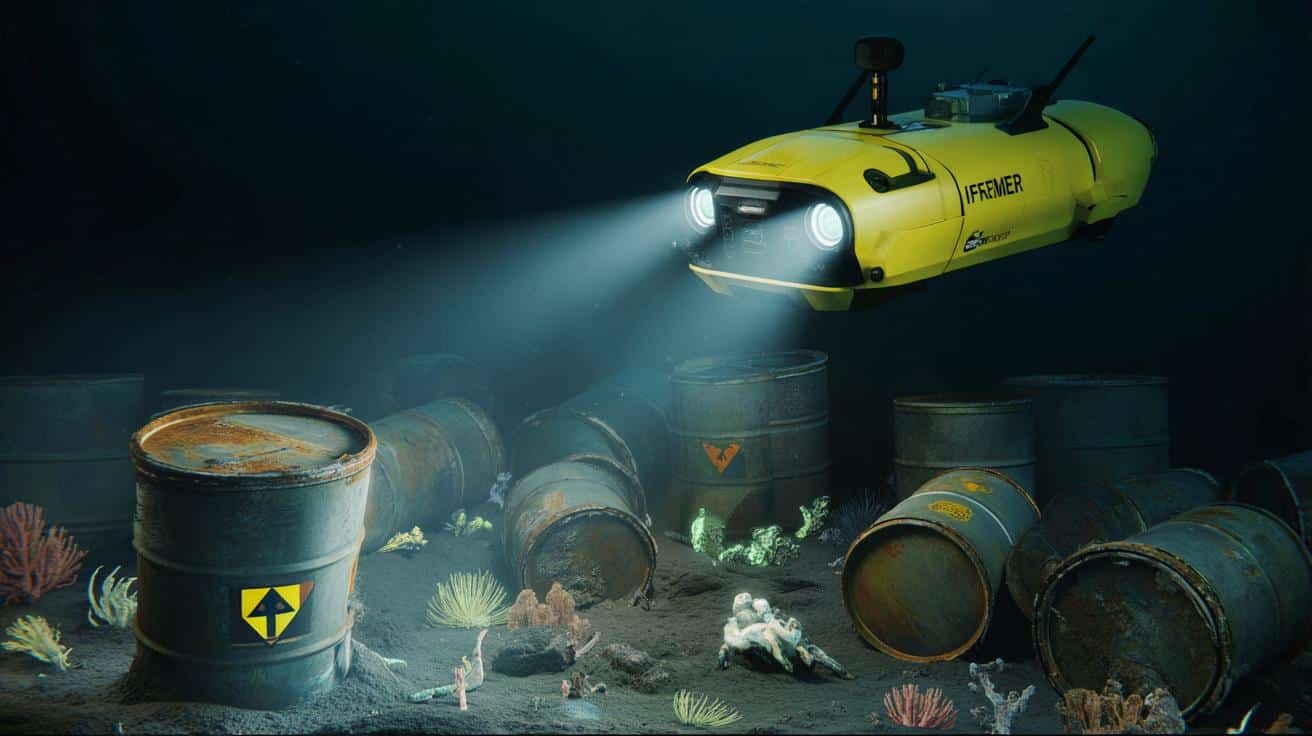
Once seen as a convenient solution for troublesome waste, the deep ocean is now the focus of a high‑stakes French campaign that wants hard data on what lies beneath, not vague reassurances or alarmist myths.
A forgotten nuclear practice resurfaces
From the early Cold War to the early 1980s, several European countries treated the North-East Atlantic like a bottomless bin for low-level radioactive waste. Steel drums, stacked in ship holds, were pushed overboard in carefully defined “dump sites”, far from coasts and fishing grounds.
France was part of this practice. Between 1949 and 1982, more than 200,000 drums of low-level radioactive waste were immersed in the North Atlantic. Around 45,000 of those came from French operations alone, representing about 14,000 tonnes of waste such as contaminated sludges and laboratory materials.
At the time, the logic felt reassuring: huge depth, strong dilution, long distance from coastal populations and seafood markets. The ocean floor was viewed as a remote, almost sterile landscape.
Lesions of the past are coming back into focus: what looked like a definitive solution now looks more like a deferred question.
The London Convention of 1972 began to restrict sea dumping of radioactive waste, and a global ban followed in 1993. Monitoring campaigns in the 1980s and 1990s did not reveal significant rises in marine radioactivity near the sites, so public and political attention drifted elsewhere.
The Nodssum mission heads back down
That indifference has faded. Scientific understanding of the abyss has changed, and so has society’s tolerance for unknowns around radioactivity.
Launched by the CNRS and Ifremer, the Nodssum mission targets a dump zone roughly 1,000 kilometres off Brittany, at around 4,700 to 5,000 metres depth. The study area spans about 163 square kilometres, known to be studded with radioactive drums sunk more than half a century ago.
On 16 June 2025, about forty researchers from France and abroad boarded the oceanographic vessel L’Atalante. Their aim: document, with modern tools, what has actually happened to this submerged legacy.
➡️ The sentence that puts a condescending person back in their place
➡️ Japan reveals new toilet paper innovation: and shoppers can’t believe it didn’t exist sooner
➡️ EDF Extends Its Canadian Push With Long‑Awaited Green Light For Madawaska Wind Farm Project
The abyss is not a dead zone
Since the 2000s, deep-sea research has overturned the old picture of empty, lifeless plains. The abyss hosts slow-growing corals, strange invertebrates and intricate food webs built on particles drifting down from the surface or on chemical reactions in the sediments.
Those ecosystems evolve over centuries. They recover slowly from disturbance. That makes the presence of long-lived pollution sources, even low-level ones, a serious question.
The key issue is not only radiation levels, but how long-lived waste intersects with equally long-lived deep-sea life.
In this context, Nodssum is less an archaeological mission and more a real-time environmental assessment, carried out half a century after the initial decision.
UlyX, the French robot that sees in the dark
Human divers cannot reach 5,000 metres, where pressure reaches around 500 times that at the surface. The work relies instead on UlyX, an autonomous underwater vehicle (AUV) developed by Ifremer.
How the robot operates on the seafloor
UlyX is about 4.5 metres long, weighs 2.7 tonnes, and can function down to 6,000 metres for up to 48 hours thanks to 28 kWh of lithium-ion batteries. The vehicle carries an arsenal of gear: multibeam sonars for topography, high-resolution SAS sonar to image objects, a 3D laser profiler and cameras, plus sensors to track oxygen, methane, pH and other parameters.
During Nodssum’s 2025 leg, UlyX systematically scanned the dump area. It located and mapped 3,350 drums. Fifty of them were photographed in exceptional detail, providing the clearest visual assessment yet of their condition.
- Some drums look almost intact, with recognisable markings.
- Others show advanced corrosion, with deformed or thinned steel.
- Several have been colonised by deep-sea organisms that use them as hard substrate.
Three focused dives allowed the team to approach selected drums closely. They recovered more than 300 samples: sediment cores at various depths, water taken just above the seabed, and tissues from animals living near or on the drums.
Seeing without disturbing
One major principle of the mission is “observe, don’t interfere”. Researchers want data about how the waste behaves in situ, without creating new risks by handling old containers roughly or dragging them across the seabed.
The goal is clarity, not heroics: measure risks where they stand, instead of trying to haul them back in a spectacular but hazardous operation.
The first campaign’s results will shape a second phase planned for 2026. That stage should include more direct sampling at the surface of the drums themselves and within visible corrosion zones, to track which radionuclides, if any, are escaping.
Three key scientific questions
Nodssum’s work revolves around three straightforward questions that determine whether the legacy drums remain mostly contained or represent an ongoing problem:
- Corrosion: How much have the steel walls degraded after more than 50 years under high pressure and cold seawater?
- Dispersion: Are radionuclides present in detectable amounts in the surrounding sediments, water column or nearby organisms?
- Biological impact: Do the animals and microbes around the drums show signs of contamination or altered communities?
Answering these questions requires matching physical imaging with chemistry and biology. Sediment cores can reveal how far radioactive elements have moved over decades. Animal tissue analysis can show whether food chains are incorporating contaminants.
| Aspect | What scientists measure | Why it matters |
|---|---|---|
| Drum condition | Thickness, rust patterns, openings | Indicates current and future leakage potential |
| Sediments | Radionuclide levels with depth | Shows whether waste has migrated beyond the containers |
| Water | Dissolved radioactivity, chemistry | Captures any dispersion in the local environment |
| Fauna | Contamination in tissues, species mix | Reveals real exposure of deep ecosystems |
A scientific and political memory exercise
Nodssum is not just a technical mission; it acts as a form of institutional memory. The drums on the seabed embody an era when nuclear waste management was guided by optimism in physical barriers and faith in ocean vastness.
France’s national radioactive waste agency, Andra, plays a quiet but crucial role on land. It compiles and updates the national inventory of radioactive materials and waste, including historic sea disposal. That inventory feeds international databases and helps set priorities for research and monitoring.
Commitments made during the 2009 “Grenelle de la Mer” process in France pushed for a clearer view of underwater dumping sites, better assessment of their hazards, and targeted work on local fauna, flora and sediments. Nodssum fits directly into that push, replacing rumours or vague maps with quantified observations.
A Russian mirror in the Arctic
The French case is not isolated. In late 2025, the Russian research vessel Akademik Ioffe carried out a campaign near Novaya Zemlya, in Arctic waters where the Soviet Union had also disposed of radioactive material.
That expedition located long-forgotten sites in the Barents Sea, including the Likhter‑4 barge and the experimental submarine K‑27, scuttled with its nuclear fuel still on board. Russian scientists mapped the wrecks, measured radiation directly on their hulls and sampled the surrounding seabed.
Initial data were described as relatively reassuring: no strong active leaks, containment structures still functioning to some degree, and contamination mainly restricted to the outer surfaces of the wrecks. The stakes there are similar to Nodssum’s: not to raise the wrecks, but to reduce uncertainty, define a realistic level of risk and plan future monitoring.
What “low-level” radioactive waste actually means
The drums in the North Atlantic do not contain spent fuel or highly active reactor cores. Most hold so‑called low-level waste: contaminated filters, resins, protective gear, laboratory equipment or industrial sludge with traces of radioactivity.
These materials emit radiation, but at a far lower intensity than fuel rods or high‑level waste. Their hazard lies less in intense short-term exposure and more in long-term persistence if radionuclides migrate into food chains or drinking water sources. In deep-sea settings, the key question is whether those elements stay locked in the drums and sediments, or spread into wider ecological networks.
Possible future scenarios
Scientists working on Nodssum often describe three broad scenarios for the next decades:
- Stable containment: Drums continue to corrode slowly, but radionuclides remain mostly trapped in sediments close to the waste, with weak biological uptake.
- Localised leakage: Some containers fail, causing modest but measurable releases that affect a limited area of the seabed and nearby organisms.
- Progressive spreading: Over longer periods, repeated failures and ocean dynamics lead to broader dispersion, still diluted, but more widespread.
Current measurements aim to distinguish which of these paths is already under way, rather than guessing from models and past assumptions.
Why this matters for coastal populations and seafood
Public concern often jumps straight to fish on the plate. So far, previous studies near Atlantic dump sites have not shown worrying radioactivity levels in commercial species, and the sites sit far from major fishing zones.
That said, regulators want to avoid blind spots. Long-lived radionuclides can, in theory, travel with currents or settle gradually in new areas. Confirming low levels in the immediate vicinity of the drums strengthens the case that wider impacts remain limited.
Nodssum’s findings will feed into national and international risk assessments, shaping how strictly these zones should be monitored over the next decades and how scientists model the ocean’s capacity to retain or transport contaminants.
Lessons for future waste decisions
This deep-ocean campaign also carries a message for current nuclear debates. Even though sea dumping is now banned, societies still face questions about where and how to manage long-lived waste: in geological repositories on land, in interim storage, or through new technologies that might reduce its longevity.
By putting numbers and images on a practice once considered safe enough, Nodssum provides a reality check. Decisions that looked acceptable under one scientific paradigm can appear much less convincing when knowledge advances and values shift.
For younger researchers on board L’Atalante, the mission doubles as a field school in long-term responsibility. They study corrosion rates and sediment chemistry, but also how policies, archives and public memory interact with hard data from the seabed.
What happens at 5,000 metres depth, far from smartphones and shorelines, may seem remote. Yet the results from UlyX and its samples will feed into debates on energy, climate policy and environmental justice that unfold very much at the surface – and far beyond the French Atlantic.







