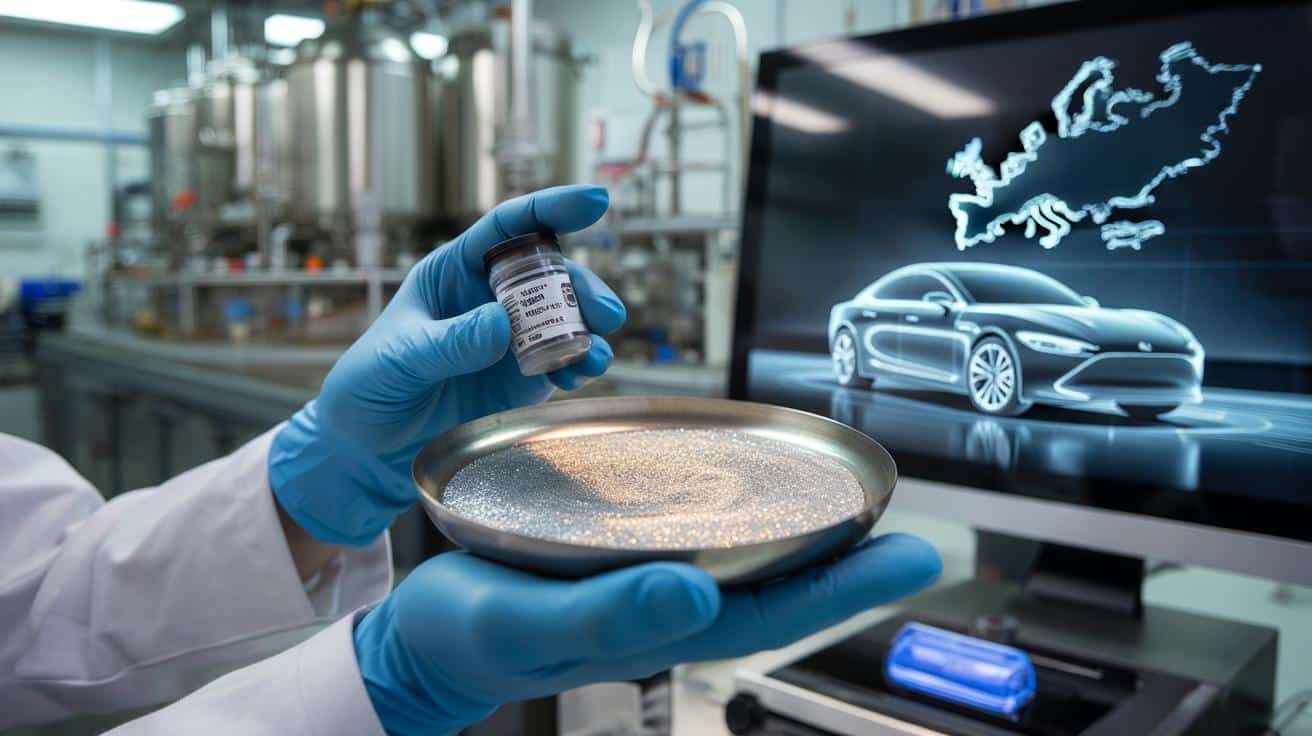
While most eyes are fixed on gigafactories and flashy electric models, France is quietly targeting a far more discreet asset: a crucial battery ingredient that may dictate which countries still build cars a decade from now.
The hidden material that could make or break future EVs
At Rueil-Malmaison, near Paris, a new company called Argylium has started operations with a bold objective: to become Europe’s leading producer of sulfide solid electrolytes, often shortened to SSEs. These materials sit at the heart of so‑called all-solid-state batteries, seen by many in the industry as the likely successor to today’s lithium‑ion packs.
The project is backed by a heavy-hitting alliance: French groups Axens and IFP Énergies nouvelles on one side, and Belgian chemical specialist Syensqo on the other. Between them, they bring a decade of research, a portfolio of patents already tested in the lab, and teams of engineers who have cut their teeth on battery materials for years.
France is betting that mastering this single battery component could give it leverage over Europe’s entire electric car value chain.
Argylium’s ambition is not just to supply labs with grams of powder. The target is industrial volume: tonnes of electrolyte material delivered to European gigafactories, before Asian and North American rivals can fully occupy the space.
Why solid electrolytes matter for tomorrow’s cars
From flammable liquids to solid architecture
In a conventional lithium‑ion battery, the electrolyte is a liquid that lets lithium ions travel between the anode and the cathode. This liquid is flammable and sensitive to shocks, overheating and manufacturing defects. It forces manufacturers to add complex safety features and to limit charging speeds.
All-solid-state batteries remove that liquid and replace it with a solid electrolyte. Argylium focuses on a family of sulfur compounds called argyrodites. These materials can conduct lithium ions quickly without needing any liquid solvents.
That shift brings several potential advantages for electric cars:
- Less flammable solvent, which cuts the risk of fire from the electrolyte itself.
- Better resistance to heat and harsh conditions, easing safety constraints.
- New battery designs with higher energy density, meaning more range for the same weight.
Argylium is aiming for cells around 500 Wh/kg by 2028–2030. Many of today’s lithium‑ion car batteries sit closer to 200–300 Wh/kg, depending on chemistry and application. If the company hits its target, that would mean far more energy stored per kilogram and the possibility of slimmer or lighter packs.
➡️ It’s confirmed and official : heavy snow expected starting late tonight
➡️ The habit that quietly keeps kitchens under control
➡️ What does pushing your chair back in after a meal really say about you, according to psychology?
➡️ It’s official and confirmed urgent : heavy snow expected starting late tonight
➡️ “I cook this oven meal when I want everything done at the same time”
➡️ Hygiene after 65 : not once a day, not once a week, shower frequency that keeps you thriving
The firm also claims that its technology could lower charging times to under ten minutes, a threshold that would dramatically change driver behaviour and pressure petrol infrastructure.
A strategic duo at the helm
To steer this complex transition from lab to factory, Argylium has appointed two experienced leaders. Alessandro Chiovato, a chemist with more than 25 years at Solvay and then Syensqo, becomes chief executive. He has long worked at the crossroads of strategy, innovation and battery materials markets.
Alongside him, technical director Valérie Buissette brings continuity on the scientific front. Trained in materials science and a specialist in solid-state batteries for around a decade, she represents the link between academic research and industrial performance targets.
France is trying to turn years of European lab work into hard industrial power, before the window closes.
France’s four-step plan to dominate sulfide electrolytes
From pilot batches to mass manufacturing
Argylium has mapped out a four-stage roadmap to secure its position in Europe.
- Phase 1 – Product line and validation: Finalise its range of sulfide solid electrolytes and run qualification campaigns with battery makers, using material from pilot plants in Paris and La Rochelle. At the same time, a financial consortium is being assembled to fund the scale‑up.
- Phase 2 – Raw material security: Lock in access to key inputs, including lithium sulfide. This involves building a pilot unit dedicated to these precursors and raising production to several tonnes per year.
- Phase 3 – Demonstration scale: Construct an industrial demonstration facility able to produce several hundred tonnes. This stage will validate manufacturing processes and deliver the first commercial shipments, especially to carmakers.
- Phase 4 – Full industrialisation: Move to capacities in the tens of thousands of tonnes per year, while licensing technology to partners to accelerate deployment across Europe.
Underpinning this plan is a drive for vertical integration. Argylium wants to control the chain from lithium hydroxide through to the final argyrodite powder. That means tighter quality control, lower costs and reduced exposure to external suppliers that might sit in rival regions.
Two French sites as a real-life testing ground
Right now, around fifty experts are spread between two locations in France:
- Paris: A research centre where chemists and engineers develop and test new electrolyte formulations at kilogram scale in a so‑called “kilo‑lab”.
- La Rochelle: A development hub with a pilot unit designed to bridge the gap between kilogram batches and tonne-scale output.
This Paris–La Rochelle axis lets teams loop quickly between formulation, testing and process engineering, which tends to be where promising battery concepts either succeed or stall.
A uniquely European asset in a global race
Argylium claims it is currently the only entity in Europe capable of developing and producing sulfide solid electrolytes at tonne scale. That position turns it into a crucial potential partner for European carmakers and gigafactories that need reliable, nearby suppliers rather than small lab samples flown in from overseas.
For France and Brussels, the project touches a raw nerve: sovereignty. The continent has watched Asian giants control much of the existing lithium‑ion value chain, from cathode materials to cell manufacturing. With solid-state batteries predicted to grow rapidly, European officials see a chance not to repeat the same mistake.
Control of advanced battery materials is quietly becoming as geopolitical as access to oil once was.
Support from French and EU authorities reflects that view. Beyond individual company performance, the debate now turns on supply security, industrial autonomy and the ability to keep high-value automotive activity within Europe’s borders.
A market set to explode by the early 2030s
According to figures from Global Market Insights, the global all-solid-state battery market could leap from about $1.1 billion in 2024 to $17.7 billion in 2034. That implies a near tripling every three years, driven by electric vehicles, consumer electronics and stationary energy storage linked to solar and wind farms.
| Year | Estimated solid-state battery market size |
|---|---|
| 2024 | $1.1 billion |
| 2034 | $17.7 billion |
Europe already represents around 22% of this global market, boosted by public investments that have passed the €1 billion mark in recent years. The share could grow if regional suppliers of advanced materials, like Argylium, manage to scale up fast enough.
At industrial scale, one fact stands out: the companies capable of shifting from grams to tonnes, then to hundreds of tonnes, naturally position themselves at the centre of the value chain. Battery makers and car brands usually prefer partners that can guarantee both volume and long-term technical support.
What this means for carmakers and drivers
Possible scenarios for 2035
If France secures a strong foothold in sulfide solid electrolytes by 2030, several scenarios open up:
- European carmakers gain access to safer, higher-density batteries made largely with regionally sourced materials.
- French industrial sites become reference plants for solid-state components, attracting further investment and skilled jobs.
- Licensing deals spread the technology into partner factories in Germany, Italy or Spain, while royalties flow back to French and Belgian owners of the patents.
For drivers, the impact would be more concrete than it sounds. A typical mid-range electric car could offer longer range without a heavier battery, and fast charging might edge closer to the time it takes to refuel a petrol car, cutting one of the main psychological barriers to EV adoption.
Risks, trade-offs and terms worth knowing
Progress is not guaranteed. Sulfide solid electrolytes bring challenges of their own: they can react with moisture, they need careful handling and they must be integrated with new anode and cathode materials. Cost will also be a decisive factor in a market where every dollar per kilowatt-hour counts.
A few key terms help make sense of the debate:
- Energy density (Wh/kg): How much energy a battery stores per kilogram. Higher values mean more range for the same weight.
- All-solid-state battery (ASSB): A battery that uses only solid components for the electrolyte, aiming for better safety and sometimes higher performance.
- Electrolyte: The medium that allows ions to move inside the battery during charge and discharge.
If France succeeds with Argylium’s roadmap, sulfide solid electrolytes could sit at the crossroads of climate policy, industrial strategy and everyday mobility. In ten years, drivers might never hear the term “argyrodite”, yet the fate of European carmaking could quietly depend on it.







