For more than a century, physics textbooks have repeated the same comforting story about a thin film of meltwater. Now, high-powered simulations are challenging that picture and showing that ice can stay slick even when it barely has the energy to move at all.
The textbook story starts to crack
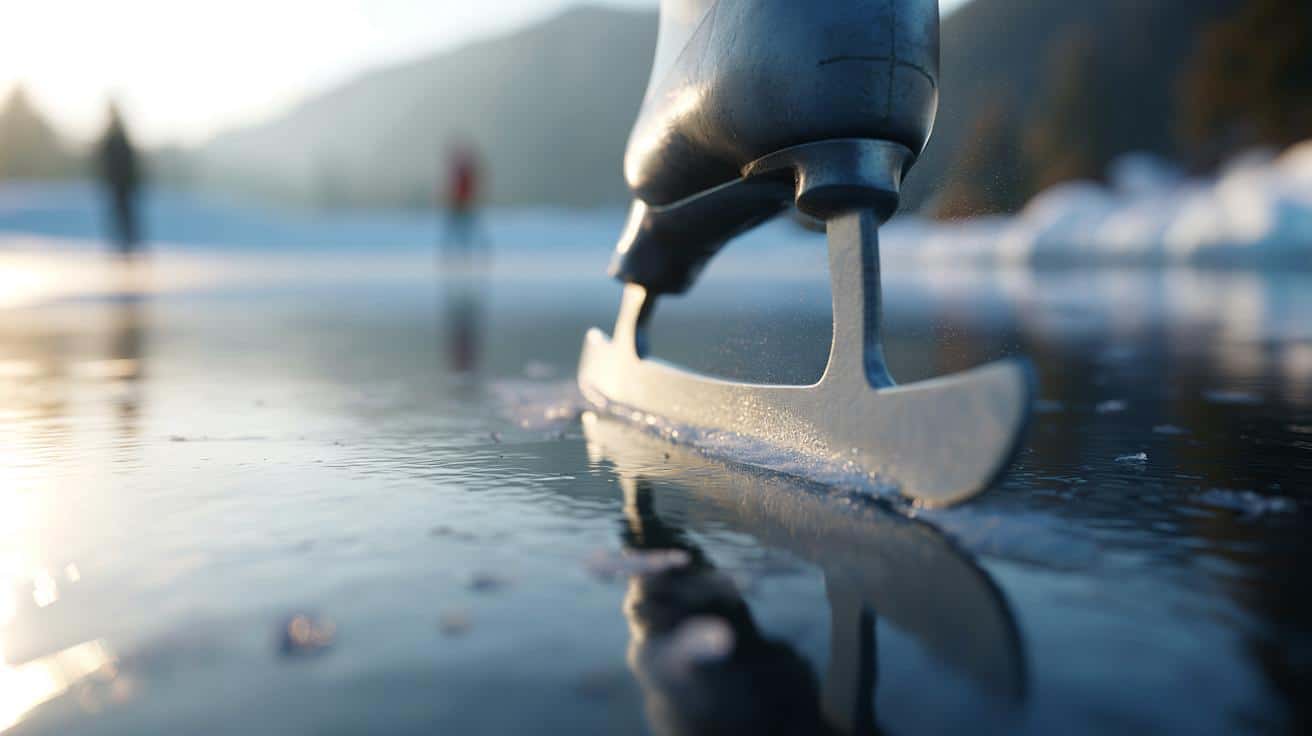
Most of us learned a simple explanation at school: pressure from your shoe, skate blade or tyre melts the top of the ice.
This melting would produce a microscopically thin layer of liquid water, which works like a lubricant between you and the frozen surface.
The story sounds neat, but reality keeps finding ways to contradict it.
People manage to ski and skate on natural ice at temperatures close to -20 °C, where the pressure from a blade or boot should not generate enough heat to melt anything.
Experiments on ultra-cold ice also detect little or no rise in temperature right where sliding occurs.
So if nothing is melting, why do we still slip?
A closer look at ice, molecule by molecule
To tackle the puzzle, a team led by physicist Martin Müser at Saarland University turned to massive computer simulations.
They used a specialised model of water and ice called TIP4P/Ice, well known among researchers for reproducing real-world properties such as density, melting point and crystal structure.
➡️ Scientists observe a rapid destabilization of polar air masses affecting mid-latitude climates
➡️ This forgotten feature in your car improves visibility during bad weather
➡️ A startup promised a four day work week. Employees say they’ve never worked more in their lives
➡️ Starlink launches mobile satellite internet: no installation, no new phone required
Instead of studying a messy, scratched ice rink, the team looked at the cleanest possible scenario.
They simulated two perfectly flat ice crystals sliding against each other, at temperatures just 10 kelvins above absolute zero – barely above -263 °C.
At such brutal cold, there is not enough thermal energy for regular melting at the surface.
Yet in the model, the ice still behaved as a surprisingly effective lubricant.
The secret lies in the “soft” surface layer
The new work points to a different explanation: ice is slippery because its surface behaves almost like a soft, disordered skin.
Molecules at the very top of the ice crystal are less tightly bound than those deep inside the solid.
They have fewer neighbours, wiggle more and can rearrange more easily when something slides over them.
This surface layer is not fully liquid water, but it is not a rigid crystal either – it sits in an in-between state that lets it flow under stress.
In the simulations, when one block of ice slid over the other, this semi-mobile skin absorbed much of the friction.
The surface molecules reoriented and slipped around each other instead of tearing the crystal apart.
Why pressure melting is only part of the picture
Pressure and friction can still produce tiny amounts of meltwater in many real situations, especially near 0 °C.
On a slightly warm skating rink, the sharp blades, repetitive motion and body heat of dozens of people can generate local heating and cause fleeting patches of water.
But the new research suggests that this is not the only route to slipperiness.
- Near 0 °C: a mix of surface softening and thin films of liquid water likely makes ice especially slick.
- Far below 0 °C: the softened, disordered surface layer alone seems able to reduce friction dramatically.
- At extreme cold (close to absolute zero): even without melting, surface molecules can still rearrange just enough to allow sliding.
This layered picture helps reconcile everyday experience with the harsh conditions in experiments and simulations.
From winter roads to Olympic rinks
Understanding why ice is slippery is not only a curiosity for physicists.
Highways departments, winter sports engineers and even spacecraft designers all have a stake in how frozen water behaves.
On roads, the semi-mobile surface layer suggests that traditional salt – which works mainly by lowering the freezing point – is only one part of the safety strategy.
Surface texture also matters.
Roughening ice, or coating it with materials that interfere with the surface layer’s mobility, could reduce slipperiness without needing huge amounts of chemicals.
In sports, the findings help explain why the tiniest changes in ice preparation can influence records.
Ice technicians for Olympic speed skating already adjust temperature and resurfacing methods by fractions of a degree.
By tuning how “soft” or “hard” the top layer becomes, they can effectively adjust the friction felt by athletes.
| Ice surface condition | Typical friction | Everyday example |
|---|---|---|
| Warm, near melting | Very low | Wet winter pavement, indoor rinks |
| Cold, dry but smooth | Low to moderate | Outdoor lakes at -10 °C |
| Cold and rough | Higher | Snowy, sanded roads |
What this means for everyday slipping and sliding
When you walk on an icy pavement, your shoe grips or fails to grip based on this delicate surface layer.
The rubber, tread pattern and even microscopic dust particles all interact with those restless molecules at the top of the ice.
Strong pressure under a heel can locally reorganise the surface layer and sometimes create tiny melted spots, especially when the air is not too cold.
That shifting interface explains why a flat, soft-soled shoe can feel safer than a hard, smooth one, and why metal studs can dig through the soft skin into firmer ice beneath.
Key terms worth unpacking
Two scientific ideas appear often in this field and are useful to understand:
- Absolute zero: the lowest possible temperature, at 0 kelvins or -273.15 °C, where a system has minimal thermal energy.
- Friction: the resistive force that appears when two surfaces move against each other, turning motion into heat.
In ordinary materials, higher friction means more heat, which can change the material itself.
On ice, that feedback loop is especially delicate because small temperature changes around 0 °C can quickly alter whether water is solid, semi-soft or liquid.
Future scenarios: smarter materials inspired by ice
The idea of a solid with a naturally soft, mobile surface layer is not unique to ice, but ice shows it in a dramatic, visible way.
Engineers are already thinking about coatings that copy this behaviour to create surfaces that change their slipperiness with temperature or pressure.
One scenario being studied is aircraft wings or wind turbine blades that shed freezing rain efficiently.
By mimicking the way the top of ice reorganises itself under stress, designers hope to build materials that resist dangerous ice build-up without constant de-icing sprays.
On a smaller scale, medical devices, syringes and even everyday kitchen tools could benefit from surfaces that glide when needed yet stay stable when at rest.
The humble question “why is ice slippery?” has turned out to be a gateway into subtle physics, advanced simulations and real-world technologies.
Ice, it seems, is not just frozen water – it is a restless solid with a remarkably agile skin.