Before stacking the logs in the garage, a practical question comes first: how many cubic metres of wood do you really need to keep an 80 to 120 m² home comfortably warm all season?
What “a winter of wood” means in real life
In conversations with neighbours, the phrase “I used six cubic metres last winter” gets thrown around a lot. Yet those numbers only make sense when you look at the broader picture: the size of the home, its age, how well it’s insulated, where it’s located, and what kind of stove or fireplace is doing the work.
For a typical 80 to 120 m² home, winter consumption usually ranges from 4 to 12 cubic metres, depending largely on insulation and appliance efficiency.
That gap may look huge, but it reflects radically different situations: a compact, well-insulated house with a modern stove has nothing in common with a draughty older property heated by an open fireplace.
Key factors that change how much wood you burn
Size of the home: 80 m² is not 120 m²
The larger the surface, the more energy required. In practice, for homes between 80 and 120 m², the range looks roughly like this, assuming you rely on wood as the main heat source:
- 80 m²: around 3 to 8 cubic metres per winter
- 100 m²: around 4 to 10 cubic metres per winter
- 120 m²: around 5 to 12 cubic metres per winter
These values move up or down depending on how the other factors stack up.
Insulation: the quiet budget-breaker
Two houses of the same size can have completely different wood needs. The main reason is thermal insulation: roofs, walls, floors, windows and air tightness.
A well-insulated 100 m² home with a modern wood stove can get through winter on 4 to 6 cubic metres, while a poorly insulated one might need double.
Single-glazed windows, uninsulated lofts and air leaks around doors create huge heat losses. You keep feeding the fire, but the warmth escapes almost as fast as you make it.
➡️ A polar vortex anomaly is approaching, and its intensity is almost unheard of in February
➡️ “I became a field quality lead, and my income finally stopped fluctuating”
➡️ Researchers say this everyday behavior may influence sleep quality
Type and performance of the heating appliance
A modern wood stove is essentially an efficient machine for turning logs into heat. An open fireplace is mainly a flame show.
| Appliance type | Typical efficiency | Wood for ~100 m² / winter* |
|---|---|---|
| Modern wood stove | 70–85% | 4–6 m³ |
| Insert / closed fireplace | 60–75% | 6–8 m³ |
| Open fireplace | 10–20% | 12–15 m³ |
*Figures assume decent insulation and a temperate climate.
The less efficient the appliance, the more wood you buy for the same comfort. Upgrading the appliance can cut your wood needs more than any clever “burning trick”.
Climate and how you actually live
A family in a mild coastal area will not burn like a household in a snowy inland valley. Number of frost days, wind exposure, and humidity all shift your wood budget.
Daily habits matter too:
- Home all day, constant cosy warmth: higher consumption
- Heating mainly mornings and evenings: lower consumption
- Accepting 18–19°C instead of 21–22°C: clear savings in wood
Type and quality of the wood
Not all logs deliver the same heat. Hardwoods like oak, beech or hornbeam burn longer and hotter than softwoods such as spruce or fir.
Dry hardwood with less than 20% moisture content gives off far more usable heat than damp or freshly cut wood.
Wet wood wastes energy evaporating water, cools the fire, smokes more and clogs flues faster. A cheap load of green logs often ends up “costing” more heat than it provides.
Concrete scenarios for 80, 100 and 120 m² homes
80 m²: small footprint, big differences
Imagine a compact 80 m² house used as a main residence:
- Well insulated, modern stove: around 3 to 4 m³ for the winter
- Average insulation, insert: 5 to 7 m³
- Poorly insulated, open fireplace: 10 to 12 m³ or more
For a holiday home used mainly at weekends, you can often halve those numbers, provided the house does not sit icy cold for weeks on end.
100 m²: the common case
This is where many suburban or village homes sit. Based on the French figures often cited by installers, adapted to a full heating season:
A 100 m² well-insulated home with a modern stove usually runs between 4 and 6 m³ of wood for the season.
Switch that stove for an insert with average insulation and you rise to roughly 6 to 8 m³. Keep the same house but use an open fireplace as the main heater, and the tally jumps towards 12 to 15 m³.
120 m²: stretching the surface
At 120 m², the trend continues:
- Good insulation, powerful modern stove: around 5 to 7 m³
- Mixed insulation, insert: about 7 to 9 m³
- Draughty, with open fireplace: 12 m³ and upwards
Many households in this size bracket also use a hybrid approach: wood as primary heat during the coldest hours, topped up by electric radiators or a heat pump in milder periods. That can bring the wood requirement down by one or two cubic metres.
Choosing and storing the right wood
Hardwood vs softwood
Hardwoods (oak, beech, ash, hornbeam) usually cost more per cubic metre, but offer a higher energy density and longer burns. They suit evening and night-time heating.
Softwoods (pine, spruce, fir) light quickly and are useful for starting fires or boosting temperature rapidly, but they burn faster and can produce more tar if the flue is cold or the wood is not perfectly dry.
Storage: the hidden part of the equation
Even good wood turns bad if stored poorly. Logs should be:
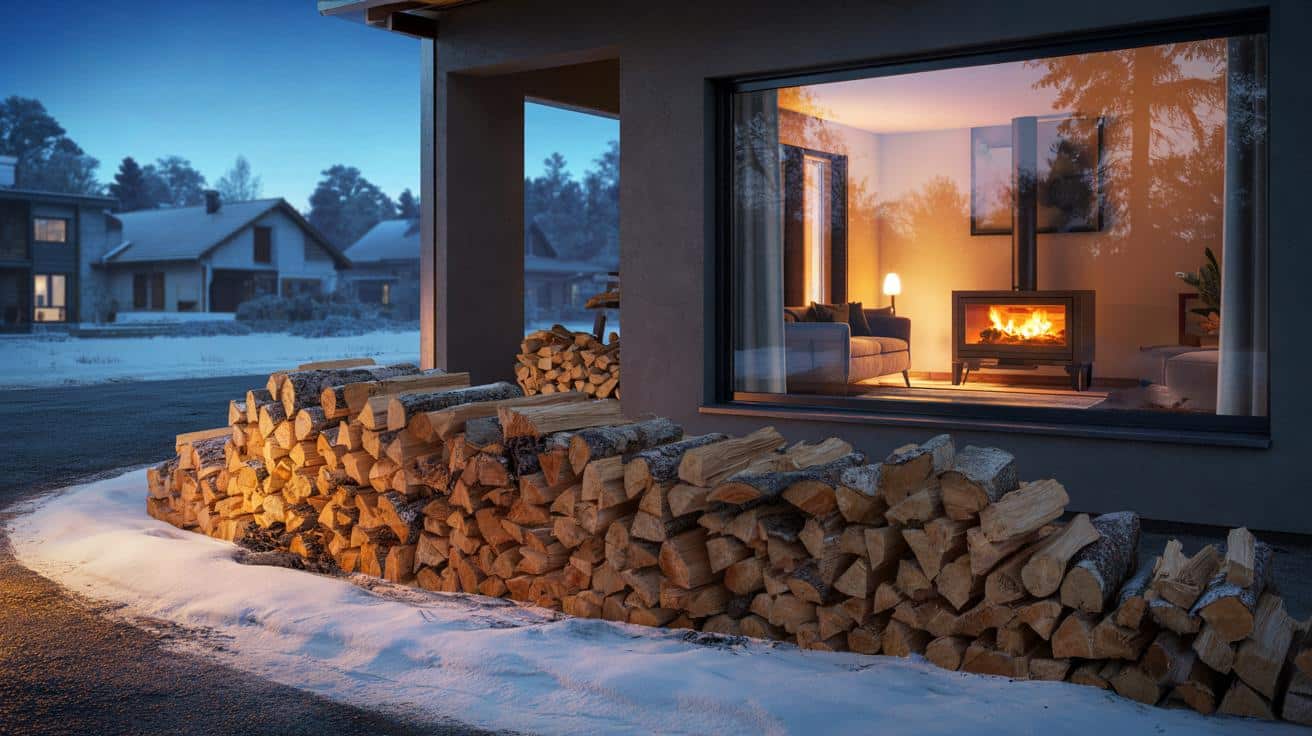
- Raised from the ground (on pallets, for instance)
- Stacked in an airy way, not packed tight
- Protected from direct rain, while still exposed to airflow
- Cut and split at least 18 to 24 months before burning for many hardwoods
Well-stored wood keeps its calorific value, lights more easily, burns cleaner and reduces soot and creosote build-up.
Planning your winter stock without guesswork
A simple method to size your order
For a main home of 80 to 120 m² relying mostly on wood, a practical approach is:
- Start with a base of 5 to 6 m³ if you have good insulation and a modern stove
- Add 2 to 3 m³ if your insulation is average or your appliance is an insert
- Add yet another 3 to 4 m³ if the house is clearly draughty or you use an open fireplace
- Reduce by 1 to 2 m³ if wood is only a back-up or occasional heating source
For a first winter in a new home, many installers advise ordering slightly more than you think you need, keeping any surplus properly stored for next year rather than risking a shortfall during a cold snap.
What “dry wood” and “cubic metre” really mean
Two terms often confuse new wood users: “cubic metre” and “dry”. A “cubic metre” (or “stère” in French) originally describes a tightly stacked pile of one-metre logs measuring one metre by one metre. Once cut into 30 or 40 cm lengths and restacked, the visible pile volume changes, even if the same quantity of wood is present.
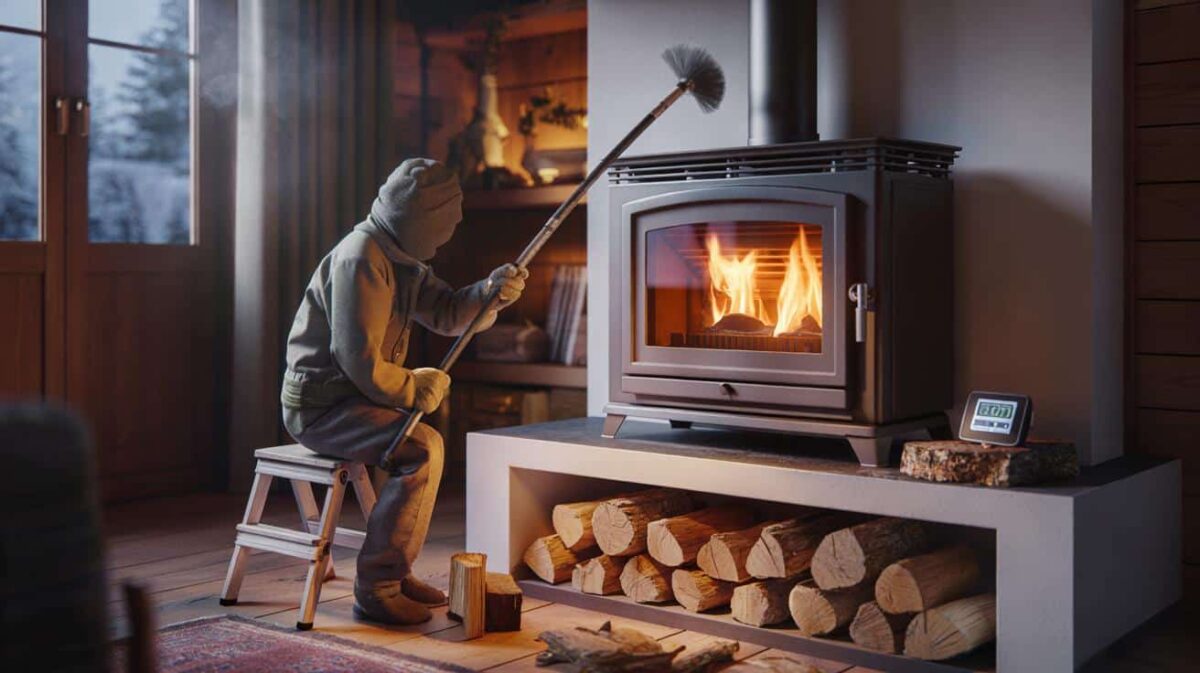
“Dry” usually means less than 20% moisture content. Some sellers talk about “seasoned” wood, but that can hide big variations. If you rely on wood as a major heat source, a cheap moisture meter is a surprisingly useful gadget: you quickly see which logs are ready and which still need months under cover.
Beyond cost: other gains and trade-offs
Heating with wood often starts as a way to escape high energy prices, yet it also brings side effects that matter: regular handling of logs, ash cleaning, flue sweeping, storage space and delivery access.
On the plus side, many households appreciate the autonomy. With a well-sized stock, an efficient stove and decent insulation, a 100 m² home can stay warm through outages or price spikes in gas and electricity. Combined with small insulation upgrades — sealing gaps, insulating the loft, fitting thick curtains — the amount of wood needed each winter can quietly drop without sacrificing comfort.