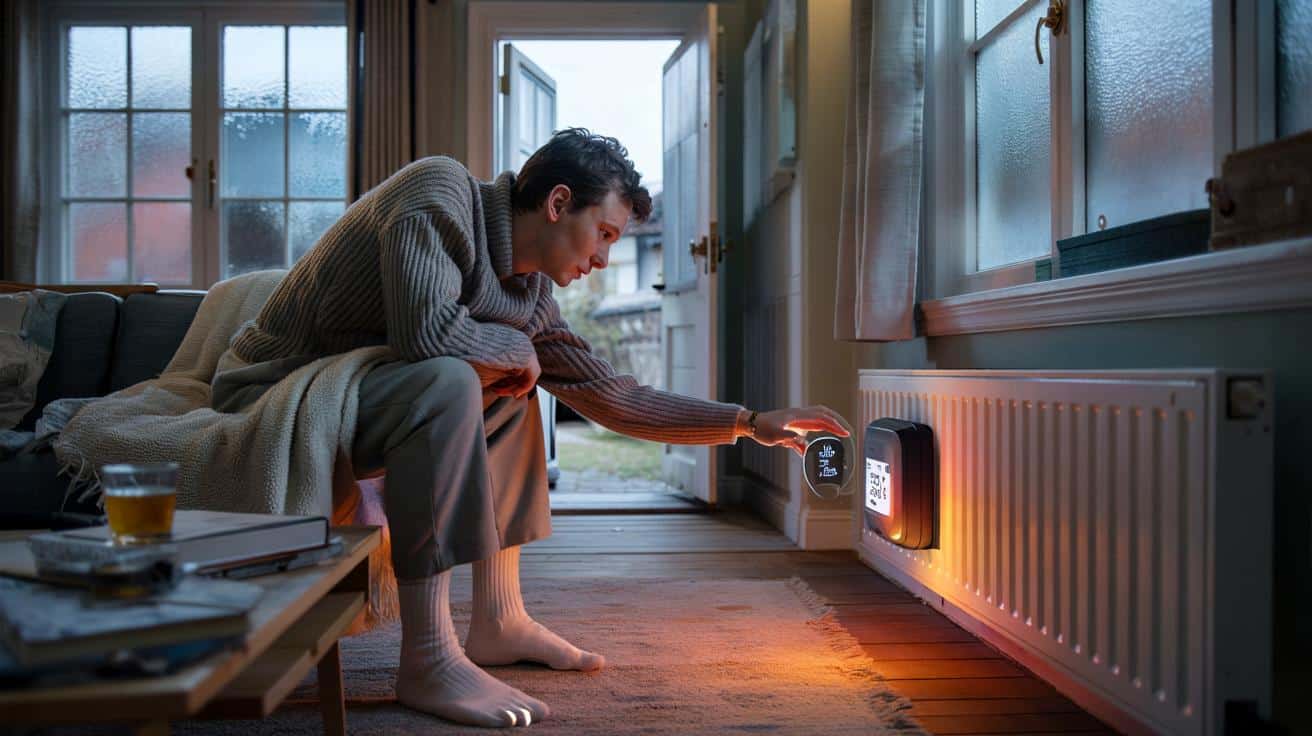
The night I realised something was wrong, the thermostat glowed a stubborn 23°C and my toes still felt like ice cubes. I padded around the living room in two sweaters and a blanket cape, bumping the heat up one more notch with the vague guilt of someone watching the energy bill climb in real time. The radiators hissed like they were working hard. The air felt… warm-ish. My body didn’t agree.
I checked the windows, the doors, even put my hand flat on the wall like a doctor feeling for a pulse. The house felt tired, leaking warmth from somewhere I couldn’t see.
The next morning, a heating engineer gave me a sentence I can’t un-hear now.
“Your problem isn’t the temperature,” he said. “It’s where the heat is going.”
Why you keep turning up the heat and still feel cold
There’s a strange frustration in watching the thermostat number rise while your fingers stay numb. You start to wonder if you’re imagining it. The air measures 22°C, yet you’re wrapped in a blanket, nursing a hot drink, and still not comfortable. The room “should” be warm. Your body refuses to agree.
Experts say this gap between temperature and comfort is incredibly common, especially in older homes. A house can technically be warm on paper and still feel draughty, damp, or oddly chilly. Think of it as the difference between a photo of a sunny beach and actually standing in the sun. One is data. The other is experience.
Take Sofia, 36, who lives in a small semi-detached house on the edge of town. She spent last winter in a permanent hoodie, convinced her boiler was dying. “I’d crank it up to 24, 25 degrees,” she remembers. “The bill went crazy, and I still sat there with cold feet.”
When a technician finally came to check, the boiler was fine. The real culprit? Heat vanishing through poorly insulated walls, a badly sealed loft hatch, and a front door you could practically see daylight around. “You’re heating the street,” the technician joked, half serious. After new weatherstripping, a thicker curtain over the front door, and a bit of loft insulation, Sofia dropped her thermostat to 20°C and felt warmer than before.
What’s happening in cases like this is simple physics mixed with human biology. Your thermostat only measures air temperature. Your body cares about a wider mix: air temperature, radiant temperature from walls and windows, humidity, and draughts brushing against your skin. If the walls are cold, your body “radiates” heat toward them and interprets that as feeling chilly, even if the air is technically warm.
Humidity joins the party too. Very dry air can make your skin and throat feel uncomfortable, while damp air makes everything feel clammy and cool. So you might be chasing numbers on a thermostat when the real problem lives in the walls, at the window frames, or in silent currents of cold air slithering under the doors.
Small changes that actually make you feel warmer
The first expert trick sounds almost too simple: hunt for draughts like you’d look for a lost phone. On a windy day, walk slowly around your home and really feel. Use the back of your hand near window frames, sockets on exterior walls, skirting boards, and around doors. A slim line of cold air can undo a lot of what your heating is trying to do.
➡️ Winter storm alert: Up to 64 cm of snow could lead to the closure of schools and many services
Once you’ve found them, tiny fixes start to add up. Self-adhesive foam tape on frames, a proper seal on the letterbox, a brush-style draught excluder under doors. Thick curtains that overlap the window frame instead of just kissing the edge. These aren’t glamorous renovations. They are the kind that make you suddenly realise, one evening, that your feet aren’t frozen for the first time in weeks.
There’s also the way we use our radiators and thermostats. Many people blast the heating for short bursts, then turn it off completely, thinking this “saves” energy. What often happens instead is a rollercoaster: the room never really stabilises, the walls stay cold, and your body never catches up.
Energy experts often recommend a lower, more stable temperature, especially in well-used rooms. That might mean 19–21°C during the day, with doors closed to keep heat where you actually live. Bedrooms can usually be cooler. Let’s be honest: nobody really measures every room precisely every single day. But knowing that stability beats big swings changes the way you twist that dial.
The comfort equation also includes something more personal: you. Two people can sit in the same room at 21°C and one will be perfectly happy in a T-shirt while the other is shivering. Age, circulation, medication, and even how much you’ve moved that day all shift your “comfort point.”
“People blame their boiler when half the time it’s a mix of air movement, surfaces, and habits,” says Tom Riley, a heating engineer with 20 years on the job. “Your system might be okay. Your house might just need to stop leaking like a sieve.”
- Check for draughts: windows, doors, floorboards, and letterboxes are classic weak spots.
- Use thick curtains and close doors between rooms you heat and those you don’t.
- Bleed radiators once or twice a season so they heat evenly from top to bottom.
- Keep furniture and big objects away from radiators so heat can circulate freely.
- Look at humidity: a small hygrometer is cheap and shows if the air is too dry or too damp.
Rethinking what “warm” really means at home
Once you start seeing heat as something that moves and escapes, the way you look at your home shifts a little. You realise that your cosiest room might simply be the one with fewer external walls, a rug on the floor, and a big curtain trapping warmth around the window. You notice that ten minutes of sunlight on a south-facing wall sometimes feels warmer than an extra degree on the thermostat.
*There’s a kind of quiet power in understanding this instead of just jabbing angrily at the + button every time you feel a shiver.*
This doesn’t mean everyone has the budget for triple glazing or full internal insulation. Many don’t. Yet small, carefully chosen changes often bring a surprising difference to everyday comfort. A draught excluder under the door of the cold hallway. A cheap roll of reflective foil behind the radiator on an external wall. A thick rug over a bare floor that used to feel like a block of ice.
Sometimes, the biggest shift is mental. Moving from “my heating doesn’t work” to “my house loses heat here, here, and here” opens the door to practical steps, not just frustration. Experts stress one plain truth: **you’re not supposed to suffer in your own living room**. If that sentence hits a nerve, you’re not alone.
We’ve all been there, that moment when you look at the thermostat and wonder if you’re just being fussy. You’re not. Feeling warm at home is about more than a single number on a screen. It’s a mix of building, habits, body, and a few leaks you can often fix with a free afternoon and a modest budget.
The next cold evening, before turning the dial up yet again, you might pause and walk the edges of your rooms instead. Listen to your house: the faint whistle near the window, the chill seeping up from the floor, the oddly cold corner by the front door. That’s where your warmth is disappearing. And that’s where your comfort story can quietly begin to change.
| Key point | Detail | Value for the reader |
|---|---|---|
| Heat loss beats thermostat settings | Cold walls, leaky windows, and draughts can make a 22°C room feel icy | Helps explain why bills rise while comfort doesn’t |
| Small fixes matter | Draught-proofing, curtains, and radiator care improve real warmth | Gives low-cost, realistic actions for everyday homes |
| Comfort is personal | Biology, habits, and humidity change how warm “warm enough” feels | Reassures readers they’re not imagining their discomfort |
FAQ:
- Why do my feet stay cold even when the thermostat is high?Cold floors, air leaking under doors, and poor insulation at ground level often keep your feet chilled while the air temperature reads as “warm enough.” Rugs, slippers, and blocking draughts at floor height can change this a lot.
- Is it cheaper to leave the heating on low all day or turn it on and off?In a reasonably insulated home, a stable, moderate temperature can be more efficient than big swings. If your house leaks a lot of heat, targeted heating in occupied rooms often works better than warming the whole place constantly.
- My radiators are hot but the room feels cold. Why?This usually points to heat escaping quickly or cold surfaces lowering your sense of comfort. Check windows, doors, external walls, and whether radiators are blocked by furniture or curtains.
- What’s a good indoor temperature for winter?Many experts suggest around 19–21°C for living spaces and cooler bedrooms, but personal comfort, health, and building quality all play a role. Start there, then adjust slowly to how your body actually feels.
- Do I need an expensive insulation overhaul to feel warmer?Not always. While deep insulation helps, simpler steps like sealing gaps, adding thick curtains, using rugs, and optimising how you run your heating can significantly boost comfort without a massive budget.