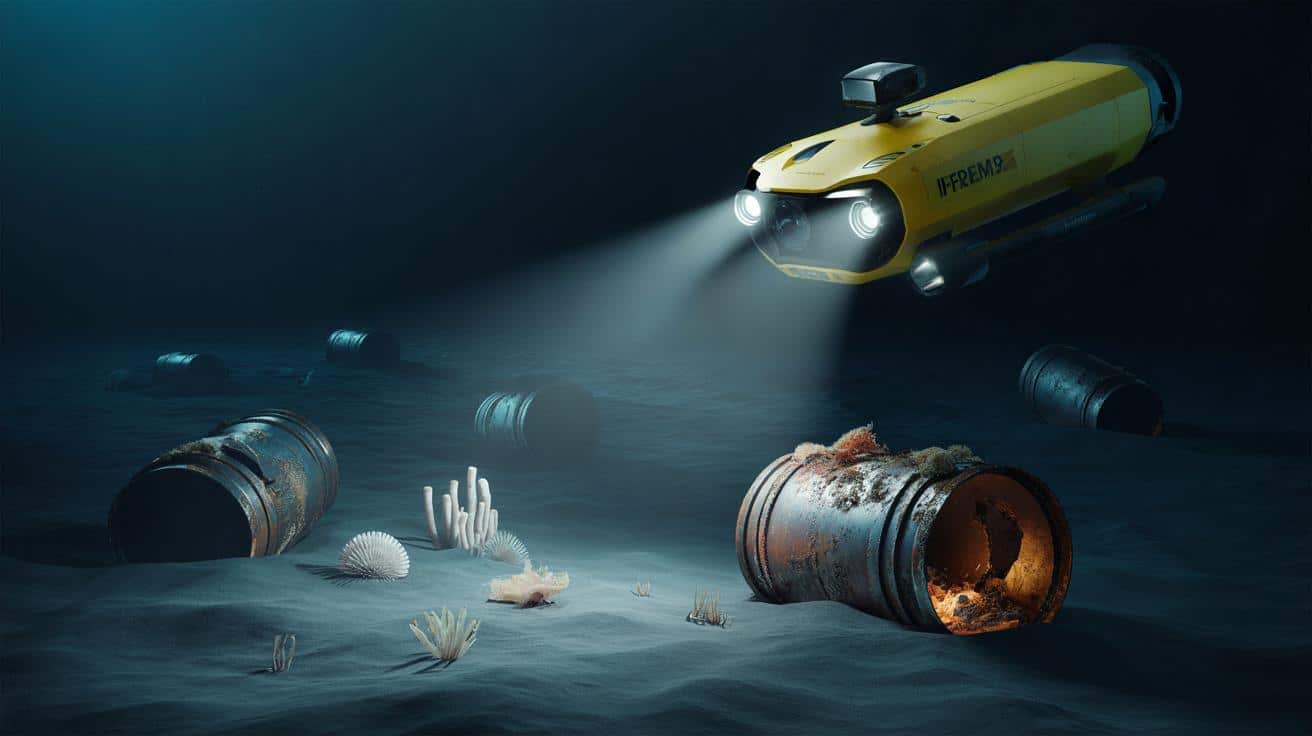
Now a French robot is going back.
The North Atlantic seafloor, once treated as a bottomless dustbin for “low-level” nuclear waste, is again under scrutiny, as French scientists return with a new generation of deep-sea technology to check what those decisions from the Cold War era really left behind.
A forgotten nuclear dumping ground in the Atlantic
Between 1949 and 1982, more than 200,000 barrels of low-level radioactive waste were dropped into the north-east Atlantic by several European countries, including France and the UK. The argument at the time sounded simple: great depth, huge dilution, far from coasts — so risk was judged negligible.
That confidence, backed by the nuclear industry and many governments, began to crack in the 1970s. The London Convention of 1972 started to restrict ocean dumping, and by 1993 the practice was banned outright. Monitoring cruises in the 1980s and 1990s measured no clear rise in radioactivity in surrounding waters, and the subject faded from public debate.
For the first time in a generation, European scientists are returning systematically to a vast nuclear dumping zone almost 5,000 meters below the surface.
Now, with a far better understanding of deep-sea life and far better tools, that complacency is gone. The barrels are still there. Their metal is aging. And the ecosystems around them are no longer seen as empty.
The Nodssum mission: back to 5,000 meters
The new French-led campaign, known as Nodssum, is funded and coordinated by the CNRS and Ifremer. It focuses on a dump site roughly 1,000 kilometres off Brittany, in waters around 4,700 to 5,000 meters deep, covering about 163 square kilometres of seabed littered with drums placed there more than half a century ago.
In June 2025, around 40 researchers from France and abroad boarded the research vessel L’Atalante, a workhorse of the French oceanographic fleet. Their aim was not to clean the seabed — a technical and environmental nightmare at that depth — but to finally establish what condition the waste and its surroundings are in.
The deep ocean is not a desert
For much of the 20th century, abyssal plains were seen as almost lifeless mud. Since the 2000s, that picture has flipped. Biological surveys reveal slow-growing, long-lived communities of worms, crustaceans, sponges and microbial mats, all adapted to cold, darkness and crushing pressure.
Those organisms have limited capacity to recover from disturbance, and they often sit at the very base of long food chains. Any contamination in sediments or porewaters can work its way slowly, but steadily, through the system.
➡️ In Japan, a toilet paper innovation revolution no one anywhere saw coming
➡️ Psychology says people who say “please” and “thank you” tend to have these rare emotional strengths
➡️ Most people don’t realize how often they pay twice for the same thing
➡️ Spain turns an engineering headache into a new turbine‑free source of hydropower for humanity
➡️ Marine biologists warn of a troubling shift in orca interactions with vessels
Far from being dead, the abyss hosts fragile, slow-motion ecosystems that react on timescales measured in decades rather than days.
That shift in understanding is one reason Nodssum exists at all: scientists no longer accept that “out of sight” means “out of impact.”
UlyX: the French robot built for the abyss
To access the dump zone, divers are useless. The workhorse here is UlyX, a new-generation autonomous underwater vehicle (AUV) developed by Ifremer specifically for ultra-deep missions.
How UlyX works at 6,000 meters
UlyX is roughly 4.5 meters long and weighs about 2.7 tonnes. It runs on lithium-ion batteries with around 28 kWh of capacity, enough for up to 48 hours of operation without returning to the ship.
- Maximum depth: 6,000 m
- Autonomy: about 48 hours underwater
- Main tools: high-resolution cameras, multi-beam sonar, synthetic aperture sonar (SAS), 3D laser profiler, physico-chemical sensors
- Typical coverage: up to 50 km² in a single high-resolution survey
During the 2025 Nodssum cruise, UlyX systematically swept the seabed, mapping 3,350 barrels. Fifty of them were photographed in detail, revealing a patchwork of conditions: some nearly pristine, others heavily corroded, and several clearly colonised by deep-sea animals.
Three targeted descents allowed close inspection of around twenty drums and the collection of more than 300 samples. Researchers retrieved sediment cores at different depths, fragments of seabed around the barrels, and tissues from nearby organisms.
“See without touching” is the philosophy: push imaging and measurement to the limit before any physical interaction with the waste.
The three key questions scientists want answered
The mission is built around a focused set of questions:
- How advanced is the corrosion of the barrels after more than 50 years on the seabed?
- Are radionuclides measurably spreading through sediments, water or living organisms?
- What biological changes or damage, if any, are observable in species living close to the waste?
The 2025 data now feed into models and lab work, and they also guide a second campaign planned for 2026. That follow-up trip should include sampling in direct contact with barrel surfaces, a more sensitive step that needs cautious planning.
France’s share of the legacy
What Andra knows about the barrels
The French national radioactive waste agency, Andra, does not run the ships or robots, but it plays a quiet central role. Through the National Inventory of Radioactive Materials and Waste, it compiles information from historical records, international bodies and modern surveys.
| Country (example) | Period | Estimated number of barrels | Type of waste (typical) |
|---|---|---|---|
| France | 1967–1969 | 45,000+ | Low-level waste, lab equipment, treatment sludges |
| Multiple European states | 1949–1982 | 200,000+ total | Low-level institutional and industrial waste |
France alone immersed more than 45,000 drums during two main operations in 1967 and 1969, representing around 14,000 tonnes of material. Most of it came from medical and research facilities, and from nuclear industry treatment plants, and was classed as “low-level” radioactive waste.
These data, refined since the 2009 “Grenelle de la Mer” environmental agreement, guide where scientists look and which sites are considered priorities for ecological studies.
A Russian mirror in the Arctic
The Atlantic dump sites are not unique. Late in 2025, the Russian research vessel Akademik Ioffe carried out a mission near Novaya Zemlya in the Arctic, revisiting long-forgotten nuclear burial grounds in the Barents Sea.
Using modern mapping tools, the team located several structures, including the Likhter-4 barge and the experimental submarine K‑27, which was sunk with its nuclear fuel still onboard. They then measured radioactivity directly on the hulls and in surrounding sediments.
The first set of results were unexpectedly reassuring: no clear active leaks, confinement barriers still functioning, and contamination largely restricted to surfaces already known to be polluted. Yet the message from scientists was cautious: these are aging systems in remote, cold waters, and long-term behaviour remains uncertain.
Across both Atlantic and Arctic sites, the new strategy is the same: locate precisely, measure rigorously, and keep watching instead of pretending the past never happened.
Why not just bring the waste back up?
Removing barrels from 5,000 meters is not just expensive; it carries serious risk. The metal casings are corroded to varying degrees. Hauling them to the surface could rupture them, creating concentrated plumes of contamination in the water column and on the deck of the vessel.
Engineers would also have to handle intense pressure changes, unpredictable structural failures and the challenge of re-packaging waste that was never designed for retrieval. Any misstep could produce a problem that currently does not exist at a significant scale.
For now, most experts favour a strategy of detailed observation and risk assessment, supported by repeat surveys. Only if evidence shows a clear trend towards failure might targeted recovery of specific drums be considered.
What “low-level” actually means under the sea
Terms that often cause confusion
The phrase “low-level radioactive waste” sounds benign, but it covers a wide spectrum. Typically, it includes contaminated clothing, tools, filters, sludges and laboratory equipment. Activity levels are much lower than in spent nuclear fuel, yet still far above natural background.
In ocean-dump contexts, a key factor is the physical and chemical form of the radionuclides. Some bind strongly to particles and stay trapped in sediments. Others remain soluble and mobile, potentially entering food webs. The deep environment’s low temperatures and absence of light slow many processes, from corrosion to biological turnover, making long-term predictions tricky.
Potential scenarios for the next 50 years
Scientists working on Nodssum and related projects often run through several future pathways:
- Slow, contained corrosion: barrels continue to degrade but most radionuclides stay locked in sediments close to the drums, with only subtle local biological effects.
- Patchy failures: a minority of containers fail catastrophically, creating small “hot spots” that need closer watch or targeted remediation.
- Progressive seepage: long-term leaching gradually spreads contaminants over a wider area, still at low levels but potentially detectable in food chains.
Nodssum’s measurements of sediment cores, microfauna, and water chemistry will feed directly into these models, narrowing the range of uncertainty. That in turn shapes international discussions about what to do with similar legacy sites worldwide.
The story of those 200,000 barrels is no longer just a Cold War footnote. It has become a real-time test of how modern societies handle old mistakes that sit far beyond everyday view, on a seabed still largely unmapped, five kilometres down.







