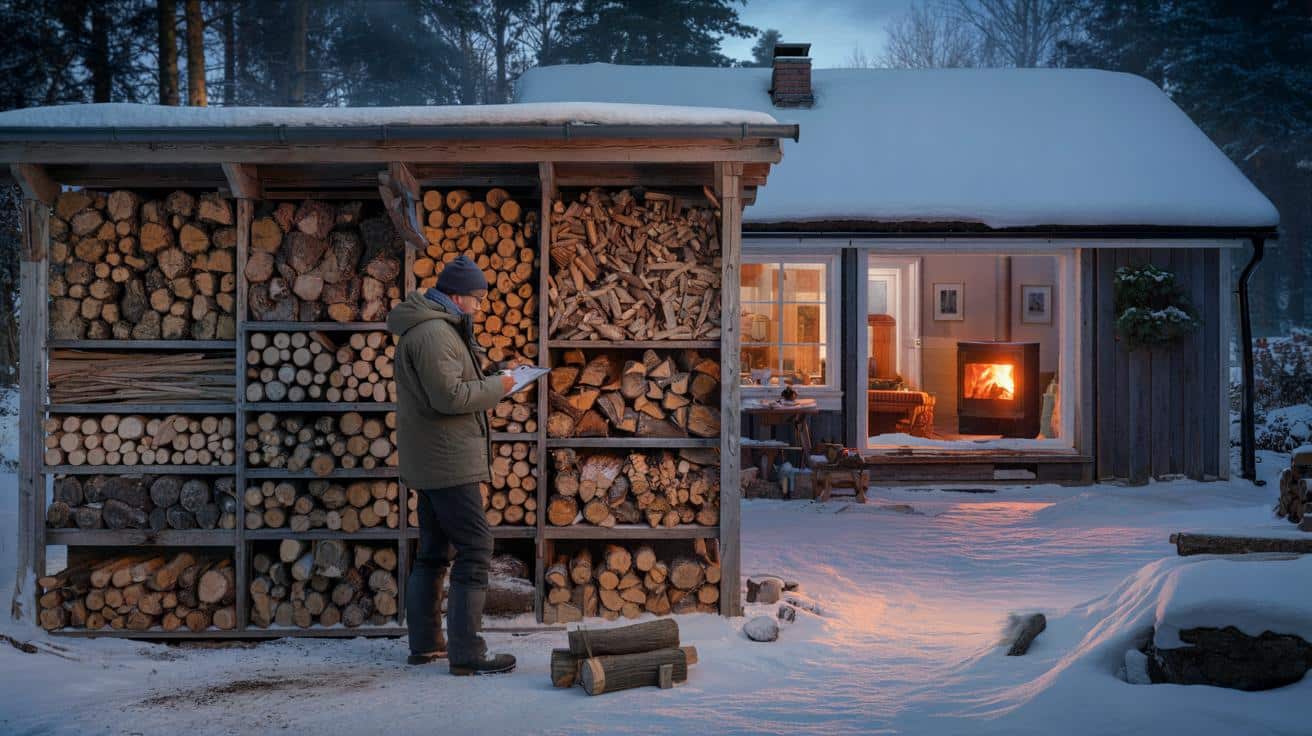
Across Europe and North America, more households are turning back to wood for heat. Some are trying to cut their gas or power bills, others simply want that reassuring glow in the living room. But misjudge your winter stock, and you can end up shivering in late January just as prices spike and deliveries slow.
Why your neighbour’s firewood maths doesn’t work for you
There is no universal answer to the question “how many logs for the winter?”. Two houses with the same floor area can burn wildly different quantities. The key variables are your climate, insulation, heating habits, and stove efficiency.
Most households end up underestimating by one to three cubic metres of wood, especially during their first fully wood‑heated winter.
Energy advisers say the biggest mistakes come from copying a friend’s order without checking simple facts such as ceiling height or average indoor temperature. A cosy 20°C target does not use the same energy as a toasty 22°C living room, and that difference compounds over several months.
Step one: define how you really use wood heat
Before you reach for a calculator, you need to be honest about your habits and plans.
- Occasional use: a weekend fire or a few evenings per week, mainly for atmosphere.
- Supplementary heat: your boiler or heat pump does the main work, the stove helps on cold days.
- Primary heating: the appliance runs most days from autumn to early spring.
Then think about daily running time. A living room stove burning three hours every evening uses far less than a central wood boiler feeding radiators for ten hours a day.
The three pillars: surface, insulation, climate
Once your usage pattern is clear, three technical points shape your consumption:
- Surface and volume: 100 m² with standard 2.4 m ceilings needs less heat than the same area with a lofty 3 m volume.
- Insulation and glazing: cavity walls, roof insulation and double glazing can cut wood needs by a third versus an older, leaky building.
- Climate: a house in northern Scotland or the US Midwest will typically burn 30–50% more wood than the same home on a mild southern coast.
Raising your target indoor temperature from 20°C to 22°C can drive firewood use up by around 30% over a full season.
From stères to cubic metres: getting the units straight
One of the most confusing parts of ordering wood is the jumble of units. In many European markets, suppliers still talk in “stères”, while others use apparent cubic metres (m³) of stacked logs.
➡️ Winter storm alert: Up to 64 cm of snow could lead to the closure of schools and many services
➡️ The reason some cleaning products stop working effectively over time
➡️ I followed the 50/30/20 rule for six months, here’s what really happened
The trap: a “stère” only equals one cubic metre when logs are one metre long. Cut those in half, they stack more tightly and take less volume, even though the energy content stays the same.
| Log length | 1 stère equals | Approx. stacked volume | Practical note |
|---|---|---|---|
| 1 m | 1 m³ | 1.00 m³ | Reference unit, less handy to handle |
| 50 cm | ≈ 0.8 m³ | 0.80 m³ | Common for large stoves, denser stacking |
| 33 cm | ≈ 0.7 m³ | 0.70 m³ | Very common for domestic living‑room stoves |
For budgeting and comparing quotes, using apparent cubic metres is usually clearer, because you are paying for the volume you can physically stack in your shed.
How much wood for different types of use
Energy specialists use broad seasonal benchmarks for a typical, reasonably insulated home with a modern, efficient stove or insert. Treat them as starting points rather than exact figures.
| Use case | Average daily run | Estimated volume (m³) | Estimated hardwood stères | Main adjustment factors |
|---|---|---|---|---|
| Occasional, “cosy fire” | A few hours per week | 2–3 m³ | ≈ 2–3 | +30% in poorly insulated homes, −20% with very efficient stoves |
| Supplementary heating | 2–4 h/day | 4–6 m³ | ≈ 4–6 | +30% in cold climates, −10% with very dry wood |
| Primary heating | 6–10 h/day | 8–12 m³ | ≈ 8–12 | +30–50% in northern regions, −20% in well insulated homes |
A concrete scenario: 100 m² family house
Take a 100 m² house with decent insulation, standard ceiling height and a recent, labelled high‑efficiency stove used as the main heat source in a temperate climate. Most professionals would expect consumption in the range of 6 to 10 stères of dense hardwood for the winter.
If the household likes 22°C instead of 20°C indoors, that range might rise to roughly 8 to 13 stères. Shift the same home to a more severe northern climate, and the gap can stretch by as much as 50%, which is why many families now order with a safety margin rather than last year’s exact quantity.
Ordering 10–20% extra at the start of the season often costs less than a panic purchase in mid‑January during a cold snap.
The hidden factor: stove efficiency and wood quality
Two homes, same volume of logs, very different comfort. The difference usually lies in the appliance and the moisture content of the fuel.
- Old open fires lose much of the heat up the chimney and can burn almost twice as much wood for the same comfort level.
- Modern stoves and inserts reach far higher efficiency, converting more of the wood’s energy into usable heat.
- Wet logs with more than about 20% moisture waste a large share of their energy boiling off water rather than warming the room.
Buying “seasoned” wood does not always guarantee it is dry. A cheap hand‑held moisture meter can quickly show if your logs are ready to burn or need months more under cover.
Hardwood or softwood: what to choose for winter?
Species also play a role in your winter planning. Dense hardwoods such as oak, beech or ash offer more energy per cubic metre and burn more slowly, which suits long winter evenings. Softwoods like spruce or pine light easily and give fast heat, but burn through more quickly and can lead to higher consumption over the season.
Many households now mix both: softwood for kindling and shoulder seasons, hardwood for the long, cold spells. When you negotiate with a supplier, asking clearly for well‑dried hardwood and confirming the proportion of species protects you from surprises when the first cold front arrives.
Storage, safety margin and practical tricks
A generous log order is useless if the pile rots in a damp corner. Storing wood in a well ventilated, covered space, raised from the ground, preserves its energy value and avoids mould. Good airflow around the stack finishes the drying process and keeps smoke levels down indoors.
A dry, ventilated shed can “create” energy: the same log gains usable heat value as it loses moisture through proper storage.
For households new to wood heating, energy advisers often recommend a simple approach for the first two or three winters:
- Year one: use the general benchmarks and add at least 15% margin.
- Year two: track how much was actually burned and adjust the next order.
- Year three: stabilise on a quantity that covers a typical winter with a small reserve.
A basic winter diary helps: note average daily burning hours, outside temperatures during cold spells, and when you reach the halfway mark of your log store. Over time, these records become more valuable than any generic calculator.
Key terms and small risks worth understanding
Two expressions often confuse new wood users. “Apparent cubic metre” refers to the total volume of stacked logs including gaps between them, not just the solid wood inside. “Heating value” or energy content is usually given in kilowatt‑hours per cubic metre for a given species at a given moisture level.
There are also risks behind poor planning. Running out of wood during a cold spell forces some households to burn damp off‑cuts or low‑grade scrap, which increases smoke, chimney deposits and the chance of a chimney fire. On the other hand, over‑ordering by a small margin is rarely wasted: properly stored logs only improve with another year of drying and can cushion you against an exceptionally harsh winter.
Thinking ahead, combining wood with other solutions also smooths out the peaks. A modest electric heater for shoulder seasons, or a programmable thermostat on your backup system, lets you reserve your best logs for the deepest cold while still keeping the living room comfortably warm.







