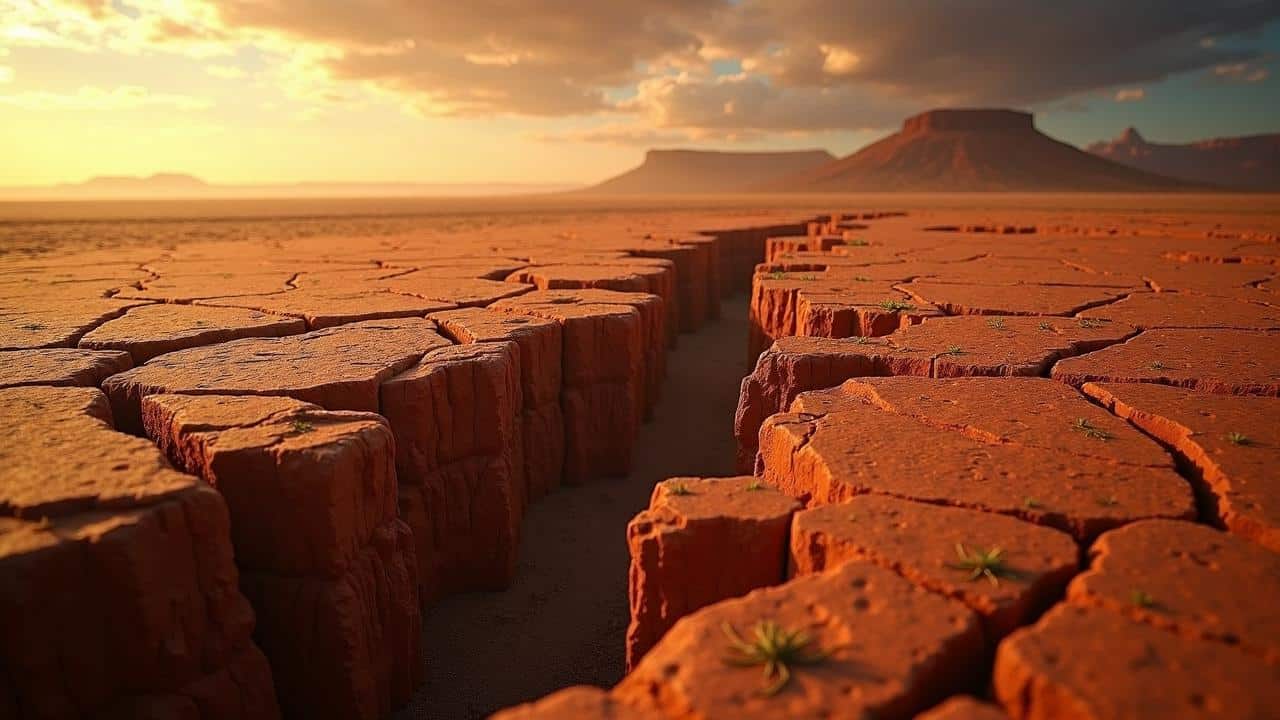
The road across southern Kenya looks solid enough. Asphalt ribbon, trucks drifting past, kids in school uniforms kicking a flat football in the dust. But a few hundred meters away, the ground tells a different story: a jagged crack, several kilometers long, cutting through fields and grazing land like someone dragged a knife across the Earth. Farmers walk along the edge, shaking their heads, as if the planet itself had broken a promise.
Dust slips softly down the sides, pebbles tumbling into the dark. The chasm isn’t bottomless, but it feels that way when you stand on the rim and feel the wind diving into it. Somewhere deep beneath those dry hills, Africa is stretching and tearing at a pace your eyes can’t see, yet that scientists are now able to track almost day by day.
The continent looks still.
It isn’t.
Where Africa is quietly coming apart at the seams
On a satellite map, East Africa looks like a long scar. From the Red Sea down through Ethiopia, Kenya, Tanzania, and further south toward Mozambique, the African Plate is rifting like an old book whose spine is finally giving out. Geologists call it the East African Rift System. Locals just call it home.
The strangeness is this: the land still feels familiar underfoot, goats still find grass, people still queue for boda-bodas. Yet the GPS stations anchored in concrete blocks across the region tell another story entirely. Numbers shifting by millimeters each year. A continent in slow motion.
Ask people in southwestern Kenya about the day the road fell apart back in 2018 and you’ll get vivid memories. A section of highway near Mai Mahiu suddenly cracked open after heavy rains, swallowing fence posts and slicing through farmland. Photos of a yawning, reddish gorge went viral, with headlines screaming that Africa was “splitting in two overnight.”
Reality was less dramatic, but far more interesting. The crack followed old fault lines, zones of weakness that had been building strain for ages. The rain just washed away enough loose volcanic soil to expose the wound. It wasn’t the start of the split. It was the moment we briefly saw what’s been happening under our feet for millions of years.
Geologists now measure this continental unzipping with a precision that would have sounded like science fiction a generation ago. Tiny GPS receivers, bolted to rock and linked by satellite, record how points on the ground move a few millimeters per year—east here, west there—like the slow breathing of the planet. Seismometers pick up the faint shivers of rock cracking deep below, while satellite radar can detect the ground inflating above magma pockets.
Over tens of millions of years, the Somali Plate is slipping away from the larger Nubian Plate. At roughly the speed your fingernails grow, the rift widens. Glacially slow on a human timescale. Violent and fast on a geological one.
How scientists “watch” a continent tear itself apart
If you picture geologists as people hammering rocks in dusty hats, you’re only seeing half the story. The modern version also looks a lot like someone installing a Wi‑Fi router in the middle of nowhere. A typical rift monitoring station might be a small concrete pillar with a high-precision GPS antenna on top, a solar panel, a battery box, and a metal cage to keep out curious goats and bored teenagers.
➡️ Two years ago this CEO fired 80% of staff for refusing AI – now he says he was right
➡️ Vacuum Cleaner G30 Max: Xiaomi unveils its new high‑performance vacuum to challenge Dyson
➡️ Psychology explains why emotional resilience is usually quiet, not visible
➡️ Optician-Approved Tricks to Clean Your Glasses and Keep Them Spotless—No Cloths or Liquids
➡️ Goodbye hair dyes : the new trend that covers grey hair and helps you look younger
Every second, that antenna talks to satellites overhead, logging its exact position down to a few millimeters. Over months and years, scientists see the trend: one side of the rift creeping east, the other west. When an earthquake hits, the trace suddenly jumps, like a heartbeat spiking on a hospital monitor.
The tech doesn’t always have an easy life. Cables get chewed by rodents, solar panels are stolen, dust storms coat sensors in a thick red film. Local researchers and villagers often end up as quiet guardians of these metal totems, phoning teams in the city when something goes wrong.
We’ve all been there, that moment when a blinking light on a box suddenly becomes the most important thing in the room. For a community near an active rift, that box could be their early warning of a swarm of small quakes or the subtle rise of the ground before a volcanic vent reawakens. It’s science, yes, but also a kind of neighborhood watch for the deep Earth.
The data feeds into models that try to answer a hauntingly simple question: where is the crust weakest, and when might it finally give way? Researchers combine GPS measurements with satellite radar images, earthquake catalogs, and gravity surveys to build 3D pictures of what’s happening under East Africa.
Some zones, like the Afar Triangle between Ethiopia, Eritrea and Djibouti, have already started to behave more like young ocean floor, with thin crust, intense volcanism, and deep fissures. Lava quietly oozes from long cracks, lakes of molten rock form in desert basins, and new crust is born. *It’s like catching the Atlantic Ocean in its awkward teenage years, when it was still just a stretched-out scar in a splitting supercontinent.*
What this slow-motion breakup really means for people
On a human level, the first “method” for living on a tearing continent is simple: learn to read the land. In rift regions, houses built along old fault lines or on loose volcanic ash are far more vulnerable when the ground shifts or heavy rains arrive. Kenyan and Ethiopian engineers increasingly use geological maps and rift data to decide where to put roads, schools, and water pipes, avoiding zones that are quietly sliding, cracking, or sinking.
Volcanologists watch gas emissions and ground deformation around volcanoes like Nyiragongo in DR Congo or Ol Doinyo Lengai in Tanzania, searching for patterns. Tiny changes in the ground level—the sort you’d never sense walking—can warn of magma rising, giving cities like Goma precious hours or days to react.
There’s also the emotional side that rarely makes the scientific papers. Families living near a fresh crack or a restless volcano often feel caught between fascination and fear. They hear scientists talk about millions of years, while they worry about next season’s harvest or whether the well will still hold water.
Let’s be honest: nobody really reads a 150‑page geological report when they’re wondering whether to keep their kids home from school during a swarm of small quakes. That’s why local science communicators, teachers, radio hosts and village leaders matter so much. They translate millimeters per year into “your house is safe” or “we should avoid this hillside now.”
“Continents don’t just sit there,” says one Nairobi-based geologist who’s spent the last decade chasing GPS points across East Africa. “They wrinkle, they sag, they crack open. Our job is to listen to that movement in time to keep people out of the way when something snaps.”
To understand how this affects daily life across the region, three simple realities keep coming back:
- Rift zones concentrate both danger and opportunity – From fertile volcanic soils and geothermal energy to earthquakes and eruptions, the same forces that tear the land also feed it.
- Good data turns “acts of God” into known risks — When you know which slopes slide and which faults move, you can plan roads, dams, and neighborhoods with fewer nasty surprises.
- Local knowledge is a science tool, too — Stories of past cracks, “angry” hills, or streams that suddenly disappeared often match mapped faults and old quake records with uncanny precision.
A continent in the middle of a very long goodbye
The wildest part of this story is the timeline. East Africa won’t fully split for another 5 to 10 million years. Long after our languages, flags, and current city skylines are forgotten, a new ocean will likely be lapping between what’s now Ethiopia, Somalia, Kenya and the rest of the continent. Future maps may show a long, slim sea where today there are cracked roads and grazing lands.
Standing on the edge of a rift valley, it’s hard not to feel small in the best possible way. Your lifespan is a flicker compared with the slow heave of lithospheric plates. Yet our brief moment still matters: the data collected now, the decisions about where to build and how to explain risk, will shape how millions of people live with the restless ground.
There’s a quiet intimacy in knowing the planet is moving under you, not symbolically, but literally, by three or four millimeters this year. The same physics that once ripped apart the supercontinent Gondwana is playing out under dusty villages and crowded cities, with children checking their phones on the bus above fractures that may one day outline a new shoreline.
Somewhere between fear and awe, between research station and cattle track, Africa’s slow split invites a different way of thinking about home. Not as a fixed piece of land, but as a moving chapter in the long, restless story of Earth.
| Key point | Detail | Value for the reader |
|---|---|---|
| Continental breakup is measurable today | GPS and satellite data show East Africa widening by millimeters per year | Turns a vague “geology fact” into something real, current, and trackable |
| Visible cracks are just the surface expression | Events like the Mai Mahiu road rupture follow ancient faults and deep rift dynamics | Helps separate sensational headlines from the long-term, underlying process |
| Living on a rift is both risk and resource | Earthquakes and volcanoes coexist with fertile soils and geothermal energy | Shows why people stay, adapt, and even benefit from unstable ground |
FAQ:
- Is Africa really splitting into two separate continents?Yes, geologists agree that the Somali Plate is pulling away from the larger Nubian Plate along the East African Rift. Over millions of years, a new ocean basin is expected to form, separating parts of East Africa into a distinct landmass.
- Can we see the continent splitting with the naked eye?On a daily basis, no. The movement is only a few millimeters per year. What you occasionally see are dramatic cracks or sinkholes that expose existing faults, especially after heavy rains or small quakes.
- Is this process dangerous for people living in the region?Rift zones bring higher risks of earthquakes, ground subsidence and volcanic eruptions. Many communities already live with these hazards, and better monitoring, building codes, and land‑use planning can reduce the impact.
- Will a huge crack suddenly open and swallow cities?That’s the kind of image movies love, but geology doesn’t work like that. Large-scale splitting happens gradually through many smaller events: repeated quakes, eruptions, and fault movements spread over long periods of time.
- Why do scientists care about measuring a process that takes millions of years?Real-time measurements improve hazard forecasts for today’s populations and help test models of how continents and oceans form. The same physics behind East Africa’s rift also governed past supercontinents and shapes future coastlines.