Before stocking up for winter, many owners want to know how long one standard bag of wood pellets will actually keep their home warm. The answer changes a lot depending on the stove, the settings and even the house itself, but there are clear benchmarks that help plan both comfort and budget.
Why one 15 kg pellet bag never lasts the same time twice
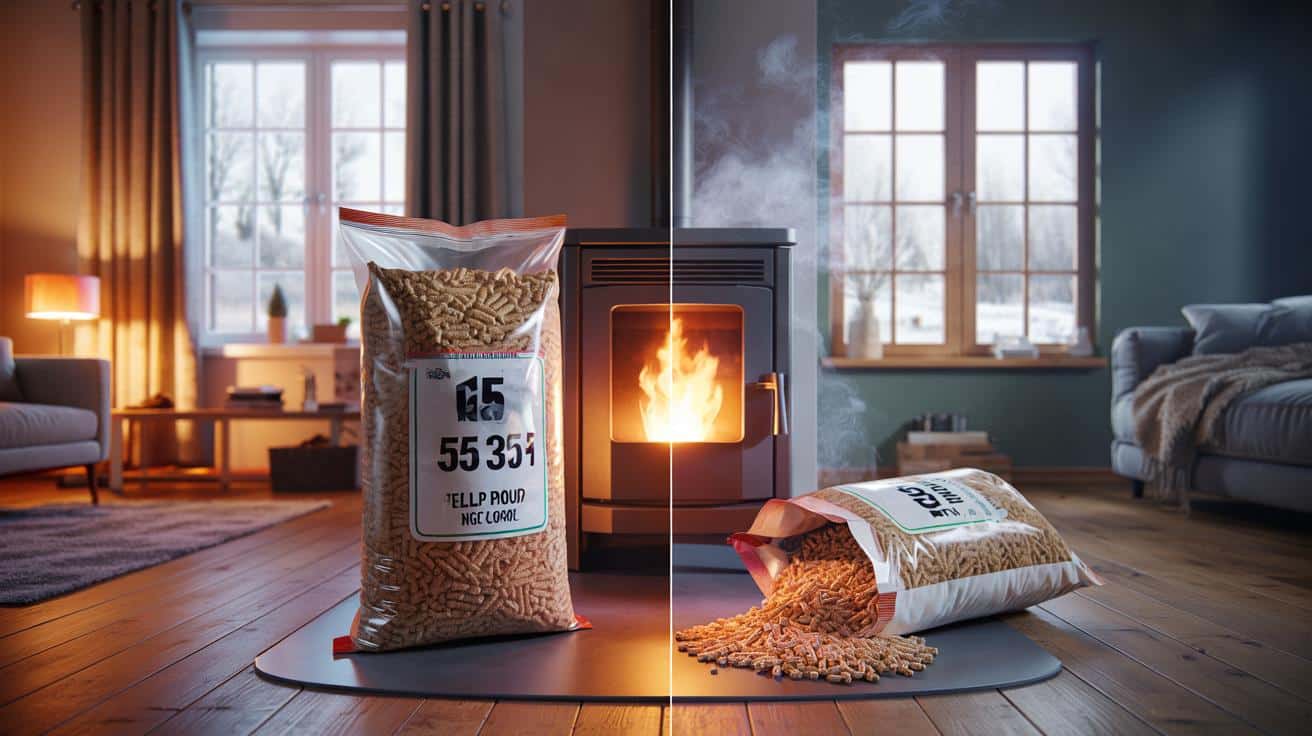
A 15 kg bag looks reassuring on the pallet, yet its “lifespan” can range from a few hours to nearly two days. The main reason is simple: pellet stoves are not all used in the same way, and the heat they need to produce varies hugely between homes.
On a powerful setting, a 15 kg bag can disappear in under 8 hours. On a gentle eco mode, it can stretch to around 30–40 hours.
Several technical factors influence this range: the output of the stove, the selected power level, how well the house holds heat, and the quality of the pellets themselves.
Stove power and efficiency: the starting point
Most modern pellet stoves have a rated power between about 2 kW and 10 kW. That figure tells you how much heat the appliance can deliver to your room when running near full power.
Efficiency: how much heat you really get
Current pellet stoves are generally efficient, often between 85% and 95%. That means most of the energy stored in the pellets becomes usable heat instead of going up the flue.
A well-maintained, recent stove operating at around 90% efficiency will extract more heat from the same 15 kg bag than an old, neglected unit. Soot build-up, a dirty brazier or clogged air inlets can easily nibble away at a few percentage points of efficiency, which you end up paying for in extra bags.
A clean, well-adjusted pellet stove can turn almost all the energy in a 15 kg bag into usable warmth.
Full blast vs eco mode: how long can it last?
The power setting is usually the biggest variable for everyday use:
➡️ The Emir of Qatar flies in a private jet so large it helped modernise Sardinia’s airport
➡️ Meteorologists warn an unusually early Arctic breakdown is accelerating toward February
➡️ The hidden psychological meaning behind your need to stay busy all the time
- High power (around 8–10 kW): ideal when the house is cold or outside temperatures are very low. At this level, a stove can burn through a 15 kg bag in roughly 8–10 hours.
- Low or eco mode (around 2–3 kW): designed to maintain a steady background heat. Here, the same bag can last in the region of 30–40 hours.
In practice, many households alternate: high power for a quick warm-up when people get home, then eco mode to keep temperatures stable. That mix has a strong impact on how many bags you’ll need each week.
Pellet quality: why all bags are not equal
Two bags of pellets can weigh the same but perform very differently. The key factors are moisture content, density and ash production.
| Pellet characteristic | What to look for | Impact on a 15 kg bag |
|---|---|---|
| Moisture content | Below 10% | Drier pellets burn hotter and longer per kilogram. |
| Certification | ENplus, DINplus or equivalent | More consistent quality and predictable performance. |
| Ash content | Low ash rate | Less residue, better airflow, more stable combustion. |
Cheaper pellets with higher moisture will burn faster and cooler. That means you may need an extra bag or two over the month just to maintain the same comfort level.
How your home’s insulation changes everything
A pellet stove does not heat in a vacuum. The way your home holds on to heat is often more decisive than the brand of the appliance.
A typical rule of thumb used by installers: around 1 kW of heating power is needed for every 10 m² of reasonably insulated space. That gives some rough benchmarks:
- For a 100 m² home in a cold region, a stove may need to run at 8–10 kW during the harshest days.
- For the same size home in a milder climate, 4–6 kW might be enough most of the time.
Older, badly insulated houses leak heat through walls, roofs and windows. In that case, the stove spends its time “compensating” for losses, which shortens the lifespan of each 15 kg bag.
A well-insulated home can effectively add several hours of heating to each bag of pellets.
Real-life scenarios: how long does one 15 kg bag last?
Theoretical numbers are useful, but what happens in day-to-day life? Here are two clear-cut scenarios based on typical usage.
Scenario 1: well-insulated home, eco mode
Picture a modern 90–100 m² house with decent insulation and double glazing. The owners use the stove as the main heating source and favour a gentle but steady temperature.
- Power level: around 2 kW
- Estimated pellet burn rate: roughly 0.5 kg/hour
- Estimated duration of a 15 kg bag: about 30 hours of continuous operation
In practice, if the stove runs 10 hours a day at this setting, one bag can last roughly three days.
Scenario 2: poorly insulated home, full power
Now imagine an older house with thin walls, draughty windows and a harsh winter outside. Here, the stove needs to run near maximum output to keep rooms liveable.
- Power level: around 8 kW
- Estimated pellet burn rate: close to 2 kg/hour
- Estimated duration of a 15 kg bag: under 8 hours of continuous use
In this case, several bags per day may be needed during intense cold, which can quickly inflate the seasonal budget.
How many bags for a full heating season?
Over an entire winter, pellet needs vary widely between households. Broadly speaking:
- A family in a well-insulated 100 m² house may go through around 1.5 to 2 tonnes of pellets per season, which equals roughly 100–130 bags of 15 kg.
- A similar-sized but poorly insulated home, or a location with long, severe winters, can easily push usage above 3 tonnes, or more than 200 bags.
The stove’s role also matters: some people use it as a cosy top-up next to a gas boiler or heat pump, while others rely on pellets as their only heating system. In mixed setups, a 15 kg bag might last several days because the stove is not running constantly.
Tips to stretch each 15 kg bag further
Several practical habits can extend the useful life of every bag without sacrificing comfort.
- Regular cleaning: Empty ash, clean the brazier and check air inlets. Better airflow improves combustion and reduces wasted pellets.
- Use eco or modulating modes: Maintaining a stable temperature usually consumes less than repeatedly overheating and letting rooms cool down.
- Smart scheduling: Program the stove to cut back when everyone is away or at night, especially in well-insulated homes that hold heat.
- Targeted insulation upgrades: Simple work like adding loft insulation or sealing window gaps can noticeably reduce pellet use.
Fine-tuning settings and improving insulation often saves more pellets than switching brands.
Key terms that help make sense of your consumption
Pellet heating jargon can be confusing at first. A few concepts are worth keeping in mind when you look at your bags disappearing.
- kW (kilowatt): Measures the heating power your stove can provide at a given moment. Higher kW means faster heating but faster pellet use.
- kWh (kilowatt-hour): Measures energy over time. Your stove’s manual usually states how many kWh you gain from 1 kg of pellets.
- Calorific value: The amount of heat released when a certain amount of fuel is burned. Higher values mean more heat per kilogram of pellets.
By understanding these terms, you can compare stoves, evaluate pellet brands and estimate how many hours of heating one bag can realistically provide in your home.
Practical simulations for planning your winter budget
Consider a household that runs its stove 8 hours a day on a medium setting, burning around 1 kg of pellets per hour. That’s 8 kg per day. A 15 kg bag would cover almost two days, so roughly 15 bags per month. Over a 5‑month heating season, they would need about 75 bags, or just over 1.1 tonnes.
Another home, less insulated and in a colder area, might run the stove 12 hours a day at a higher power, using 1.5–2 kg per hour. That is 18–24 kg a day, meaning 1.5 bags daily. Over the same 5 months, this jumps to around 225 bags, or more than 3 tonnes. The gap between these two examples shows why investing in insulation and careful settings has a direct, visible effect on the number of 15 kg bags stacked in the garage.