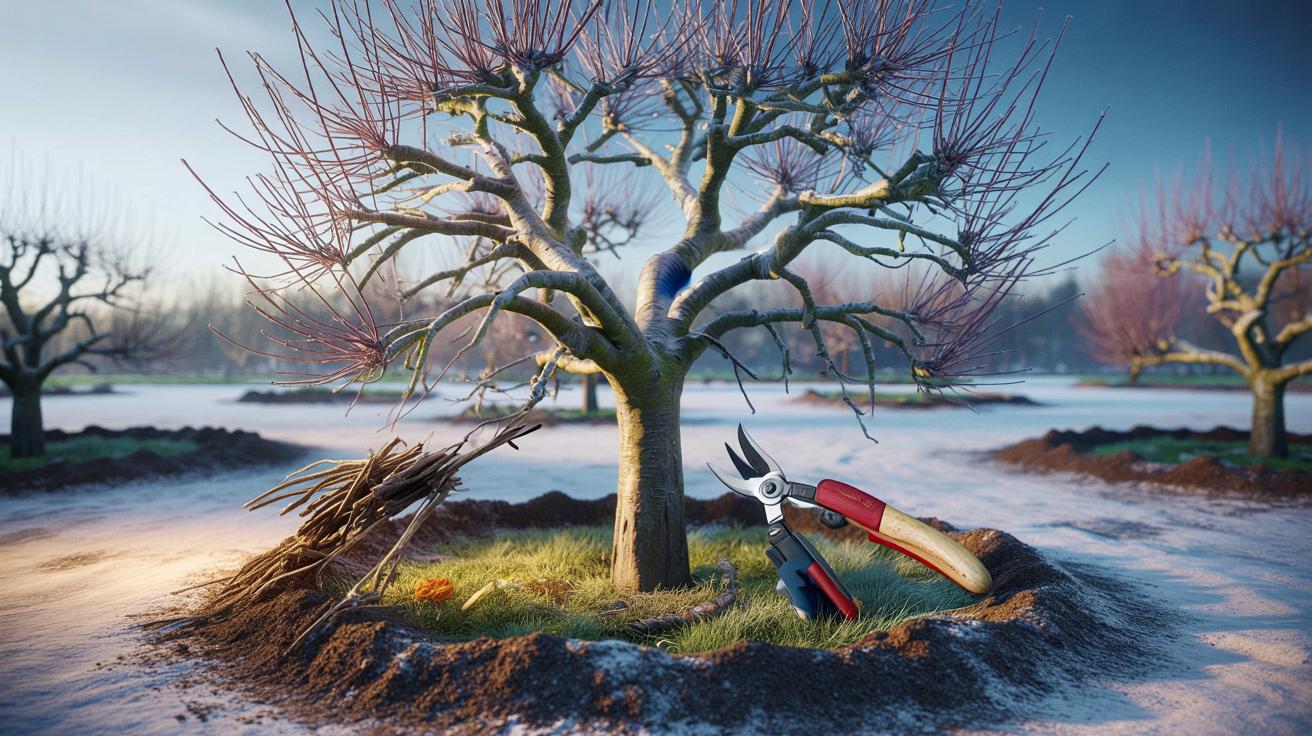
While most people are still packing away Christmas lights, experienced orchard keepers are out in the cold, pruning, cleaning and feeding their apple trees. Those discreet winter gestures, done at exactly the right moment, can radically change the number and quality of apples you pick a few months later.
Why January is the month that decides your summer harvest
Apple trees look lifeless in January, but that bare, dormant phase is when they respond best to structural work. The sap has dropped, growth is paused and the tree tolerates cuts far better than in spring.
When pruning waits until buds swell or blossoms appear, every cut removes precious energy the tree has already invested. In mid‑winter, that energy is still stored in the roots and trunk, ready to feed new, better-placed branches.
Winter pruning reshapes where the tree spends its strength, turning wasted wood into productive, fruit-bearing branches.
A well-timed January session brings three big gains: more light inside the canopy, better air circulation and stronger, better-balanced limbs. All three directly affect how many blossoms survive and how many of them turn into firm, unblemished apples.
The three tools that change everything
Gardeners who swear their harvest has doubled rarely talk about magic fertilisers. They talk about basic, sharp tools used at the right time.
- Hand pruners for thin shoots and young branches
- Loppers for thicker, older wood you can’t cut one-handed
- A pruning saw for any limb thicker than your thumb
Blunt blades crush bark instead of slicing it, leaving ragged wounds that heal slowly and attract disease. Clean steel with alcohol or a mild bleach solution before and after you work. That simple step stops you carrying fungi and bacteria from one tree to another.
Sharp, disinfected tools reduce infection risk and help cuts seal quickly, which keeps the tree’s energy focused on fruit.
The key gestures that turn wood into apples
Start by removing what the tree no longer needs
Step back and study the shape of the tree before you touch it. Look for dead branches, dark or sunken bark, and twigs that rub or cross. These pieces waste energy and invite disease.
➡️ How to identify who’s behind an unknown or blocked phone number
➡️ Sheets shouldn’t be changed monthly or every two weeks: an expert gives the exact frequency
- Cut out dead or diseased wood right back to healthy tissue, without leaving little stubs.
- Remove inward-growing branches that block light from reaching the centre of the tree.
- Check for damaged limbs cracked by wind or heavy crops, and shorten or remove them safely.
Once this “cleaning” is done, the skeleton of the tree is easier to read. You can see where light can pass and where it still struggles.
Open the canopy to light and air
Apple trees need sunlight on leaves and fruiting spurs to produce sugars. When the canopy is dense and tangled, the interior stays damp and dark. That’s where problems like scab and powdery mildew start.
Gardeners often aim for a goblet or pyramid shape: a clear centre, strong main branches radiating outward, and plenty of space between them.
A bright, open structure lets the morning sun dry leaves quickly and helps blossoms turn into full, sweet fruit instead of rotting on the branch.
Whenever you shorten a branch, cut just above a bud that points in the direction you want future growth to go, ideally outward, not back into the middle of the tree.
The mistakes that quietly ruin apple crops
The biggest error in winter pruning is enthusiasm without a plan. Removing more than about a third of the tree’s wood in one go shocks it. Instead of fruiting, it reacts by sending up long, whippy shoots with few blossoms.
Another common problem is “flush cutting” branches right against the trunk. That slices into the natural collar of tissue the tree uses to seal a wound. Cuts made a few millimetres away from this collar heal more reliably and are less likely to rot.
Harsh, thoughtless pruning often leads to a wild burst of useless shoots the following year, not bigger baskets of apples.
Rushing is tempting on a cold day, but pausing before each cut—checking where that branch sits, what it shades and what it supports—pays off in fruit rather than firewood.
How steady, regular pruning doubles production
Apple trees don’t just flip between “on” and “off.” They tend to alternate: one heavy year, then a light one. Careful, annual winter pruning smooths that pattern.
By thinning crowded areas and shortening certain shoots, you encourage the tree to form more flower buds along well-lit branches. Those buds are visible by late winter as slightly plumper structures on two- or three-year-old wood.
| Pruning habit | Likely result |
|---|---|
| Light, yearly winter pruning | Stable, regular crops and good fruit size |
| No pruning for several years | Dense canopy, disease, small apples on outer tips |
| Severe pruning in a single year | Vigorous shoots, few flowers the following season |
Gardeners who track their yields often notice that, after two or three winters of consistent, thoughtful work, the number of marketable apples—those worth eating or selling—can easily double compared with an untouched, tangled tree of the same age.
Treating pruning wounds so they heal fast
Every cut is a small injury. The cleaner the cut, the lower the risk of infection. On larger limbs, some growers still like to protect the wound.
Commercial pruning sealants exist, but simple mixtures also work. A paste made from clay and fine wood ash, for instance, can be dabbed over the exposed area. It forms a breathable shield while the tree starts to knit new tissue around the edge.
Neat cuts that shed water, combined with a light protective coating on bigger wounds, keep fungal diseases at bay in the wet months.
What to do after the last branch is cut
Once pruning is finished, the job isn’t over. The soil around the roots needs attention too. Spread well-rotted compost or an organic fertiliser in a ring under the canopy, where most feeding roots sit.
Add a mulch of shredded branches, leaves or straw around the base, keeping it a little away from the trunk itself. This layer feeds the soil life, keeps moisture longer in dry spells and buffers the roots from late cold snaps.
Use this moment to check trunks and main limbs for signs of pests, such as small holes, sawdust, or patches of lichen hiding insects. Catching trouble now is easier than fighting it in July when the tree is in full leaf.
Understanding a few key orchard terms
Two expressions often puzzle new growers. “Dormancy” simply describes the winter rest period when visible growth halts, but internal processes continue at a slower pace. Working with the tree during dormancy lets you change its structure without tugging against active growth.
“Alternating fruiting,” or biennial bearing, describes the swing between heavy and light crops. Winter thinning of branches, and later thinning of young fruits in spring, encourages the tree to spread its effort more evenly. That means fewer overloaded branches one year and disappointing emptiness the next.
How these winter gestures play out in real life
Imagine two apple trees of the same age at the bottom of a garden. One is left untouched. Its centre darkens year after year, branches cross and rub, and apples form only on the very outside. Many never reach full size, and disease spots appear where damp lingers.
The second tree is pruned gently each January. Dead wood disappears, light slips right into the centre, and strong, well-spaced branches carry fruiting spurs along their length. By August, that tree is carrying fewer but larger clusters of apples, with better colour and far less wastage on the ground.
Spread across a small orchard, the difference between those two approaches is no longer theoretical. It can mean crates instead of buckets, and a summer kitchen full of juice, pies and jars rather than a handful of windfalls feeding only the compost heap.







