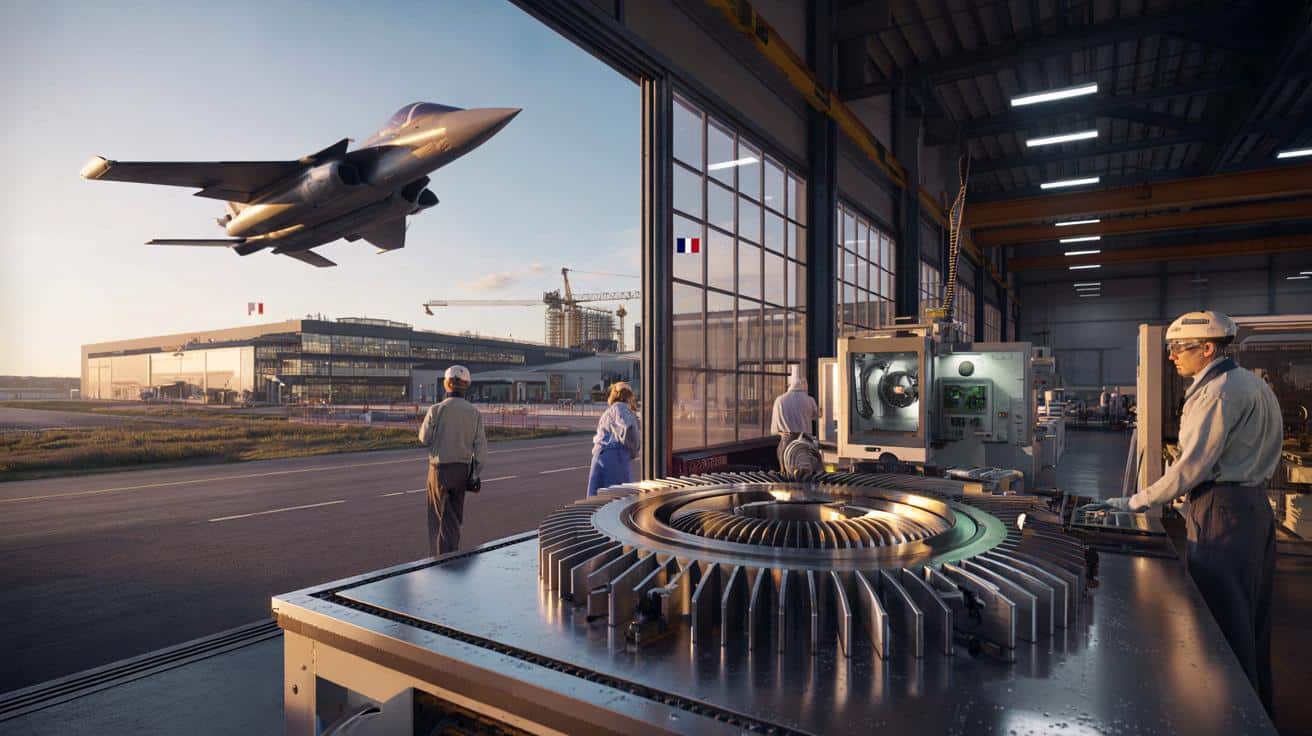
At Le Creusot, a historic steel and engineering centre, Safran Aircraft Engines is pouring money, people and cutting-edge machinery into an already busy factory that will soon rank among France’s most strategic sites for the Rafale combat aircraft.
A €70 million bet on Burgundy
Safran has confirmed a €70 million investment to expand its Le Creusot plant, in eastern France’s Saône-et-Loire department. The goal is simple: turn a specialist civil aviation workshop into a central pillar of the Rafale’s industrial backbone.
By 2029, Le Creusot is expected to emerge as one of France’s key sites for manufacturing critical rotating parts for the Rafale’s M88 engine.
The project adds 9,000 square metres of new industrial space, taking the total surface to about 26,000 square metres. Construction and tooling will run over several years, but production linked to the Rafale programme will start to ramp up much earlier.
From 2026, some machining operations for the M88 engine will begin on the current lines before being transferred into the new buildings once they are ready. This phased approach lets Safran boost capacity without disrupting deliveries of existing civil engines.
From civil workhorse to military anchor
Until now, Le Creusot had a very focused mission. The site was dedicated to producing low-pressure turbine discs for Safran’s LEAP and CFM56 engines – the powerplants behind most Airbus A320 and Boeing 737 single-aisle aircraft.
These are high-precision parts, but firmly in the civil aviation sphere. The expansion changes that balance.
The factory will now manufacture complex rotating parts for two high-stakes engines: the M88 that powers the Rafale, and the GE90 used on Boeing 777 long-haul jets.
For the Rafale, the change is especially significant. Le Creusot will become the second internal source for complex rotating parts on the M88, alongside Safran’s existing site at Évry-Corbeil near Paris. That redundancy is not just an industrial detail; it carries clear defence and political implications.
➡️ Meteorologists warn early February may trigger an Arctic breakdown with global implications
➡️ The emotional reason silence can feel overwhelming
➡️ This specific type of log is up to 300% more efficient than traditional firewood
➡️ Psychology highlights the three colors most often chosen by people struggling with low self-esteem
➡️ The hidden psychological meaning behind your need to stay busy all the time
Securing M88 production rates
France and a growing list of export customers want more Rafales, faster. By January 2026, export orders alone had reached 220 aircraft. Each aircraft needs two M88 engines, and those engines rely on a steady flow of discs, shafts and other rotating components.
Safran’s aim is to ensure no single bottleneck can slow production.
- Évry-Corbeil: existing primary site for M88 complex rotating parts
- Le Creusot: new complementary source, focused on added capacity and resilience
- Villaroche: final assembly and testing of engines
By splitting production across multiple French plants, the group reduces operational risk and sends a reassuring signal to export clients such as Egypt, India and Greece: the industrial chain is both diversified and anchored on French soil.
Sovereignty written into the factory layout
Safran’s management openly links this move to strategic autonomy. The company talks of “internal supply chain reinforcement”, “business continuity” and “industrial sovereignty”. Behind the corporate language lies a blunt reality: combat aircraft engines are not something France wants to outsource.
Each rotating component in a fighter engine carries years of metallurgical know-how and testing, making it one of the least offshorable parts of the defence industry.
By expanding domestic capacity for these components, France limits exposure to supply chain shocks, whether from geopolitics, shipping snarls, sanctions or export controls. That matters for domestic fleets, but also for foreign air forces that have committed billions to the Rafale and expect uninterrupted support for decades.
Inside the M88, the Rafale’s mechanical core
The M88 is a compact twin-spool turbofan with afterburner, designed from the outset for high manoeuvrability and low maintenance. Built around 21 modules, it delivers around 50 kN of dry thrust and 75 kN with afterburner in its current standard configuration.
Safran is already working on a more powerful variant, dubbed M88 T-REX, which targets around 90 kN of thrust for future Rafale F5 standards. More advanced evolutions, labelled M88-4, are studied in the 95–105 kN range, which could support future-generation fighters.
| Key feature | M88 engine data point |
| Dry thrust | ≈ 50 kN |
| Afterburning thrust | ≈ 75 kN (up to 90 kN on T-REX) |
| Length / diameter | 3.54 m / 0.70 m |
| Dry weight | 897 kg |
| Thrust-to-weight ratio | About 8.5 |
The rotating parts produced at Le Creusot sit at the heart of this performance. They endure extreme temperatures close to 2,000°C and enormous centrifugal forces. Machining tolerances can be on the order of a few microns. Any defect risks catastrophic failure, which is why Safran keeps these operations under tight control.
Factory of the future, running behind closed doors
Le Creusot is already considered an “industry 4.0” demonstrator inside the Safran group. The plant uses fully digitalised production flows, real-time monitoring and extensive automation.
One of its defining features is so-called “closed door machining”: clusters of machine tools that run unattended, often all night, under sensor surveillance.
Operators programme the machines, load raw material and check finished parts, but most of the cutting happens with the doors literally shut. Sensors track vibrations, temperatures and tool wear, feeding the data back into Safran’s systems.
This model supports three priorities: steady quality, predictable cycle times and the ability to ramp up output without dramatically increasing headcount. For military programmes, it adds another benefit: the production environment is easier to secure, both physically and from a cybersecurity standpoint.
New jobs, new skills for Le Creusot
Today, Safran’s Le Creusot factory employs roughly 200 people. With the extension fully up and running, that figure should reach about 300 around 2032. A hundred industrial jobs may not sound huge on a national scale, but for a mid-sized town, the impact is meaningful.
These are not assembly-line positions in the classic sense. The project requires specialised machinists, material scientists, quality engineers and maintenance experts familiar with high-value automated lines.
The shift from largely civil to mixed civil-military production raises the skill bar and tends to lock long-term industrial activity into the region.
Training will play a central role. Staff already working on discs for LEAP and CFM56 engines will transition to tighter tolerances and different alloys for the M88 and GE90. New recruits will have to cope with complex digital systems as much as with traditional metal-cutting techniques.
A discreet but strategic node in Safran’s French network
Safran operates a dense web of sites in France, each covering a slice of the engine life cycle, from forging and machining to final assembly and maintenance. Le Creusot’s expanded role must be seen in that context.
| Site | Location | Main activities |
| Villaroche | Seine-et-Marne | Assembly, engine tests, R&D |
| Évry-Corbeil | Essonne | Critical and complex rotating parts, including M88 |
| Le Creusot | Saône-et-Loire | Machining of discs and complex rotating components |
| Gennevilliers | Hauts-de-Seine | Engine maintenance and repair |
Spread across these sites, Safran employs close to half of its roughly 92,000-strong global workforce in France. The group posted €27.4 billion in revenue in 2024, driven mainly by engines, landing systems, avionics and defence electronics.
What “complex rotating parts” really means
For non-specialists, terms like “low-pressure turbine disc” or “complex rotating component” sound abstract. In practical terms, these are the parts that spin at thousands of revolutions per minute, often made from nickel-based superalloys or advanced steels.
They must be light enough not to weigh down the engine, yet strong enough to survive repeated take-offs, supersonic dashes and rapid throttle changes. Each part goes through forging, heat treatment, machining, surface finishing and multiple rounds of non-destructive testing.
If you picture the engine as a chain, these discs and shafts are the links most likely to break if anything goes wrong.
This explains why engine makers like Safran tend to keep such work close, in fully controlled factories, instead of spreading it across a fragile global supply chain.
Risks and benefits for France and its customers
The expansion at Le Creusot carries its own set of risks. The aerospace industry is cyclical, and defence budgets can change with elections. Delays in building or qualifying the new lines could also slow the planned boost in Rafale output.
On the other hand, the benefits look substantial for France’s industrial base. The country gains more resilience in one of its few globally competitive sectors, while providing high-skilled jobs in a region that knows the pain of deindustrialisation.
For export clients, a reinforced M88 supply chain reduces the likelihood of spares shortages and helps keep fleets available. In a hypothetical crisis, where global transport is disrupted or sanctions hit certain suppliers, a concentrated, national production chain can keep delivering engines and parts.
The move also fits a wider European push to secure critical defence technologies at home, from microelectronics to missiles. In that picture, a quiet factory in Burgundy, running closed-door machining centres through the night, starts to look less like a regional story and more like a core asset for air power on both sides of the Channel.







