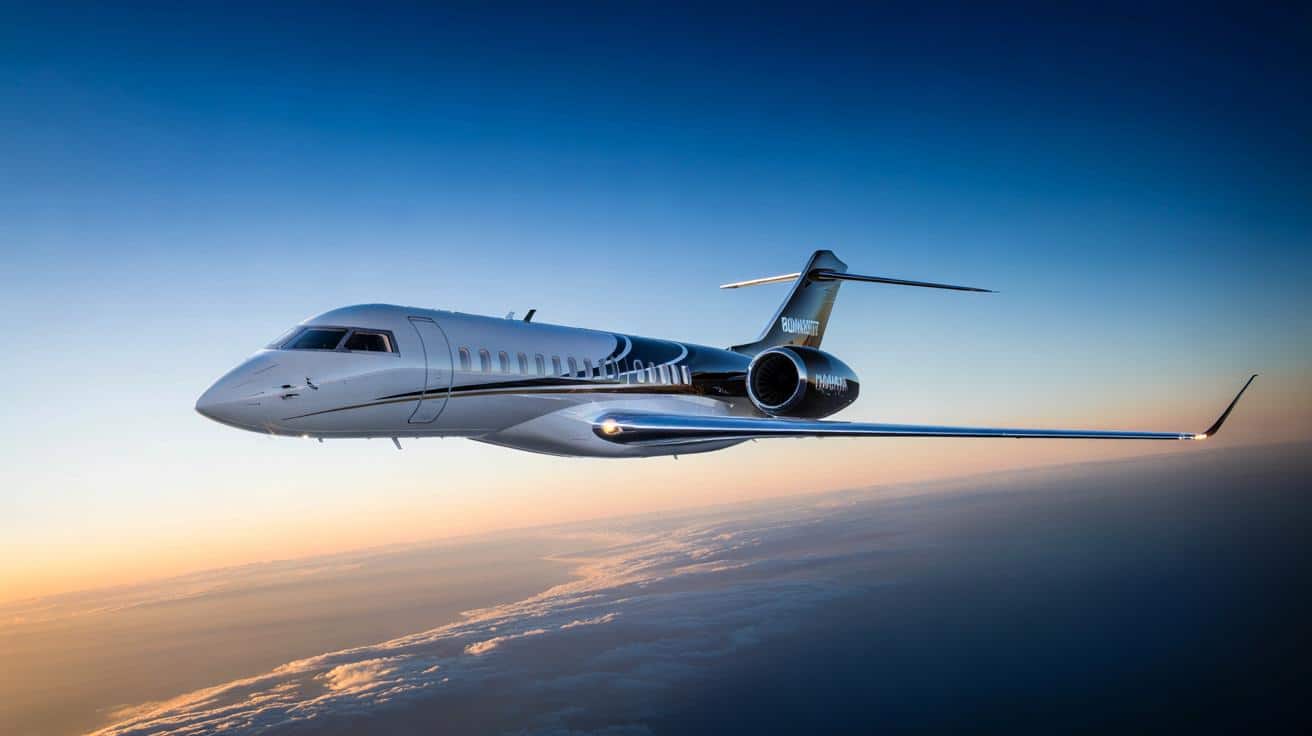
The latest flagship from Canadian manufacturer Bombardier has been certified on three continents and now holds a title no one has claimed since Concorde stopped flying. It doesn’t go supersonic, but it gets close enough to seriously bend the usual rules of long‑haul travel for the ultra‑rich and corporate elites.
A civil jet that flirts with the sound barrier
Engineers have a nickname for the speed range just below Mach 1: the transonic trap. As an aircraft approaches the speed of sound, pockets of air around the wings and fuselage start hitting Mach 1 before the rest of the flow. That triggers local shock waves, a brutal rise in drag and a loss of lift that can make extra engine thrust feel almost useless.
Bombardier’s new Global 8000 has been designed specifically to skim that danger zone without stepping over it. The jet has now been certified to cruise at a top speed of Mach 0.95, making it the fastest civil aircraft in service since the days of the Anglo‑French Concorde.
The Global 8000 holds the current record as the fastest civil airplane in the world, with a certified maximum speed of Mach 0.95.
Unlike Concorde, this is not a technology demonstrator or a prestige project for national airlines. It is a business jet you can charter or buy, as long as you can justify a price tag of roughly €74 million before options, plus millions a year in operating costs.
Bombardier’s comeback aircraft
A manufacturer that nearly lost its wings
Bombardier Aerospace emerged in its current form in the late 1980s, when the Canadian industrial group bought Canadair and began stacking up aviation brands. Over the following decades it built everything from rugged turboprop regional planes to the once‑ubiquitous CRJ regional jet family, and a series of increasingly capable business jets under the Challenger and Global names.
Then came a brutal downturn. The aftermath of 9/11, international trade rows and, above all, the over‑ambitious CSeries airliner programme pushed the company to the brink. That aircraft is now sold as the Airbus A220, after Bombardier gradually ceded control and then exited the programme outright.
Between 2018 and 2020, Bombardier shed nearly all of its commercial and regional aircraft activities. Out went the CRJ line, the Dash 8 turboprops and firefighting amphibians. The company shrank and repositioned itself as a specialist in high‑end business jets, betting that wealthy individuals and corporations would provide a more stable, profitable market than airlines with razor‑thin margins.
From near‑bankruptcy to record‑breaking jet: the Global 8000 is the symbol of Bombardier’s bet on ultra‑long‑range business aviation.
➡️ The Norwegian army managed to take control of a bomb dropped by an American fighter jet mid‑flight
➡️ Polar bears in Norway’s Arctic are getting fatter and healthier, despite the climate crisis
➡️ The habit that quietly keeps kitchens under control
➡️ For years, a woman used a stone as a doorstop… only to learn it was worth a million euros
➡️ This small fridge adjustment keeps vegetables crisp longer
Today, the company focuses its engineering and production muscle on a handful of large‑cabin jets, and the Global 8000 sits at the top of that pyramid.
Triple seal of approval in record time
To sell a new aircraft broadly, a manufacturer needs certification from major regulators. For the Global 8000, that meant three key milestones.
- Type certification in Canada in November 2025
- Certification from the US Federal Aviation Administration in December 2025
- Approval from the European Union Aviation Safety Agency (EASA) in early 2026
Each authority runs its own long checklist, from structural strength and flight controls to fire protection, avionics and performance. Passing all three in quick succession signals that the jet isn’t an experimental toy, but a machine ready for global, routine operations.
EASA’s sign‑off places the Global 8000 in the club of long‑range business aircraft that can operate almost anywhere business aviation goes.
Range that reshapes long‑haul routes
14,800 km without refuelling
The Global 8000 is not just about speed. Its range sets it apart as well. Bombardier advertises 8,000 nautical miles of endurance, around 14,800 kilometres, with a full complement of passengers in a standard configuration.
That figure opens up non‑stop missions such as:
- Paris – Singapore
- Los Angeles – Sydney
- London – Buenos Aires
- New York – Hong Kong (against typical winds on some routings)
Those are routes that traditional airliners can operate, but with very different economics and passenger counts. In the Global 8000, a small group can fly point‑to‑point to secondary airports closer to their final destination, without the time loss of hubs and transfers.
Four genuine cabin zones
Inside, Bombardier has pursued a layout often promised in brochures, but not always delivered in practice: four real cabin zones that feel distinct in use.
That means one area can be arranged as an office, another for dining or meetings, a third as a lounge and a fourth as a proper bedroom. The aim is to make a 15‑hour flight feel like a working and living space, not an endurance test in a pressure tube.
The Global 8000’s cabin is designed so that passengers can work, eat, relax and sleep in clearly separated zones on a single ultra‑long flight.
Technology tailored for the transonic edge
Wings that flex with the mission
The wing is the core of the Global 8000’s performance story. Bombardier’s so‑called Smooth Flex Wing adjusts its behaviour depending on speed. At lower speeds, such as take‑off and landing, its design emphasises lift and stability, helping the aircraft use relatively short runways. At higher speeds, the shape and structure focus on reducing drag and keeping the airflow attached as the aircraft approaches transonic conditions.
This combination allows runway performance closer to that of smaller jets, with cruise performance more often associated with large airliners, while still edging up to Mach 0.95.
Cockpit built for 15‑hour days
Up front, the Vision Flight Deck uses a full fly‑by‑wire architecture. Instead of direct mechanical linkages, pilot inputs are interpreted by computers that move control surfaces and adjust for turbulence, weight changes and shifting centres of gravity.
Bombardier says the cockpit layout and automation were reviewed over thousands of test hours and pilot feedback cycles, with an aim to cut workload on very long missions. On a crossing that can stretch past half a day, mental fatigue is as real a risk as fuel planning errors or unexpected weather.
Air quality as a sales argument
Cabin air quality has become a selling point in premium aviation. The Global 8000 uses a system branded Pũr Air, combining a hospital‑grade HEPA filter, rated to capture 99.99% of particles, with an activated carbon filter to tackle odours and volatile organic compounds.
Fresh air is cycled through the cabin more frequently than on typical commercial jets. For passengers who board already jet‑lagged or sleep‑deprived, that can make the difference between arriving functional or useless for meetings.
Clean, frequently renewed air is marketed as a direct contributor to alertness and reduced fatigue on missions lasting well over ten hours.
A business jet playing a double game
Speed, reach and access
Bombardier likes to describe the Global 8000 as “two aircraft in one”: a high‑speed, near‑transonic cruiser and a long‑range business platform with strong runway performance. The wing is central to that strategy, as it should allow the aircraft to use a wider range of airports than some rivals of similar size.
In practice, that means more options to land closer to city centres or industrial hubs, avoiding congested hubs where business jets often wait behind airliners. For a board meeting where every hour matters, this time saved on the ground can be as valuable as the minutes shaved off in cruise.
Who it competes with
The Global 8000 enters a crowded top tier of ultra long‑range business jets, where speed, range and cabin space trade off against each other. Its main rivals are the Gulfstream G700 and G800, and the in‑development Dassault Falcon 10X, plus Bombardier’s own Global 7500.
| Aircraft | Range (km) | Max speed (Mach / km/h) | Cabin (m² / zones) | Price (M€) | Engines (kN x2) |
| Global 8000 | 14,816 | 0.95 / 1,155 | 16.6 / 4 | 74 | GE Passport (84.2) |
| Gulfstream G700 | 13,890 | 0.935 / 1,135 | 17.1 / 4 | 72 | RR Pearl 700 (81.2) |
| Falcon 10X | 13,890 | 0.925 / 1,125 | 16.1 / 4 | 69 | GE Passport (84.2) |
| Gulfstream G800 | 14,816 | 0.925 / 1,125 | 17.5 / 4 | 74 | RR Pearl (81.2) |
| Global 7500 | 14,264 | 0.925 / 1,125 | 16.6 / 4 | 67 | GE Passport (84.2) |
This segment is not just about numbers on a spec sheet. Buyers weigh softer elements: how easy the aircraft is to operate into smaller airports, the feel of the cabin, how quiet it is at cruise, and the support network when something breaks far from home.
After Concorde, a different idea of speed
Why Mach 0.95 and not faster?
Concorde flew at about Mach 2, more than twice the speed of sound, but paid dearly in fuel burn, noise and operating cost. The Global 8000 chooses a very different compromise. By stopping just short of the sound barrier, it avoids the complex structural and engine requirements of supersonic cruise, and stays on the right side of strict rules on sonic booms over land.
The business model shifts too. Instead of selling a handful of seats at huge prices on limited routes, Bombardier sells an aircraft platform to corporations, governments and ultra‑high‑net‑worth individuals. For them, the question is not “How fast can we get across the Atlantic?” but “How many productive hours can we salvage on this 12‑hour trip?”
For Global 8000 buyers, speed is not a spectacle, it is a tool to recover time and reduce fatigue on trips that already feel too long.
What Mach actually means
Mach is simply the ratio between an object’s speed and the local speed of sound. At typical cruise altitudes, sound travels slower than at sea level, roughly 1,060 to 1,100 km/h depending on temperature. A jet at Mach 0.95 up high is therefore moving at a slightly different true airspeed than Mach 0.95 at a different altitude or in different weather.
This nuance matters when comparing aircraft. Two jets advertised at Mach 0.92 and Mach 0.95 might differ by only a few minutes on a transatlantic dash. Where the Global 8000 gains an edge is on extremely long missions, where that small speed bonus accumulates over many hours.
Scenarios, risks and what comes next
Picture a multinational company with headquarters in London and major operations in Singapore and California. With a Global 8000, its executives could schedule London–Singapore and then Singapore–Los Angeles missions in quick succession, keeping the aircraft and crew working at the limit of duty rules. The aircraft’s mix of high cruise speed and access to secondary airports reduces delays in both the air and on the ground.
Yet this high‑performance niche comes with trade‑offs. Fuel burn per passenger can far exceed that of a well‑filled airliner, raising questions about emissions. Investors and regulators increasingly scrutinise such aircraft, even at the top end, and pressure is rising for sustainable aviation fuel usage and future hybridisation or new engine cycles.
For now, the Global 8000 demonstrates where subsonic business aviation can realistically go with current materials, engines and regulations. The next challenge will be to keep that kind of performance while cutting the environmental cost – a task that may require as much innovation in policy and operations as in aerodynamics and propulsion.







