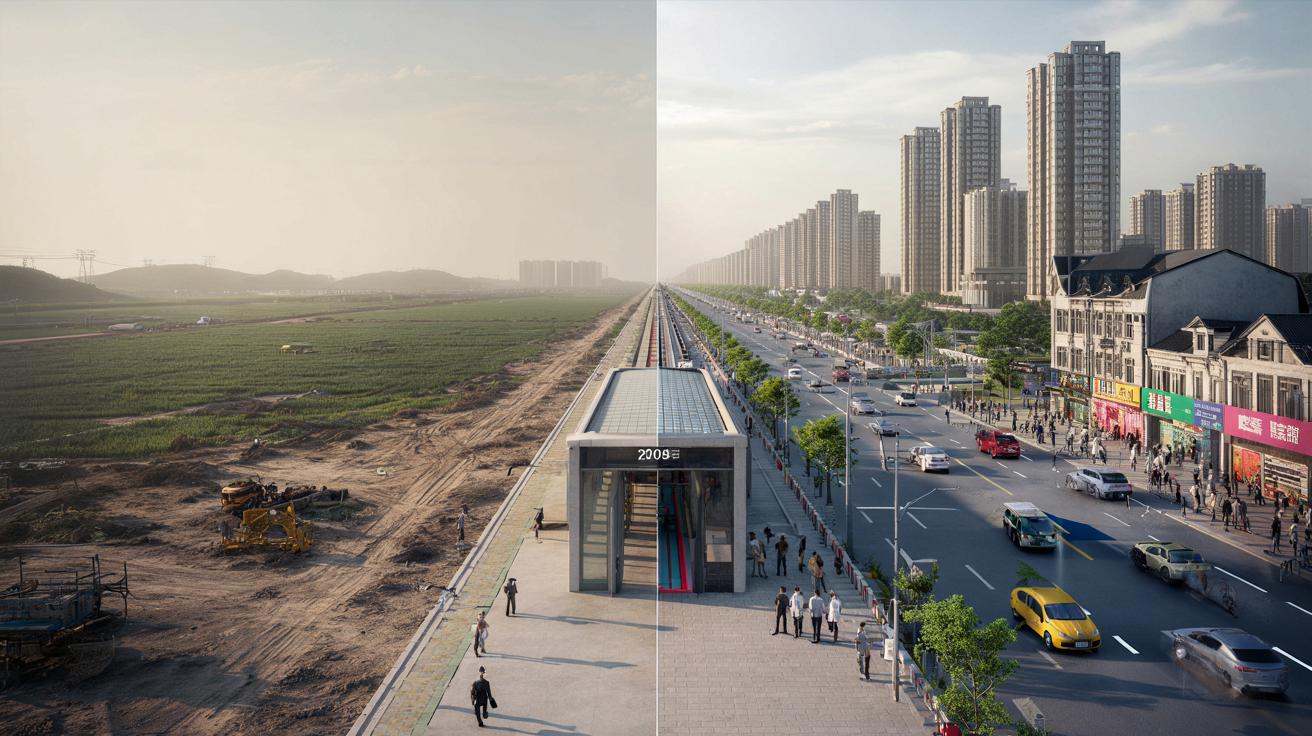
What once looked like surreal, overbuilt infrastructure scattered across wasteland has turned into a test case for how far a state can bet on the future. In 2025, many of the projects mocked as vanity schemes now force a blunt question: were we judging them with the wrong timeline in mind?
Infrastructure first, people later
Since the late 2000s, China has flipped the standard Western logic of city building. Instead of waiting for dense neighbourhoods to justify a transport line, the state often lays down the transport first and lets the city grow around it.
The turning point came around the 2008 Beijing Olympics. The country poured around $40 billion into infrastructure, and the signal to other big cities was unmistakable: build now, traffic will come later. Subway networks in dozens of metropolitan areas surged almost at once, carving tunnels under fields, industrial land and farmland on the urban fringe.
In China’s model, the metro is not a response to demand but a trigger for demand, a concrete promise that tomorrow’s city already exists on paper.
That promise is not just political. It is financial. Studies, including one in Wuhan, show that the mere presence of a metro station can sharply increase commercial land prices within about 400 metres, even if the surroundings are still half-empty. Land auctions suddenly fetch higher bids. Developers can pre-sell apartments more easily. Local governments, which depend heavily on land sales, plug some of their budget gaps.
So the sequence becomes deliberate:
- Plan the new district and its population targets.
- Lay the metro line early, even under open land.
- Auction surrounding plots at higher values.
- Use that cash flow to fund more infrastructure or repay debt.
Viewed from London or New York, this looked reckless. But in Beijing, Shanghai or Chengdu, it was framed as a 10‑ to 20‑year play, not a five‑year payback exercise.
Caojiawan, from online joke to case study
Few places illustrate this clash of timelines better than Caojiawan, a station in Chongqing’s Beibei district. When it opened in October 2015, early photos were almost comic: three station entrances rising from a grassy wasteland, with no roads in sight and barely any buildings.
Passengers who did get off there often had to jump on a minibus to get anywhere useful. Staff openly admitted they had very few riders. Social media ran with it. “Station to nowhere” headlines spread internationally, and the stop became a meme about China’s “crazy” building spree.
➡️ Lara Croft Is Back With Two Tomb Raider Games, But Something Has Changed… A Lot
➡️ Japan unveils a new toilet-paper innovation “and shoppers can’t believe it didn’t exist sooner”
Caojiawan was treated as proof that China had finally overbuilt itself into absurdity: metro tunnels under an empty horizon, guarded by bored attendants.
Then the calendar moved on. By late 2019, roads were finished around the station. Residential towers appeared. Retail followed residents. By 2020, what had been a punchline functioned like any other suburban stop serving a growing community.
For planners, Caojiawan stopped being an embarrassment and turned into a quiet victory. The timeline was five to ten years, not five to ten months. That is still uncomfortable for politicians who face elections every four years in Western democracies. In China’s one‑party system, the calculation is different: the same party can own both the bet and its long-term payoff.
“Ghost cities” that were really paused cities
China’s so‑called “ghost cities” follow a similar script. Lanzhou New Area in Gansu province became a media obsession around 2016. Giant replicas of the Sphinx, wide empty boulevards, and only a fraction of the projected residents: it was easy to frame the whole place as a $14 billion white elephant.
At that time, the area was intended to host a million people by 2030 but had only around 150,000 residents plus tens of thousands of construction workers. From outside, the gap between promise and reality looked like failure.
Urban planners inside China rarely used the word “ghost” for these places; they talked instead about “phased development” over 15 to 20 years.
The distinction sounds semantic but matters. A ghost town is something abandoned. A phased new area is something unfinished. Chinese planners argue that what global media photographed was a mid‑construction snapshot, not the end state.
This patient framing underpins the gigantic expansion of Chinese metros. Since 2002, Beijing alone has invested over $150 billion in its network, now stretching more than 870 kilometres. Similar expansions took place across dozens of cities, helped by cheap credit and strong political backing.
The hidden bill for tomorrow’s city
By 2025, the consequences of this build‑first strategy have become painfully clear on the balance sheets. Of the 28 metro companies that released their accounts, total debt has ballooned to around 4.3 trillion yuan, roughly €525 billion.
Shenzhen’s metro, one of the most heavily used systems after Shanghai, loses about 100 million yuan a day. In Chongqing, wages alone reportedly eat up about half of operating costs. Fare revenue simply does not cover the price of running such large, capital‑intensive systems.
| City | Key metro challenge | Financial/operational effect |
|---|---|---|
| Shenzhen | High ridership but low fares | Daily losses near 100m yuan |
| Chongqing | Complex terrain, long lines | High staffing and maintenance costs |
| Smaller cities | Limited demand so far | Struggle to justify big systems |
Faced with this, Beijing pulled the brake. In 2018, the central government barred cities with under 3 million residents from launching new metro projects. Further restrictions slowed approvals even for larger cities. The message to local authorities was blunt: the age of endless tunnelling on borrowed money was over.
Operational quality has also suffered. Some stations opened with just one entrance, creating bottlenecks at rush hour. Interchange designs often force long walks between lines. Express tracks, which could reduce journey times across vast metro areas, are missing in many systems. And extreme weather has exposed weaknesses: the deadly flooding of the Zhengzhou metro in 2021 raised sharp questions about drainage, emergency planning and risk modelling.
From building fast to making it work
China’s metro challenge in the mid‑2020s is no longer quantity but usability. The lines exist. The debt exists. The question is how to turn these networks into safe, efficient everyday tools that justify their huge cost.
The next phase is less about heroic construction photos and more about mundane but crucial details: timetables, station design, safety drills, and funding models.
Planners and operators are under pressure to shift mindset. For years, the mantra was “open the line on schedule”. Now, riders care more about whether trains are overcrowded, whether transfer corridors are confusing, or whether escalators keep breaking down. Designing around passenger experience requires different skills and different incentives than hitting construction targets.
Caojiawan again offers a small, symbolic lesson. What once stood as an empty shell is now integrated into an emerging neighbourhood. As residents move in, their complaints, habits and routines shape the next wave of local planning: bus routes, bike lanes, shops, schools.
Why Western cities misread the gamble
Many Western observers underestimated one basic factor: China’s ability to align land markets, planning rules and state‑backed finance around a single objective. In London or Los Angeles, a metro line must fight its way through fragmented land ownership, neighbourhood opposition and budget committees. Timelines stretch, scope shrinks, and the final system often looks compromised.
Chinese cities operate under a different set of constraints and freedoms. Local governments lease land, control zoning and can clear entire clusters of housing for new projects. This top‑down power makes mistakes easier to hide, but it also makes grand bets like pre‑building metro stations in empty districts possible at scale.
Western planners, focused on short‑term cost‑benefit calculations, often dismissed these projects as irrational. What they struggled to price in were factors like speculative land gains, political priorities, or the value of shaping migration away from overcrowded inner cores.
Some key ideas behind China’s strategy
Several planning concepts help explain what has been playing out since 2008:
- Transit‑oriented development (TOD): building dense, mixed‑use districts around stations to reduce car use and raise land values.
- Staged occupancy: accepting low initial usage for big projects, with a clear path to fuller use over 10–20 years.
- Land‑finance loop: using rising land prices near stations to partly fund the very infrastructure that created that rise.
In China, these ideas were applied at a speed and scale rarely seen elsewhere. When they work, they can turn farmland into functioning city blocks in a decade. When they misfire, they leave half‑used lines and districts waiting for residents who never quite arrive.
Future risks and what other countries can learn
Three major risks hang over this model. First, debt sustainability: if growth slows and land sales weaken, local governments may find it harder to keep metros running without cutting other services. Second, demographic shifts: China’s population is starting to shrink and age, which could undermine the long‑term ridership assumptions baked into many projects. Third, climate resilience: tunnels and stations will need upgrades to cope with more severe rainfall events and heatwaves.
Yet there are lessons for other countries too. Pre‑building high‑capacity public transport in growth corridors can steer development away from car‑dependent sprawl. Using value capture tools – such as taxing land value increases near new stations – can share some of the upside with the public purse. And accepting that a line might feel “too big” on opening day can, in some cases, be rational planning rather than hubris.
Back in 2008, seeing a fully equipped metro station standing alone in a field did look absurd. In 2025, with those fields now sprouting dense districts and crowded carriages, the picture is more complicated. The question has shifted from “were they crazy to build this?” to “can they afford to keep it running, and will the bet still pay off in a greyer, slower China?”







