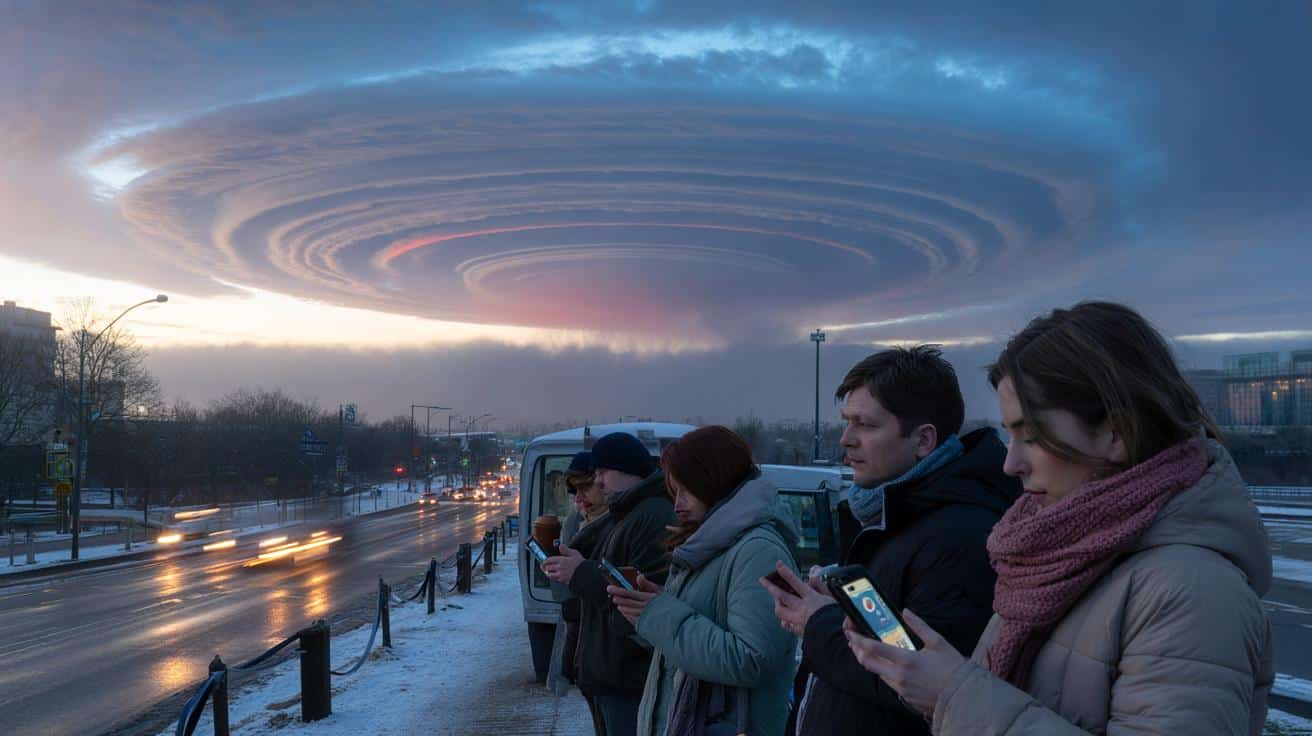
The streetlights were still on when the first flurries started drifting down, thin as dust, over a city that had already mentally moved on from winter. Commuters clutched take-away coffees and wore light jackets, scrolling through weather apps that promised a quiet, gray February day. No blizzards. No drama. Just that in-between season when winter feels half-asleep and spring is still a rumor.
Then, overnight, the headlines shifted. Meteorologists began talking about a rare “sudden stratospheric warming” event, high above the Arctic, where temperatures in the upper atmosphere were spiking by tens of degrees in a matter of days. Some forecasters warned of a February pattern flip. Others urged calm. Social media did what it does best: panicked, joked, and shared maps nobody really understood.
Up there, 30 kilometers above our heads, the atmosphere was quietly rewriting the script.
A silent shock wave 30 kilometers above your head
Picture the atmosphere as a layer cake. We live and breathe in the bottom layer, the troposphere, where clouds form and storms roll in. Above that sits the stratosphere, thinner, drier, and usually calm. In winter, a screaming river of wind called the polar vortex spins around the Arctic like a cosmic fence, locking in the cold.
Every once in a long while, that fence buckles. A sudden stratospheric warming, or SSW, is like someone slamming the brakes on that jet of wind. Stratospheric temperatures jump by 30 to 50°C in just a few days. The vortex weakens or splits like a cracked ice disk. Down here at the surface, nothing looks different yet. But the dominoes have started to fall.
Meteorologists remember February 2018 the way sports fans talk about legendary games. That winter, an SSW event unraveled the polar vortex and sent Arctic air spilling into Europe and North America. “Beast from the East” became a household phrase in the UK. In the US, snowstorms torched through the Northeast, smashing records that had stood for decades.
Not every SSW ends in a blockbuster winter, though. In 2019, a similar stratospheric disruption sparked intense speculation, only for many regions to see a relatively tame pattern instead. This is where the public conversation often goes sideways. People hear “rare stratospheric event” and translate it as “guaranteed snowmageddon.” Forecasters know better. The stats show maybe six out of ten SSWs tilt the odds toward colder, stormier weather in key population centers. Four out of ten? Mostly a shrug.
This February’s setup is especially unsettling because it’s early in the season and layered on top of a complex background: a fading El Niño, warming oceans, and already-weird jet stream behavior. When a major SSW hits against that backdrop, the models start to wobble. Some runs show the vortex shattering and cold plunging deep into mid-latitudes for weeks. Others show the disruption staying bottled up over the Arctic, with only subtle effects at ground level.
That gap between “this might happen” and “this will happen to you” is exactly where the tension lies. Forecast offices need to communicate risk, not certainty. News sites want clear headlines. The public just wants to know whether to brace for power outages or book a ski weekend.
How much should you actually worry?
If you’re trying to make sense of this without a meteorology degree, start with a simple rule: think in probabilities, not promises. When you hear about a sudden stratospheric warming, ask two questions. First: does this raise the odds of serious cold or snow where I live over the next 2–6 weeks? Second: are local forecasters beginning to align on the same story, or are they still all over the map?
➡️ For years, a woman used a stone as a doorstop… only to learn it was worth a million euros
➡️ Graphics card sale: RTX 5070 Ti hits a historic low price at this retailer
➡️ Bird lovers use this cheap February treat to keep feeders busy and attract birds every morning
That shift alone changes how you read the news. An SSW is like a storm on a distant horizon; it may drift your way or curve around. You don’t need to stockpile weeks of food the moment it’s spotted. You do want to keep an eye on updates from your national weather service, especially if you live in regions that historically get hit hard when the polar vortex wobbles.
We’ve all been there, that moment when a scary-looking map goes viral and your group chat erupts with screenshots. One winter, a German researcher posted a model image of a fractured polar vortex, and it spread like wildfire across TikTok and X. The caption: “Europe is DONE.” No nuance. No dates. Just doom.
In the end, some places saw a few strong cold snaps, others got nothing out of the ordinary. The emotional hangover was real. People felt manipulated, not informed. That’s the trap with rare atmospheric events. They’re visually dramatic and algorithm-friendly, but their real-life impact is complicated, slow, and uneven. If you’ve started to tune out weather hype altogether, you’re far from alone.
The emotional tension isn’t just on the public side. Inside forecast offices and research labs, scientists are quietly wrestling with how noisy to be about this February’s stratospheric drama. Some argue that early warnings, even if imperfect, help cities prepare their energy grids, hospitals, and transit systems. Others worry that repeated “big one is coming” messages, followed by near-misses, will erode trust.
“Communicating stratospheric warming is a tightrope,” admits one senior climatologist who advises a European national weather service. “If we underplay it and a major cold outbreak hits, we’ve failed. If we oversell it and nothing happens, we’ve also failed.”
- Watch for consistency: when multiple reputable agencies start hinting at pattern changes, the signal is getting stronger.
- Look at time windows: SSWs usually influence surface weather 10–21 days later, not tomorrow morning.
- Focus on impacts, not jargon: cold snaps, ice risk, energy demand — not just “vortex disruption.”
- Lean on local context: the same SSW can mean icy chaos in one region and mild drizzle in another.
A quiet split in the expert world
Behind the scenes, this February’s early-season warming has sparked a subtle rift among experts. On one side are the “signal amplifiers” — researchers and communicators who believe **we’ve entered an era where ignoring rare atmospheric flags is more dangerous than raising them too loudly**. They point to 2021’s Texas freeze, when cascading infrastructure failures turned a cold outbreak into a humanitarian crisis, as a brutal reminder of what happens when risk is underestimated.
On the other side stand the “trust guardians.” They worry less about one bad cold snap and more about something slower: public fatigue. *If every winter is framed as potentially historic, the word ‘historic’ stops meaning anything.* These scientists push for restraint in media interviews, stressing uncertainties and regional differences, even at the cost of less dramatic soundbites.
This divide plays out in small ways. One expert becomes the go-to guest on cable news, talking about atmospheric fireworks and vortex splits. Another quietly posts a thread explaining that “yes, this is a notable event, but no, we can’t say yet that your city will see extreme conditions.” The first gets the clicks. The second gets bookmarked by weather nerds and ignored by the algorithm.
Let’s be honest: nobody really reads four-paragraph caveats under a sensational headline. Audiences skim, panic for five seconds, and move on. The plain truth is that the attention economy rewards certainty, and the atmosphere rarely offers it. That mismatch is what makes SSWs such an ethical minefield for communicators. You can be accurate or exciting. Balancing both takes almost surgical care.
This February, the stakes are higher because of timing. An early SSW can reverberate longer into late winter and even early spring, nudging storm tracks, shaping flood risk, and affecting energy consumption patterns. European power planners, for instance, quietly watch these events because a poorly timed cold spell can strain grids and spike prices. Farmers track the odds of late frosts that could hit budding crops.
At the same time, climatologists are using this moment to test their evolving models. Some new-generation systems try to “connect” the stratosphere to the surface more realistically, promising more skillful long-range forecasts. **If this SSW plays out in line with those model projections, it could be a quiet leap forward for seasonal forecasting**. If it doesn’t, hard questions will follow about how much we really understand that boundary between sky and space.
A winter story still being written
For now, most of us will experience this rare atmospheric drama indirectly. Maybe as a sharper-than-expected cold snap. Maybe as one of those overstayed winters that keeps throwing wet snow at you in March when you’ve already planted tulips. Maybe as nothing more than a few extra windy, unsettled days that you forget by April.
What lingers longer is something more subtle: how this kind of event shifts our relationship with forecasts, risk, and trust. Do we come out of this winter more skeptical of weather headlines? Or slightly more aware that what happens far above our heads can shape school runs, grocery bills, and heating costs weeks later? There’s no neat answer, and maybe that’s the point.
The atmosphere doesn’t care about our need for clean narratives. It moves in pulses and waves, in rare jolts like this February’s stratospheric warming, nudging our lives in ways we only half see. The rest of the story will unfold on weather maps, in local alerts, in the quiet choices people make when they decide whether to take this forecast — just this one — a little more seriously than the last.
| Key point | Detail | Value for the reader |
|---|---|---|
| What an SSW is | Rapid warming in the stratosphere that disrupts the polar vortex and can alter winter weather patterns for weeks | Gives context for alarming headlines and helps decode technical jargon |
| Why forecasts diverge | Only some SSWs lead to major cold outbreaks; model runs differ on how surface weather will respond regionally | Explains why experts sound cautious and why your local forecast may change quickly |
| How to react smartly | Focus on probabilities, follow trusted local sources, and prepare proportionally to evolving guidance | Reduces panic, improves personal readiness, and helps you see past clickbait maps |
FAQ:
- Does a sudden stratospheric warming always mean extreme cold is coming?Not always. SSWs raise the odds of cold and snow in some regions, but the outcome depends on how the disrupted polar vortex interacts with the jet stream and local patterns. Historically, several events produced only modest surface impacts.
- How long after an SSW could my weather change?Surface impacts usually show up 10–21 days after the peak stratospheric warming, sometimes stretching over a month. You won’t see an instant shift the next morning.
- Should I change my travel plans because of this February’s event?Not automatically. Watch forecasts for your specific destinations 5–7 days before departure. If multiple reputable sources highlight increased storm or cold risk, then consider backup options or flexible tickets.
- Why do experts seem to disagree about how worried people should be?They often agree on the science but differ in communication style and risk tolerance. Some prioritize early warnings, others prioritize avoiding false alarms. Both perspectives are reacting to past experiences with public trust.
- How can I avoid getting overwhelmed by weather hype?Follow one or two trusted meteorologists or national services, ignore anonymous viral maps, and focus on concrete impacts — temperature ranges, snow amounts, wind, power outage risk — instead of dramatic labels alone.







