On a small suburban lot at the edge of town, a woman is crouching in her vegetable patch, frowning at her lettuce. The leaves look like Swiss cheese. Slugs have feasted all night. A couple of meters further, the young bean shoots are leaning, gnawed at the base. She sighs, already picturing another season of spoiled salads and half-eaten strawberries. The neighbor calls over the fence and waves a piece of brown cardboard. “Try this,” he says. “Just cardboard. You’ve got tons of it from your deliveries, right?” She looks skeptical. Cardboard, really? Not a product, not a magic spray, just the stuff that usually ends up by the recycling bin.
Yet a week later, her garden doesn’t look quite the same.
This overlooked “waste” that quietly saves your crops
Cardboard arrives at home quietly: under online orders, pizza boxes, packages from the office. Most of the time, it goes from doorstep to recycling, in a straight, forgettable line. In the garden, it can change that story completely. Placed on the soil, under a thin layer of mulch, cardboard becomes a discreet shield. It blocks certain predators, keeps moisture longer, and slows down weeds that normally jump at the chance to invade.
Nothing high-tech. No gadget. Just flattened boxes, scissors, and a bit of patience between two watering rounds.
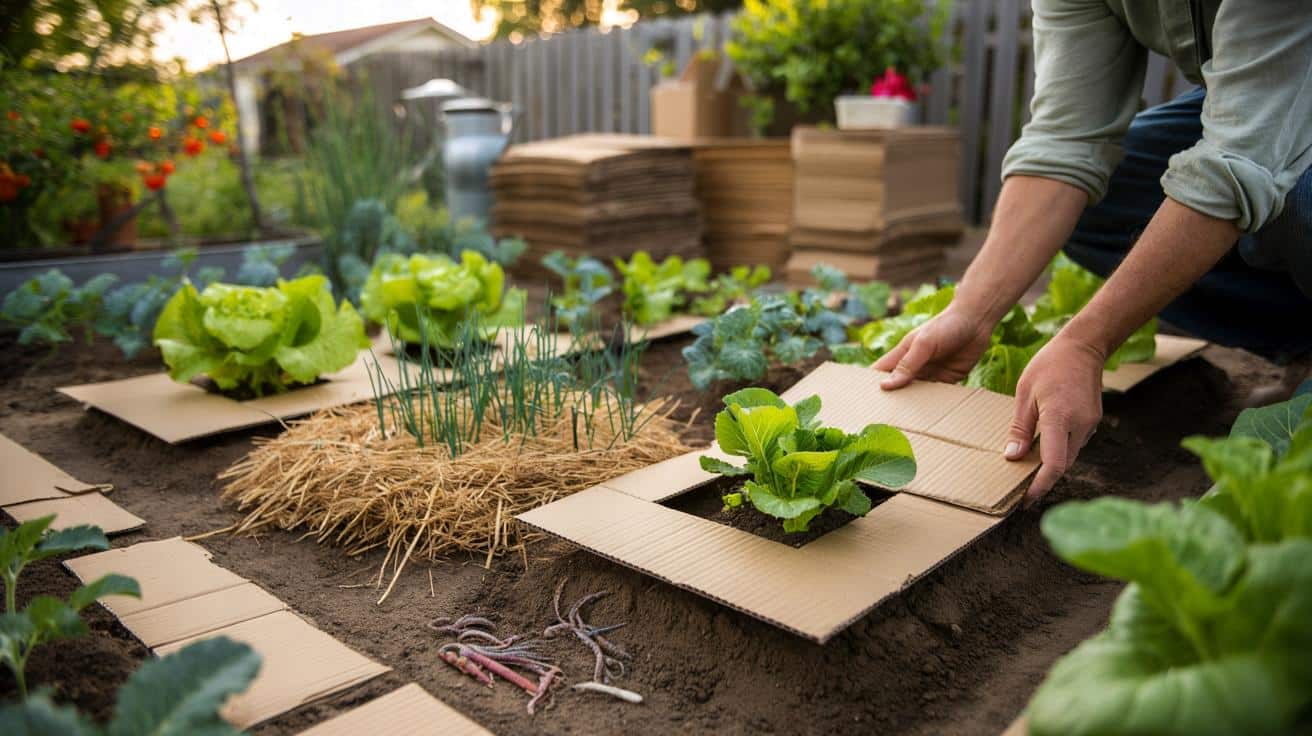
One market gardener I visited in early spring had long, neat beds covered with brown rectangles, neatly overlapped like roof tiles. Under the cardboard, the soil was surprisingly soft, dark, almost silky between the fingers. On top, only a few centimeters of straw and dead leaves. He lifted a corner and smiled: “Look at the worms.” Dozens of earthworms wriggled away from the light, proof that this “trash” was turning into a feast for soil life.
He swore that his courgettes and tomatoes suffered less from water stress that year. Less stress, more fruit.
There’s a simple logic behind this strange alliance between vegetables and packaging. Cardboard, once moistened, clings slightly to the ground and forms a physical barrier. Slugs hesitate to cross it when it’s set up as collars around plants. Weeds, deprived of light, rot slowly underneath. The soil, protected from direct sun and wind, loses far less water and can host more micro-organisms. Over time, the cellulose in the cardboard breaks down and joins the organic matter, enriching the whole system.
This slow transformation is what gardeners quietly call “free mulch”.
How to use cardboard to protect and boost your vegetable garden
The method starts with the right type of cardboard. Go for brown, uncoated boxes, without shiny prints or colored ink. Remove tape, labels and staples. Then cut pieces according to what you want: large sheets to cover a bed, or strips and collars for the base of plants. For a bed, overlap the sheets by at least 10 cm so no light can sneak in between.
Water the soil first, lay down the cardboard, then water it too so it softens and hugs every bump.
On top of this layer, add 5 to 10 cm of organic material: grass clippings, shredded branches, straw, dead leaves. This helps hold moisture and hides the cardboard from the sun so it lasts longer. Around young plants, you can cut a slit from the edge of the sheet to the center and slide the stem through, like putting on a cardboard scarf at ground level. That’s where slugs often sneak in. The collar complicates their life without you having to spread pellets every two days.
Let’s be honest: nobody really crawls out at dawn daily to hand-pick slugs.
The main trap with cardboard is going too fast and using the wrong kind. Glossy boxes, heavily inked packaging and laminated food cartons can introduce unwanted substances into the soil. That’s rarely what you want next to your lettuces. Another frequent error is laying cardboard on dry soil and not weighting it down with mulch or stones. The first gust of wind can send your “system” into the neighbor’s yard, along with your dignity.
*The garden tends to remind us that shortcuts without care rarely hold up for long.*
To avoid these disappointments, many experienced gardeners give the same advice: start small, on one bed, and watch what happens a few weeks in. As one of them told me during a seed swap:
“Cardboard isn’t some miracle cure. It’s a helper. It calms the soil, gives you a break, and leaves life time to reorganize beneath.”
Then he listed the three rules he always repeats to newcomers:
➡️ Psychology says people who say “please” and “thank you” tend to navigate conflict differently
➡️ Experts say this habit often forms earlier than people think
➡️ If you feel anxious without an obvious trigger, psychology says your brain may still be on alert
➡️ This forgotten feature in your car improves visibility during bad weather
➡️ What your garden birds really need you to do this winter besides feeding them
➡️ Decathlon has snapped and just built an electric bike capable of riding at 150 km/h!
- Use plain brown cardboard only, no glossy, no colored prints, no plastic film.
- Always water soil and cardboard, then cover with mulch to keep it in place and help decomposition.
- Check under the cardboard from time to time to track slugs, ants or any imbalance before it spreads.
This quiet routine, far from being perfect, often marks the difference between a struggling patch and a garden that breathes.
From waste to harvest: a different way of seeing your garden
Once you’ve seen what a few layers of cardboard can do, it changes how you look at that pile by the front door. You stop seeing it as clutter and start seeing potential new beds, cooler soil in August, tomatoes that won’t crack after each heatwave. You also realize something more personal: using cardboard isn’t just a “hack”, it’s a way of slowing the garden down, of letting processes play out over weeks rather than rushing every problem with a product.
There’s a quiet satisfaction in knowing that yesterday’s delivery box might become tomorrow’s basket of beans.
The emotional shift is subtle. Instead of fighting constantly against weeds, slugs, drought, you’re building small, protective layers: shade, humidity, shelter for micro-fauna. It doesn’t solve everything. Some years, the slugs will still win a few rounds. Some beds will stay too wet if the cardboard is too thick on heavy clay. Yet this method invites experimentation. You adjust the thickness, the layout, the mulch above, as if you were tuning an instrument. *We’ve all been there, that moment when a garden finally feels like a dialogue, not a battlefield.*
This humble material, so ordinary we barely look at it, becomes a link between two worlds: the hyper-connected life of deliveries and screens, and the slow, earthy rhythm of seeds, rain and worms. The boxes that once carried consumer goods end up feeding carrots and cabbages. You may find yourself storing flattened cardboard in a dry corner, waiting for the right day to transform a weedy patch into a future bed. You understand that **productivity in the garden isn’t about doing more**, but about letting the soil work better. And that sometimes, **the most effective tools are the ones we were throwing away without a second thought**.
| Key point | Detail | Value for the reader |
|---|---|---|
| Choosing the right cardboard | Plain brown, no glossy coating, minimal ink, tape removed | Reduces risk of pollutants in soil and protects edible crops |
| Installation method | Moisten soil, overlap sheets, water cardboard, cover with mulch | Boosts soil life, limits weeds, stabilizes moisture and temperature |
| Targeted protection | Cardboard collars and strips around plants and rows | Slows slug attacks and protects young shoots with almost no cost |
FAQ:
- Can I use cardboard in a vegetable garden with edible crops?Yes, as long as you stick to plain brown corrugated cardboard without glossy coatings, colored inks or plastic film, and remove tape and staples before using it.
- Will cardboard attract slugs instead of repelling them?It can offer hiding spots if left very thick and always wet, so use it in thin layers, lift it occasionally to check underneath, and combine it with plant collars and light traps.
- How long does cardboard last in the soil?Depending on climate, watering and soil life, a layer can last from a few months to a year before fully decomposing into organic matter.
- Can I plant through cardboard directly?Yes: you can cut crosses or holes with a knife, fold the flaps back, then plant seedlings through so roots reach the soil while the surface stays protected.
- Is cardboard better than plastic mulch?Cardboard doesn’t last as long as plastic, but it breathes, decomposes, feeds the soil and avoids plastic waste, which many home gardeners now prefer.