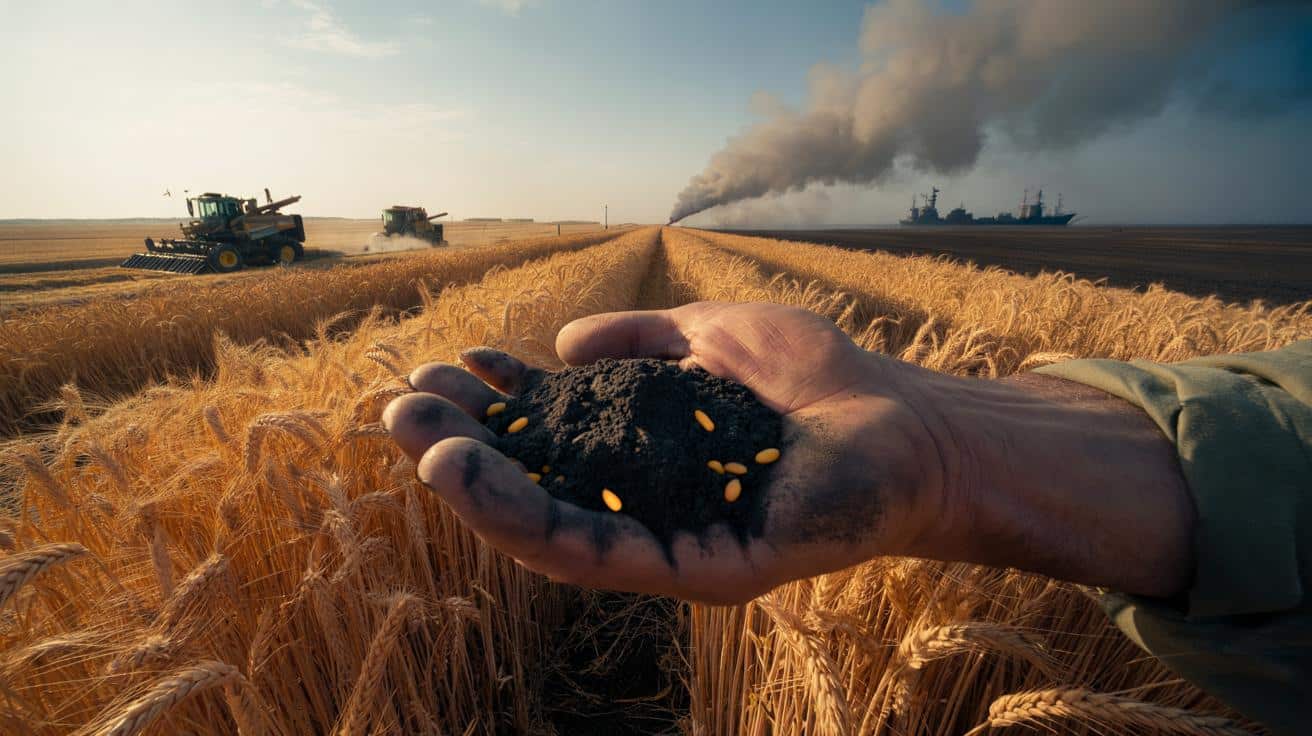
Damp earth, a hint of grass, the metallic chill of early spring. On the edge of a village in central Ukraine, a farmer rubs black soil between his fingers like a jeweler weighing gold dust. A few hundred kilometers east, on the Russian steppe, a tractor pushes through the same dark ground under a different flag. Farther still, in northern Kazakhstan, the landscape opens into endless gray-brown waves of future wheat.
Same soil, different borders. Same “black gold of agriculture”, different stories. These three countries sit on one of the most fertile stretches of land on the planet, a quiet giant that feeds entire regions from Cairo to Karachi. Yet as ships are blocked in the Black Sea and railways become military targets, that quiet giant has turned into a strategic fault line.
Grain, it turns out, is never just grain.
From silent steppe to global breadbasket
Stand in the middle of a chornozem field in summer and you almost feel small. The soil is so dark it looks wet, even when it’s bone dry. Grasshoppers crackle, heat trembles on the horizon, and the wheat heads sway like a low, yellow tide. This is the legendary “black earth” belt that runs in a crooked arc from eastern Ukraine across southern Russia into northern Kazakhstan.
For centuries, this soil barely had a voice in global headlines. Farmers knew it was special. Empires quietly fought for it. But for the rest of the world, it was just a distant steppe with impossible winters and cheap grain. Then came satellites, container ships and globalized food chains. Suddenly, what happened on these quiet fields started to show up in bread prices in Lagos and supermarket shelves in London.
Look at a map of major wheat exporters and you see the same trio again and again. Before the full‑scale invasion of Ukraine in 2022, Russia, Ukraine and Kazakhstan together supplied around a third of global wheat exports. Ukraine alone fed tens of millions of people each year through its corn, sunflower oil and wheat shipped across the Black Sea. Russian grain crowded markets in the Middle East and North Africa, underpinned by aggressive export strategies. Kazakhstan, less talked about, became a vital supplier for Central Asia and parts of China.
Then war slammed into this picture. Ports shut down, shipping insurers panicked, and grain corridors turned into bargaining chips in high‑stakes negotiations. In small bakeries in Beirut, the price of flatbread jumped. In Egypt, where subsidized bread is a political lifeline, officials suddenly had to scramble for alternative suppliers. A conflict starting in the soil of Eastern Europe had rippled across entire continents in just a few weeks.
To understand why this soil became so strategic, you have to dig below the surface. Chornozem is rich in humus, deep and spongy, able to store water and nutrients like a battery. That means stable yields, even when the weather misbehaves. Combine that with vast, flat landscapes perfect for large machines, and you get some of the most efficient grain production on Earth.
States noticed early. The Russian Empire colonized the steppe for wheat. The Soviet Union turned these lands into collective farms and “Virgin Lands” campaigns in Kazakhstan. After 1991, privatization arrived, then foreign investors, then agroholding giants with fields bigger than some European countries. The result was simple: this region became an agricultural engine the world quietly relied on. *When that engine coughs, half the planet hears it.*
Guns, grain and the new geopolitics of bread
If you want to see how fragile this power is, watch a single harvest in wartime Ukraine. Tractors run without headlights at night to avoid being spotted. Some fields are littered with unexploded shells. Farmers negotiate with local commanders just to cross a road that used to be a simple dirt track. Every loaded truck is both food and a potential target.
➡️ When the United States calls on France to help counter China
➡️ Sales: -44% on this Asus OLED laptop rival to the MacBook
➡️ This ultra-simple cardboard trick protects your crops and boosts vegetable garden harvests
➡️ The financial impact of delaying small money decisions
Across the border, Russian officials talk openly about “weaponizing” food exports. Limiting grain shipments becomes a lever in talks with countries that fear social unrest if bread prices spike. In Kazakhstan, leaders walk a tightrope: exporting enough to profit from high prices, while keeping domestic supplies stable so their own citizens don’t suddenly pay triple for flour. On paper, these are just logistics questions. On the ground, they’re questions about stability, trust, and whose children go to bed full.
We’ve all been there, that moment when the supermarket shelf is half empty and you start doing mental math about what you can still cook with what’s left. Now scale that feeling up to a whole country that imports 60, 70, sometimes 80 percent of its wheat. When Russian missiles hit Ukrainian ports on the Black Sea, the blast wave runs straight through Cairo, Tunis, Dhaka. The UN calls emergency meetings. Traders in Geneva stare at wheat futures on multiple screens. Somewhere in Odesa, a dock worker just sees another silo in flames.
This is the quiet truth of modern power: controlling the flow of calories is as strategic as controlling oil pipelines. Moscow knows that when it hints at cutting exports, governments in grain‑dependent countries listen. Kyiv knows that every ton of wheat that leaves its ports is both income and soft power. Astana knows that being a “reliable supplier” can build diplomatic capital faster than a dozen speeches.
Let’s be honest: nobody really reads a shipping manifest and thinks they’re looking at geopolitics. It’s just wheat, corn, barley, sunflower oil. Yet each contract reflects a balance of fear and dependence. When the Black Sea Grain Initiative briefly allowed safe passage for Ukrainian exports, it wasn’t just about moving cargo. It was about showing that even in a brutal war, the world still had a red line: starving distant populations was a step too far.
Analysts now speak of “food corridors” with the same intensity they once reserved for gas pipelines. Turkey positions itself as a broker at sea. The EU rushes to open “solidarity lanes” by rail and road, sending Ukrainian grain through Poland and Romania, triggering protests from local farmers who suddenly face a flood of cheaper grain. What began as a soil story turned into a dense web of trade, anger, survival and raw strategic calculation.
What this means for your plate – and your future
So what does a farmer in Kherson or Kostanay have to do with the price of your sandwich or your cooking oil? More than you’d think. The simplest gesture that connects you to this “black gold” is tracing back where your staples come from. Flip over that bag of flour, that bottle of sunflower oil, that box of pasta. Somewhere on the label is a country, sometimes a region, sometimes just a vague “EU” or “non‑EU”.
Once you start noticing, you realize how often Eastern Europe and Central Asia appear in small print. Ukrainian sunflower oil in European supermarkets. Russian wheat behind cheap bread in the Middle East. Kazakh grain feeding livestock that ends up as burgers thousands of kilometers away. Suddenly, conflicts you once filed under “far away” sit very close, right on your kitchen shelf.
There’s a temptation to shrug and think, “Well, that’s global trade, nothing I can do.” That resignation is understandable. The system feels distant, managed by traders, ministers and CEOs whose names we’ll never know. Yet part of being an informed citizen in this era is acknowledging that food is political, whether we want it to be or not.
Paying attention doesn’t mean obsessing over every headline or boycotting half the world. It can be as simple as following one or two reliable sources on food security, or supporting policies that reduce fragile dependencies on single suppliers. It can also mean valuing farmers closer to home, not as romantic rural figures, but as part of the same nervous system that keeps societies stable.
A Ukrainian agricultural economist I spoke to put it bluntly:
“When a port in Odesa closes, a baker in Senegal feels it. They may never hear each other’s names, but their lives just collided.”
That collision is what turns a fertile blessing into a powder keg. The same soil that quietly grows wheat can, under the wrong conditions, feed inflation, protests, even unrest. Yet it can also anchor cooperation and peace. Countries that depend on each other’s grain have one more reason to talk before they fight.
- Ukraine: high‑quality chornozem, huge export potential, now under fire
- Russia: world’s top wheat exporter, using grain as a diplomatic tool
- Kazakhstan: landlocked but crucial for Central Asia’s food security
- Consumers everywhere: indirectly tied to all three through prices and supply
The plain-truth sentence hiding behind all this is simple: soil doesn’t care about borders, people do. And when those borders slice through one of the planet’s richest agricultural regions, every harvest becomes a question mark hanging over someone’s breakfast.
Living with a world that eats from a powder keg
The story of Ukraine, Russia and Kazakhstan’s “black gold of agriculture” isn’t finished, and maybe that’s what makes it so unsettling. The same dark soil that looks calm under a summer sun sits on fault lines of empire, memory, ambition and hunger. One season it feeds the world quietly, the next it fills news feeds with smoke and grain‑deal headlines.
It’s easy to forget that behind every statistic about “million tons exported” there are real fields, real people, real sleepless nights. A Russian farmer wondering if sanctions will cut off his machinery parts. A Kazakh driver hauling grain for 20 hours straight toward a border crossing. A Ukrainian worker checking his phone in a bunker, scrolling through photos of fields he might not see again.
As climate stress grows and population rises, the pressure on these black earth belts will only intensify. More mouths to feed, more volatile weather, more temptation to turn grain into leverage. The question isn’t just who controls the soil, but who can build a food system that doesn’t collapse every time a ship is blocked or a missile hits a silo.
Maybe the real shift starts with how we talk about food at all. Not just as a lifestyle choice or a comfort, but as a quiet global contract binding a farmer on the steppe to a family far away. When that contract holds, the “breadbasket of the world” sounds like a blessing. When it frays, the same basket starts to look a lot like a fuse.
| Key point | Detail | Value for the reader |
|---|---|---|
| Black earth as strategic asset | Ukraine, Russia and Kazakhstan share ultra‑fertile chornozem soils that drive massive grain exports | Helps explain why distant conflicts hit local food prices |
| Grain as geopolitical leverage | Control of wheat and ports turns into diplomatic pressure and bargaining power | Shows how food can shape elections, protests and stability worldwide |
| Your daily link to the steppe | Flour, bread and oil on your table often trace back to this region | Makes global food security feel concrete, not abstract |
FAQ:
- Question 1Why is the soil in Ukraine, Russia and Kazakhstan called “black gold”?Because the chornozem (black earth) there is incredibly rich in organic matter, deep and fertile, making it as economically valuable for farming as oil is for energy.
- Question 2How did these countries become a global breadbasket?Vast flat lands, fertile soil, Soviet‑era infrastructure and later large agribusiness investments turned the region into one of the world’s top grain exporters.
- Question 3How does the war in Ukraine affect global food prices?Attacks on fields, ports and storage disrupt exports, reduce supply and raise shipping risks, which quickly push up world grain and bread prices.
- Question 4What role does Kazakhstan play compared to Russia and Ukraine?Kazakhstan exports less overall but is crucial for Central Asia and parts of China, acting as a regional stabilizer for wheat and flour supplies.
- Question 5As a consumer, can I really change anything?You can’t rewrite geopolitics, but you can support diversified, resilient food systems through what you buy, who you vote for, and which policies on agriculture and trade you back.