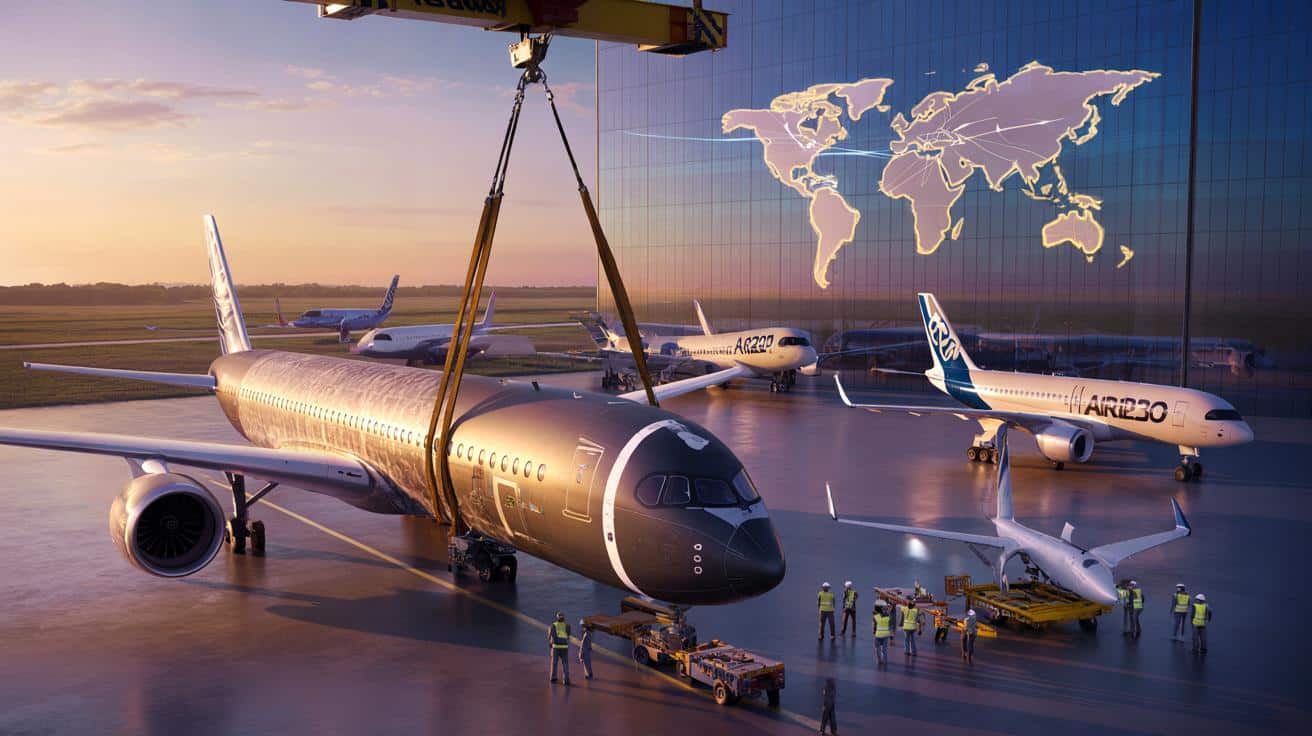
The European manufacturer has struck a deal that changes who really controls some of the most sensitive parts of its jets, from North Carolina to Casablanca and Belfast. Behind the numbers sits a clear message: Airbus wants its production back under its own roof.
A €377 million move to regain control
On 8 December 2025, Airbus completed the acquisition of six major production sites from Spirit AeroSystems for $439 million, or roughly €377 million. The deal covers factories in the United States, Morocco, France and the United Kingdom, all tied to crucial programmes: the A220, A320, A321 and A350.
For years, Airbus relied on Spirit to build critical structures such as fuselage sections, wing components and pylons. Those are not minor parts; they are the backbone of an aircraft’s structure and performance. By absorbing these activities, Airbus is tightening its grip on the early stages of production.
Airbus is not just buying factories; it is buying back control of key aircraft components that it once outsourced.
Spirit AeroSystems itself has a long history. Created when Boeing sold its Wichita Division in 2005 to investor Onex, Spirit has grown into one of the biggest aerospace suppliers in the world. It builds major parts for Boeing, Airbus and others, and employs over 20,000 people worldwide. If you have flown on a modern airliner, chances are you sat in a machine bearing Spirit-made structures.
Six plants, one strategy: cut dependence on US supply
Behind the deal lies a strategic goal: reduce reliance on American suppliers for vital components and bring them back under direct European control, or at least under the Airbus banner.
What Airbus is actually buying
The agreement covers the following activities and sites, which are now integrated into various Airbus entities:
- Kinston, North Carolina (US) – Builds sections of the A350 fuselage, now under the Airbus Aerosystems Kinston banner.
- Saint-Nazaire, France – Also focused on A350 fuselage work, folded into Airbus Atlantic as the Cadréan site.
- Casablanca, Morocco – Produces components for the A220 and A321, now named Airbus Atlantic Maroc Aero.
- Belfast, Northern Ireland – Manufactures wings and central fuselage sections for the A220, operating as Airbus Belfast.
- Prestwick, Scotland – Produces wing elements for the A320 and A350 families, now Prestwick Aerosystems within the group.
- A220 pylons – Work previously carried out in Wichita, Kansas will shift to the Airbus Saint-Éloi site in Toulouse.
This is not a full-scale takeover of Spirit AeroSystems. Boeing remains Spirit’s main customer, and the supplier continues to operate with a slimmer footprint. Airbus has been selective, choosing only those assets tied directly to its own programmes.
| Location | Country | Programme / parts | New Airbus entity |
|---|---|---|---|
| Kinston | United States | A350 fuselage sections | Airbus Aerosystems Kinston |
| Saint-Nazaire | France | A350 fuselage work | Airbus Atlantic Cadréan |
| Casablanca | Morocco | A220 and A321 components | Airbus Atlantic Maroc Aero |
| Belfast | United Kingdom | A220 wings and central fuselage | Airbus Belfast |
| Prestwick | Scotland | A320/A350 wing elements | Prestwick Aerosystems |
| Wichita → Saint-Éloi | US → France | A220 pylons | Saint-Éloi, Toulouse |
4,000 new employees and a cultural challenge
The transaction is not just about metal and composite structures. Around 4,000 Spirit employees move under the Airbus umbrella as part of the deal, spread across multiple countries and regulatory regimes.
➡️ “At 63, my endurance dropped suddenly”: the cardiovascular adaptation nobody warned me about
➡️ This ultra-simple cardboard trick protects your crops and boosts vegetable garden harvests
➡️ No vinegar and no baking soda : pour half a glass and the drain cleans itself
For Airbus, this brings fresh skills and experience. These workers carry years of site-specific know-how: manufacturing processes, tooling tricks, quality routines and local supplier relationships.
The real value lies in the human capital: experienced teams that know how to keep complex production lines running day after day.
The challenge now is integration. Airbus will need to standardise methods, digital tools and safety procedures across these new plants, while keeping what already works. If it pushes too hard for uniformity, it risks losing valuable on-the-ground expertise. If it moves too slowly, the benefits of the deal will be delayed.
From fragile supply chains to direct control
Since the pandemic, aerospace manufacturing has faced volatile demand, labour bottlenecks and shortages of everything from titanium to wiring harnesses. Outsourced production, once seen as a neat way to cut costs, turned into a risk vector when suppliers struggled to keep pace.
Why the A220 and A350 sit at the heart of the deal
The A220, originally designed by Canada’s Bombardier as the CSeries, has turned into a central asset in Airbus’s short- and medium-haul strategy. It is a relatively small single-aisle jet, but with modern engines and efficient aerodynamics that help airlines on thinner routes.
The A350, by contrast, targets long-haul markets. Built largely from composite materials, it is Airbus’s flagship against Boeing’s 787 Dreamliner. Any delay on A350 fuselage sections or wing structures can ripple through the entire premium long-haul offering.
By taking back the production of wings, pylons and major fuselage segments for these aircraft, Airbus aims to:
- Secure steady output rates despite supplier turbulence.
- Reduce delays in final assembly lines in Toulouse and Hamburg.
- Gain clearer visibility on costs and delivery timelines.
- Adjust capacity faster when airlines change their orders.
Financially modest, strategically heavy
The price tag, at $439 million, looks fairly modest compared with the billions wrapped into new aircraft programmes. The amount reflects the specific assets acquired, existing stock levels and some contract-related liabilities that Airbus has agreed to take on.
For investors, the acquisition signals that Airbus prefers to spend money on industrial resilience rather than splash out on headline-grabbing new projects. The company is essentially paying to de-risk its own future deliveries.
Aerospace geopolitics in the background
The decision to be “less dependent on the United States” is not just a throwaway line. Airbus operates in a sector where trade disputes, export controls and political tensions can quickly spill into production.
By building more capability inside Europe and allied regions like Morocco, and by running former US-linked operations under its own structures, Airbus reduces its exposure to US-centric supply chains. At the same time, the group still keeps a significant industrial footprint in North America through Kinston, but under Airbus management.
The move hedges against regulatory shocks, trade spats or sudden restrictions on sensitive aerospace technologies.
This positioning matters as competition heats up on several fronts: Boeing trying to restore its image and output, China pushing its COMAC C919, and rising environmental pressure on aviation.
Key concepts behind the deal
What “vertical integration” actually means here
Economists often talk about “vertical integration”. In this context, it simply means Airbus is pulling activities back inside the group instead of buying them from a separate supplier.
Concrete effects include:
- Shorter decision chains between design teams and factories.
- Shared digital tools and data for design, manufacturing and maintenance.
- Greater ability to prioritise scarce parts for the most urgent aircraft.
- Tighter control over quality and safety standards.
The trade-off is that Airbus also takes on more fixed costs and management complexity. When the cycle turns down, owning more factories can hurt margins if demand drops sharply.
What could go wrong – and what could go right
There are clear risks. Integrating six sites into a giant organisation can lead to overlapping roles, culture clashes and transitional delays. If key staff leave during the process, that loss of experience can slow production even more.
On the upside, if integration goes smoothly, Airbus could create a more agile industrial network. Think of a scenario where a temporary problem in Belfast can be offset by adjustments in Saint-Nazaire or Toulouse, coordinated by one central planning team rather than several separate companies negotiating through contracts.
The deal also strengthens Airbus’s bargaining position with remaining suppliers. With more in-house capacity, the company is less vulnerable when a partner stumbles or tries to push through higher prices.
For airlines and passengers, the effects will not show up on boarding passes, but they matter. Fewer delays in aircraft deliveries mean fleets can be renewed on time, with more efficient jets replacing older models. That, in turn, affects fuel use, ticket pricing strategies and the routes airlines can realistically offer.







