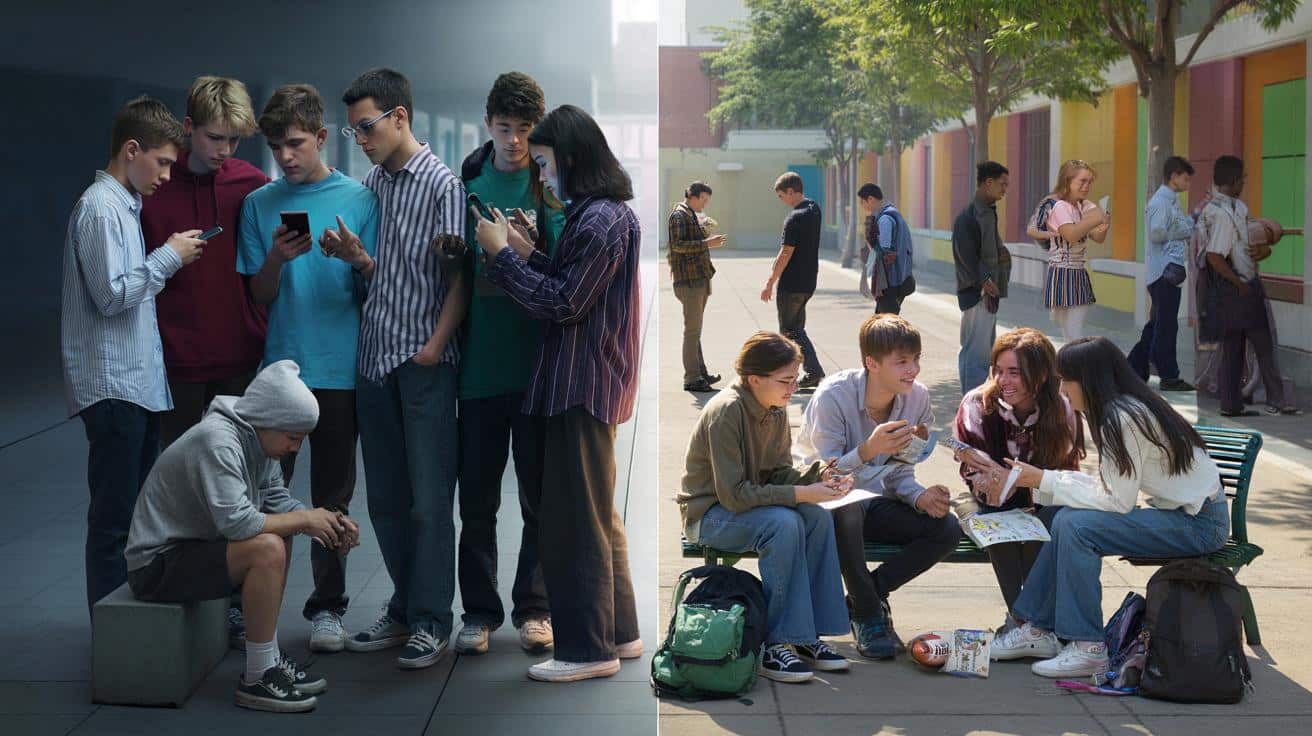
The bell rings and the courtyard explodes. Not with shouts and racing footsteps, but with a sudden, familiar glow. Half the kids at the picnic tables bend their heads at the same angle, thumbs flying, faces lit by blue light instead of winter sun. A group of girls stands in a circle, but they’re not exactly talking; they’re filming a TikTok, silently rehearsing the same dance for the fifth time. On the bench near the gym, a boy scrolls alone, hood up, disappearing into his screen while classmates stream past.
Now imagine this same scene with every phone locked away.
That’s the picture schools are quietly sketching right now.
Why schools suddenly want phones gone from break time
Across Europe, the US and Australia, a growing number of headteachers are floating a new rule: no smartphones during breaks, not just in class. For parents, that hits a nerve. Those ten or fifteen minutes between lessons are when kids text home, check the bus, send a panicked “I forgot my PE kit.”
For school leaders, though, the argument is blunt. They say corridors have become digital tunnels, playgrounds are “too quiet”, and every drama seems to start – or explode – on a screen. One UK principal told me recess duty now feels like “supervising hundreds of tiny media companies”.
At a secondary school in the north of England, they tried a partial ban last term. Phones off in class, allowed at lunch. Within weeks, staff noticed a trend. In the canteen, around a third of students were eating one-handed, phones in the other. Eye contact was scarce.
Then came a fight. Not over football or who sat where, but over a Snapchat story. A photo, a caption, an insult that spread across half the year in minutes. By the time a teacher arrived, half the crowd had their phones out, filming. When the headteacher spoke to parents, many were less angry about the punch than the public shaming that followed online.
From the school’s side, the logic is simple: if the most intense social clashes now start on screens, cut the screens. They talk about attention spans, playground loneliness, kids who literally do not know how to start a conversation without a device in their hand.
Child psychologists add another layer. They point to studies linking heavy phone use with anxiety, poor sleep, and constant low-level stress from group chats that never “switch off”. For them, break time is a golden window to reset the nervous system, run around, laugh too loudly, be bored. The fear is that childhood is being swallowed one notification at a time.
What a no-phone break really looks like for teenagers
When one French middle school brought in an all-day phone ban, they did it cold turkey. Phones off and locked in small pouches from the first bell to the last. The first week was chaos. Kids complained they had “nothing to do”. Some just stood and stared, like they’d been dropped into an empty room.
➡️ The routine of checking posture every hour that corrects slouching and reduces neck discomfort
➡️ Quote of the day by Albert Einstein: A human being is part of a whole, called by us the Universe
➡️ Excess rainfall could remake the Sahara and upset Africa’s fragile balance, study warns
➡️ Nocturnal cramps: natural tips to ease the pain
➡️ Why women in their 30s with fine hair choose this precise length
➡️ Winter storm alert: Up to 73 cm of snow could cover airport runways and ground aircraft
Then something quietly shifted. The footballs that had been gathering dust came back out. Card games appeared. A group of shy Year 7s started a sketching circle under the stairs. Teachers reported more noise, more movement, more old-fashioned “messing about”. It wasn’t perfect. Some kids still drifted on the margins. But the courtyard began to sound like… a school courtyard.
Parents were more divided. One mother I spoke to admitted the ban made her panic at first. She relied on quick WhatsApp messages to coordinate pick-up or calm nerves before a maths exam. Another worried about her daughter, who has social anxiety and leans on her phone as a shield in busy spaces.
Yet others felt unexpectedly relieved. No more pressure to respond instantly to “Mum, I forgot my homework” messages. Less dread of mid-day drama exploding in the family chat. One dad said the ban gave him a get-out clause: “I can finally tell my son, ‘I literally can’t text you during school. Talk to your teacher.’” It sounds harsh, but some parents felt the invisible cord between them and their kids had become too tight.
Behind every policy meeting on phones is a simple, messy truth: adults are scared. Scared of bullying moving from the locker room to the bedroom. Scared of mental health spirals that start with a late-night group chat. Scared of losing their kids to a world they don’t fully understand.
Schools, under pressure to “do something,” see a ban as a clear, measurable action. Fewer phones on display, fewer fights over confiscations, less filming of incidents. Parents look at the same rule and see everything they might lose: quick contact, digital literacy, the way teens actually bond today. Both sides are clinging to the same thing – a version of safety – while pulling in opposite directions. *That tension is why this debate feels so raw right now.*
How families can survive (and even use) a school phone ban
One practical step many families are trying is the “two-phone” solution. A basic, call-and-text-only handset for school hours, and the smartphone for home. It sounds extreme until you realise how many kids mainly need just one function during the day: calling home.
This approach changes the emotional weight of the device. The cheap phone is a tool, not an identity. Parents still get the comfort of being reachable. Schools see fewer glowing screens in corridors. And teenagers, once they stop rolling their eyes, notice something else: with no apps to check, the urge to constantly reach into their pocket fades surprisingly fast.
If your child’s school is moving toward a ban, the worst thing you can do is treat it like a personal attack on your parenting. Your kid will pick up that defensiveness in a heartbeat. Start by asking them how they actually use their phone at break. Is it chatting, gaming, hiding, or just filling silence.
Then be honest about your own habits. Do you text them too often during the day. Do you expect instant replies. Let’s be honest: nobody really does this every single day, but a short family “phone pact” for school hours can help everyone breathe. Something like: “Emergencies only, no mid-day drama, talk in person first when possible.” It’s not about control, it’s about giving both of you a bit of mental space.
A secondary-school teacher in Dublin told me: “The first week without phones at break, kids said they were ‘bored out of their minds’. By week three, they were laughing that they’d forgotten how loud the yard could be. One girl said, ‘I didn’t realise how anxious my phone was making me until it wasn’t there.’”
- Talk to the school early
Ask how strict the ban will be, where phones will be kept, and what happens in emergencies. - Prepare your child socially
Role-play simple “small talk” or ways to join a group, especially if they normally hide behind a screen. - Create a simple tech routine at home
Looser rules after homework, but clear times when all phones go away – adults included. - Watch for real distress, not just complaints
Grumbling is normal. Persistent stomach aches, tears or isolation might mean they need extra support. - Stay curious, not combative
Ask your teen what they notice about breaks without phones. You might hear things they’d never admit voluntarily.
Are we saving childhood or rewriting teenage social life?
Strip phones from break times and you don’t just change a rule. You change the texture of a school day. That quiet moment between lessons when a teen checks a meme, vents in a group chat, or glimpses the wider world shrinks back to the physical space of the corridor and the playground. For some kids, that’s a relief. For others, it feels like having part of their social life switched off.
This is where the debate gets uncomfortable. We like to pretend there’s a clean line between “real life” and “online life”, but teenagers don’t live that way. Their closest friendships, their jokes, their crushes, their arguments spill constantly across both. So when schools talk about “bringing kids back to reality”, teens hear something else: you’re banning the place where my life actually happens.
Yet something else is true at the same time. A generation of teachers now say they’ve never seen such fragile eye contact, such fear of awkwardness, such obsession with capturing every moment instead of simply living it. When phones vanish, they see kids rediscovering old, unremarkable pleasures: playing tag, drawing, gossiping in person, even just staring at the sky. Small things, but those are the grains out of which childhood is built.
The plain-truth sentence that nobody really wants to say out loud is this: we don’t fully know what we’re doing to teenagers’ brains with phones glued to their hands all day – and we won’t know for years. So schools are experimenting in real time, and families are left reacting. Maybe the most honest position, for now, is to hold the contradiction. Smartphones can both deepen teenage connection and quietly erode it. A ban can both protect kids and unfairly cut into their social world. The real work lies not in choosing one story, but in listening to how our own kids are living this shift, day by day, break by break.
| Key point | Detail | Value for the reader |
|---|---|---|
| Phone bans are expanding | More schools are considering no-smartphone rules during all breaks, not just in class | Helps parents anticipate and understand changes that may hit their own child’s school |
| Impact is mixed | Less visible bullying and more playground interaction, but also anxiety about losing contact and social status | Gives a realistic picture of benefits and drawbacks instead of a one-sided argument |
| Families can adapt | Options like basic “school phones”, family phone pacts, and open conversations with teens and schools | Offers concrete ways to stay connected while supporting healthier phone habits |
FAQ:
- Will a school phone ban really stop bullying?Not entirely. Bullying existed long before smartphones. A ban can reduce public shaming, filming of incidents and real-time group pile-ons, but cruel behaviour can still move to after-school chats and social media.
- What if my child has anxiety and uses their phone as a comfort object?Talk with the school about this before any ban begins. Some schools allow exceptions with a pastoral plan, or create quiet spaces and “safe people” your child can go to during breaks instead of escaping into a screen.
- Can schools legally ban phones during breaks?In many countries, yes, as long as the policy is clearly communicated and applied fairly. Laws vary, though, so schools usually consult local regulations and school boards before enforcing all-day bans.
- Should I still text my teen during the school day?Try to keep messages for genuine needs or emergencies. Frequent check-ins can raise their stress and pull them out of lessons or social moments, especially if phones are a grey area on campus.
- Won’t banning phones leave kids unprepared for a digital world?Digital skills come from how phones are used, not from constant, unsupervised access. Many educators argue structured, focused use at home and in specific lessons can teach more than endless scrolling at break time.







