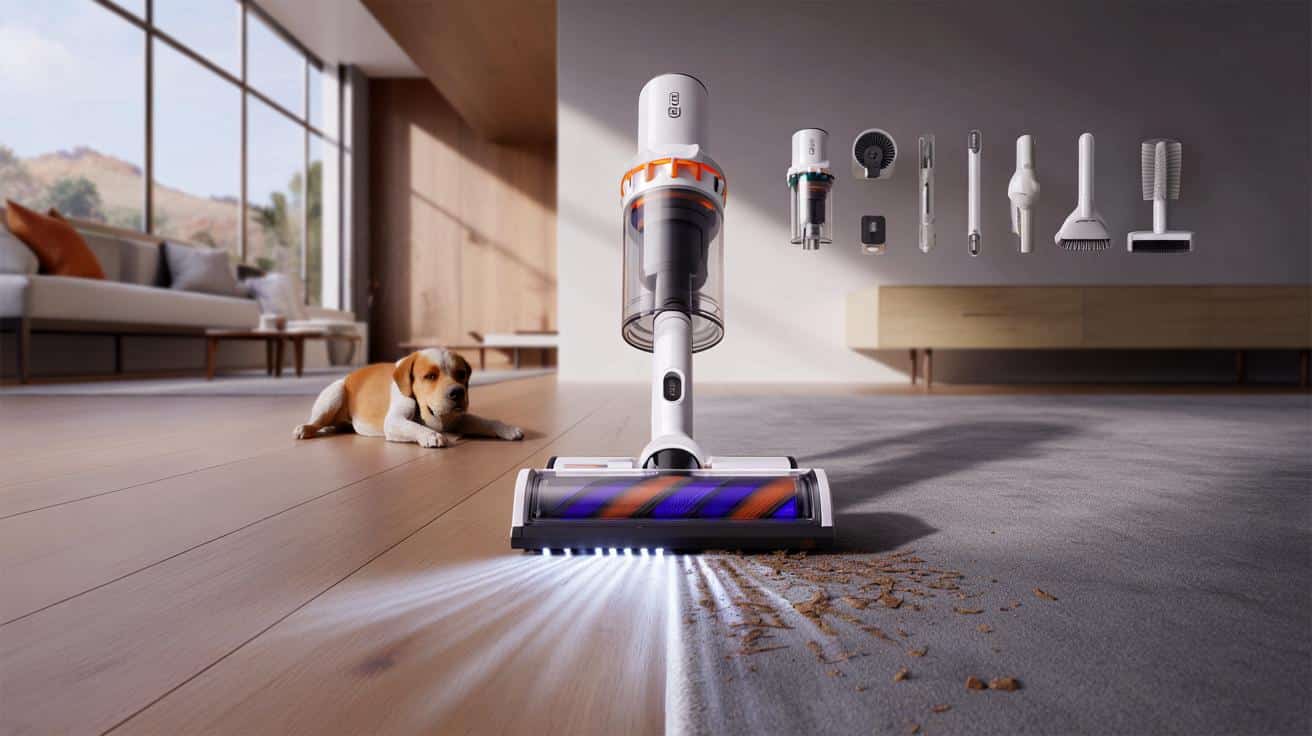
Better known for its cut‑price smartphones and smart gadgets, the Chinese brand is now aiming straight at Dyson with the Vacuum Cleaner G30 Max, a cordless stick vacuum that combines high suction power, long battery life and an aggressive pricing strategy that could reshuffle the market.
Xiaomi’s new move beyond phones
Xiaomi has already expanded from handsets to electric cars and a wide range of connected devices. Home appliances, including vacuums, are the next logic step in that strategy: sell capable hardware at a lower price than established rivals, then lock users into the wider Xiaomi ecosystem.
The Vacuum Cleaner G30 Max is the successor to the G20 Max and an evolution of Xiaomi’s earlier cordless models. The brand claims significant gains in both power and endurance, with the G30 Max pitched directly against Dyson’s popular V-series sticks.
The G30 Max jumps from 180 to 280 air‑watts of suction, putting it in the same league as several Dyson flagships.
Power levels that start to worry Dyson
Suction power is the headline number for any cordless vacuum, and Xiaomi has pushed hard here. The G30 Max reaches 280 air‑watts, a metric that combines airflow and suction to give a more realistic view of cleaning force than “watts” alone.
That rating makes a real difference on thick carpets, embedded pet hair and heavy debris. On paper, the G30 Max outguns the Dyson V12 Origin and even beats the V15 Detect Absolute, which sits at around 240 air‑watts. Only the newer Dyson V16 Piston Animal, at 315 air‑watts, clearly stays ahead.
For a brand still building its reputation in cleaning appliances, closing that gap is notable. It suggests Xiaomi is not just targeting budget buyers, but users who would normally look straight at Dyson or Samsung for a premium cordless stick.
Three modes and a “smart” dust sensor
The G30 Max offers three main operating modes:
- Eco mode – reduced suction, designed for hard floors and light dust, with maximum runtime.
- Auto mode – new to this generation, adjusting power in real time based on detected dust levels.
- Turbo mode – full power for stubborn dirt, carpets and high‑traffic areas.
The built‑in dust sensor is the most interesting change. It monitors how much dirt is being picked up and raises or lowers suction accordingly. The goal is simple: save battery on clean surfaces, then boost power only where it is genuinely needed, like hallways or under the dining table.
➡️ Winter storm warning: Up to 106 cm of snow could hit mountainous areas and trap motorists
➡️ Hygiene after 65 : antibacterial products are not always your ally anymore
➡️ This small fridge adjustment keeps vegetables crisp longer
➡️ Lidl to launch Martin Lewis approved gadget next week, just in time for winter
➡️ Why vets are increasingly warning dog owners against tennis balls
Auto mode aims to balance battery life and cleaning efficiency, so users do not have to constantly fiddle with settings.
Battery life, filtration and capacity
Under the shell, Xiaomi uses a 4,000 mAh battery. The firm claims up to 70 minutes of runtime in Eco mode with the main motorised floor head attached. That is a 51% increase compared with a previous generation model and comfortably above the 45 minutes quoted for the older G20 Max.
In higher power modes, the runtime will drop sharply, as with any cordless vacuum. But for small to medium homes, one full charge should be enough to cover most floors at mixed power levels.
Filtration is another selling point. Xiaomi talks about a five‑stage filtration system that captures up to 99.98% of fine particles. While the brand does not use the HEPA label heavily in its marketing, that level sits close to HEPA‑grade performance for household use, especially relevant for people with allergies or asthma.
Dust capacity has been raised from 600 mL on the G20 Max to 800 mL on the G30 Max. That reduces the number of trips to the bin, which matters if you vacuum large spaces or own shedding pets.
Lights on the floor head
The main rolling brush includes a white LED light bar. This is not a gimmick: once you use a lit floor head in a dim hallway or under a bed, the amount of hair and dust you suddenly see can be surprising.
The illuminated brush reveals fine dust and crumbs that usually stay invisible on hard floors and dark corners.
Accessories aimed at pet owners and small spaces
Out of the box, the G30 Max includes a wall‑mounted charging dock and a separate rack for the accessories, encouraging people to actually keep and use the extra tools instead of losing them in a cupboard.
The accessory pack is fairly extensive:
| Accessory | Main use |
|---|---|
| Main motorised brush | Everyday floor cleaning on hard floors and carpets |
| Mini motorised brush | Mattresses, stairs, car seats, pet beds |
| Sofa nozzle | Fabric sofas, armchairs, cushions |
| Wide 2‑in‑1 brush | Shelves, furniture tops, blinds |
| Crevice 2‑in‑1 brush | Corners, skirting boards, between car seats |
| Grooming brush | Direct brushing of pets while vacuuming loose hair |
The pet grooming brush stands out. It lets owners brush cats or dogs while the vacuum sucks up loose fur before it hits the floor. That said, any pet that panics at the sound of a vacuum will still bolt. The feature will mainly suit animals already comfortable around noise and handling.
Price positioning: almost three times cheaper than Dyson?
Xiaomi has not yet announced an official launch date or final pricing for the G30 Max in Europe or the US. The previous G20 Max currently sells for around €299.99 on the continent.
If Xiaomi keeps a similar price bracket, the G30 Max would land dramatically below its Dyson rivals. The Dyson V15 Detect Absolute launched at roughly €799, while the newer V16 Piston Animal is around €849 in Europe. That means Xiaomi has room to raise the price slightly for the extra power and still undercut Dyson by a large margin.
If the G30 Max stays near the €300–€400 band, it could offer Dyson‑level suction at nearly one‑third of the price.
This pricing gap is central to Xiaomi’s strategy: close the performance difference, then force buyers to ask whether the Dyson brand, longer track record and support network justify double or triple the spend.
What “autonomy” really means for buyers
The product sheets talk about “autonomy”, a term that often confuses shoppers. In vacuum marketing, autonomy simply means how long the device can run on a single charge.
Manufacturers tend to highlight the maximum figure, usually measured in the lowest power mode with a non‑motorised accessory. In real‑life use, mixing Eco, Auto and Turbo, the effective runtime can be far shorter.
A useful rule of thumb for cordless vacuums:
- Eco mode: real‑world use close to the advertised autonomy, but weaker on carpets.
- Auto mode: most practical for daily cleaning; expect 50–70% of the headline runtime.
- Turbo mode: outstanding suction but often limited to 8–15 minutes before the battery runs low.
For a typical flat, the G30 Max’s 70‑minute claim suggests users should comfortably manage a full clean in Auto with some brief Turbo bursts. Larger houses may still require either quick top‑ups or a second battery once Xiaomi offers compatible spares.
How the G30 Max might fit into everyday life
Imagine a three‑bedroom home with a mix of hard flooring downstairs and carpets upstairs. In practice, the G30 Max would likely live on its wall mount in the hallway, always charging. A weekday clean might mean a 10‑minute run on Auto in the kitchen and living room, using Eco for the tiled hallway and saving Turbo for the doormat and area around the pet bowls.
At the weekend, the small motorised brush could come out for the mattress and car seats, while the grooming brush handles the family dog, assuming it tolerates being brushed with a humming device attached to its fur. The LED on the main head would show up crumbs under the sofa and along skirting boards that usually go unnoticed.
Owners moving from a heavy corded vacuum would gain flexibility: no cables snaking across rooms, no plugging and unplugging between sockets, and less resistance when reaching under beds or on stairs. The trade‑off is that deep spring‑cleaning still demands attention to battery levels and bin capacity.
Risks and trade‑offs to keep in mind
There are a few points for potential buyers to watch. First, long‑term durability and support: Dyson has years of servicing and spare‑parts infrastructure, while Xiaomi’s repair network for vacuums is still growing in Western markets. Battery replacements, filter availability and local repair turnaround times may vary by country.
Second, headline specs do not tell the whole story. Cleaning performance depends on brush design, airflow paths and how effectively the vacuum maintains suction as the bin fills. Independent lab tests will be needed to see how the G30 Max handles real‑world mess such as sand in carpets, long hair and fine dust on hard floors.
Third, the extra suction and accessories are only useful if people actually change tools and modes. A powerful but badly used vacuum still leaves dust behind. Simple routines—like running Auto for everyday cleaning and keeping the mini motorised head near the stairs—will matter as much as raw numbers.
Even with those caveats, Xiaomi’s G30 Max signals a clear message: the age when Dyson sat alone at the top of the cordless vacuum market is fading. More brands are starting to match the performance, and the real battleground is shifting to value, ecosystem and smart features, not just who has the biggest motor.







